
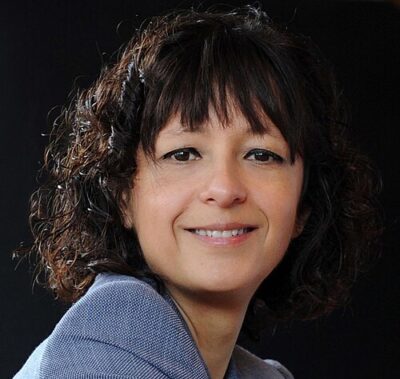
Emmanuelle Charpentier
Emmanuelle Charpentier is a French microbiologist and biochemist. Born December 11, 1968, in Juvisy-sur-Orge. Educated at Pierre and Marie Curie University and Pasteur Institute. Awards include Princess of Asturias Award for Technical and Scientific Research, Breakthrough Prize in Life Sciences and L'Oréal-UNESCO Award For Women in Science.
Facts
44 facts · 1 confirmed by two sources · 24 cited · 19 from one source
Where this comes from
Papalocal keeps its own record. It started from these sources; what each one said is kept here as it was copied, so a change on their side never changes this page by itself. Tap one to read its version.
What Wikidata says · copied November 16, 2026 · revision 2567593725
- Described as
- French microbiologist and biochemist (born 1968)
- Other names
- Emmanuelle Marie Charpentier, Emmanuelle M. Charpentier, E. M. Charpentier, E. Charpentier, Emmanuelle Marie Petitfrère, Emmanuelle M. Petitfrère, Emmanuelle Petitfrère, E. M. Petitfrère, E. Petitfrère, Charpentier, Emmanuelle Marie, Charpentier E
- Born
- December 11, 1968 · 3 references
- Born in
- Juvisy-sur-Orge · 2 references
- Citizen of
- France · 1 reference
- Occupation
- microbiologist · 1 reference; biochemist · 1 reference; geneticist · 1 reference; immunologist · 1 reference; university teacher · 2 references; scientist · 1 reference; director · 1 reference
- Worked for
- Hannover Medical School; Umeå University; Max Planck Institute for Infection Biology · 1 reference; University of Vienna · 1 reference; Max Planck Unit for the Science of Pathogens (2018–) · 1 reference
- Education
- Pierre and Marie Curie University (–1995) · 1 reference; Pasteur Institute (–1995) · 1 reference
- Member of
- French Academy of Sciences (2017–); German Academy of Sciences Leopoldina (2015–) · 1 reference; Austrian Academy of Sciences (2016–); Royal Swedish Academy of Sciences (2016–); National Academy of Sciences (2017–); Pontifical Academy of Sciences (2021–); American Academy of Arts and Sciences; Accademia Nazionale dei Lincei (2021–) · 1 reference
- Awards
- Princess of Asturias Award for Technical and Scientific Research (2015) · 1 reference; Breakthrough Prize in Life Sciences (2015) · 2 references; L'Oréal-UNESCO Award For Women in Science (2016); Massry Prize (2015); Eric K. Fernströms Svenska Pris (2011) · 1 reference; Dr. Paul Janssen Award for Biomedical Research (2014) · 1 reference; Louis-Jeantet Prize for Medicine (2015) · 1 reference; Gruber Prize in Genetics (2015); Otto Warburg Medal (2016) · 2 references; Hansen Family Prize (2015) · 1 reference; Gottfried Wilhelm Leibniz Prize (2016) · 1 reference; Paul Ehrlich and Ludwig Darmstaedter Prize (2016); Canada Gairdner International Award (2016); Tang Prize (2016); Carus medal (2015)
- Field
- microbiology · 1 reference; biochemistry · 1 reference; genetics · 1 reference
- Website
- https://www.emmanuelle-charpentier-pr.org/
- Wikipedias with a page
- 80
Wikidata item Q17280087 (wikidata.org/wiki/Q17280087), public domain (CC0). Copied November 16, 2026.
What Wikipedia says · copied November 16, 2026 · revision 1383143689
Emmanuelle Marie Charpentier (French pronunciation: [emanɥɛl maʁi ʃaʁpɑ̃tje]; born 11 December 1968) is a French academic, microbiologist, geneticist, and biochemist. She has served as a director at the Max Planck Institute for Infection Biology in Berlin since 2015. Three years later, she founded an independent research institute, the Max Planck Unit for the Science of Pathogens. In 2020, Charpentier and American biochemist Jennifer Doudna of the University of California, Berkeley, were awarded the Nobel Prize in Chemistry "for the development of a method for genome editing" (through CRISPR). This was the first science Nobel Prize ever won exclusively by two women.
- Born, in its opening lines
- December 11, 1968
From the Wikipedia article “Emmanuelle Charpentier” (en.wikipedia.org/wiki/Emmanuelle_Charpentier), by its contributors, under CC BY-SA 4.0 (creativecommons.org/licenses/by-sa/4.0/). Copied November 16, 2026; not changed.
Confirmed Two sources agree. Cited One source, and it names where it got it. One source One source, without a reference of its own. Sources disagree The sources disagree. We show the best-supported value and keep theirs below.
