
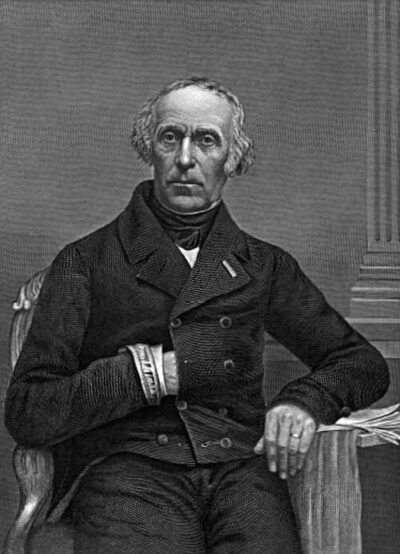
François Guizot
François Guizot was a French historian, orator and statesman. Born October 4, 1787, in Nîmes. Died September 12, 1874, in Abbey of Val-Richer. Positions held include member of the general council, ambassador and head of government of France (1847–1848). Educated at University of Geneva. Awards include Knight of the Order of the Golden Fleece, Pour le Mérite for Sciences and Arts order and Grand Cross of the Legion of Honour.
Facts
48 facts · 2 confirmed by two sources · 9 cited · 37 from one source
Where this comes from
Papalocal keeps its own record. It started from these sources; what each one said is kept here as it was copied, so a change on their side never changes this page by itself. Tap one to read its version.
What Wikidata says · copied November 16, 2026 · revision 2567479082
- Described as
- French historian, orator and statesman (1787–1874)
- Other names
- François Pierre Guillaume Guizot, François-Pierre-Guillaume Guizot
- Born
- October 4, 1787 · 18 references
- Died
- September 12, 1874 · 14 references
- Born in
- Nîmes · 4 references
- Died in
- Abbey of Val-Richer · 2 references
- Buried in
- Saint-Ouen-le-Pin
- Citizen of
- France · 3 references
- Occupation
- politician · 1 reference; diplomat; historian · 3 references; translator; writer · 2 references; literary critic
- Positions held
- member of the general council; ambassador; head of government of France (1847–1848); Member of the Chambre des députés des départements (1828–1830); member of the National Assembly (1830–1848); Member of the Académie française (1836–1874)
- Political party
- Orléanism
- Worked for
- University of Paris
- Education
- University of Geneva · 1 reference
- Member of
- Académie Française (1836–); Royal Swedish Academy of Sciences; German Archaeological Institute; Hungarian Academy of Sciences; American Academy of Arts and Sciences; Académie des Sciences Morales et Politiques; Royal Prussian Academy of Sciences; Royal Swedish Academy of Letters, History and Antiquities; Société de l'histoire de France; Bavarian Academy of Sciences and Humanities
- Awards
- Knight of the Order of the Golden Fleece; Pour le Mérite for Sciences and Arts order; Grand Cross of the Legion of Honour (1840) · 1 reference; Fellow of the American Academy of Arts and Sciences; Grand Cross of the Order of the Redeemer; Order of Saint Januarius · 1 reference; Order of the Golden Fleece · 1 reference; Order of the Elephant · 1 reference
- Spouse
- Elisabeth Charlotte Pauline Guizot (1812–) · 2 references; Marguerite Guizot (1828–) · 1 reference
- Children
- Pauline de Witt; Guillaume Guizot · 1 reference; Henriette Guizot de Witt
- Father
- André Guizot
- Mother
- Élisabeth-Sophie Bonicel
- Siblings
- Jean-Jacques Guizot
- Religion
- Reformed Christianity
- Wikipedias with a page
- 65
Wikidata item Q157324 (wikidata.org/wiki/Q157324), public domain (CC0). Copied November 16, 2026.
What Wikipedia says · copied November 16, 2026 · revision 1378199463
François Pierre Guillaume Guizot (English: gih-ZOH, French: [fʁɑ̃swa pjɛʁ ɡijom ɡizo]; 4 October 1787 – 12 September 1874) was a French historian, orator and statesman. Guizot was a dominant figure in French politics between the July Revolution and the Revolution of 1848.
A conservative liberal who opposed the attempt by King Charles X to usurp legislative power, he worked to sustain a constitutional monarchy following the July Revolution of 1830. He then served the "citizen king" Louis Philippe I, as Minister of Education 1832–37, ambassador to London 1840, Foreign Minister 1840–1847, and finally Prime Minister of France from 19 September 1847 to 23 February 1848.
Guizot's influence was critical in expanding public education, which under his ministry saw the creation of primary schools in every French commune. As a leader of the "Doctrinaires", committed to supporting the policies of Louis Phillipe and limitations on further expansion of the political franchise, he earned the hatred of more left-leaning liberals and republicans through his unswerving support for restricting suffrage to propertied men and supposedly advised those who wanted the vote to "enrich yourselves" (enrichissez-vous) through hard work and thrift.
As Prime Minister, it was Guizot's ban on the political meetings (called the campagne des banquets or the Paris Banquets, which were held by moderate liberals who wanted a larger extension of the franchise) of an increasingly vigorous opposition in January 1848 that catalyzed the revolution that toppled Louis Philippe in February and saw the establishment of the French Second Republic. He is mentioned in the famous opening paragraph of the Communist Manifesto ("a spectre is haunting Europe...") as a representative of the more liberal faction of the counter-revolutionary forces of Old Europe, contrasted with that of the more reactionary forces, Klemens von Metternich. Marx and Engels published that book just days before Guizot's overthrow in the 1848 Revolution.
- Born, in its opening lines
- October 4, 1787
- Died, in its opening lines
- September 12, 1874
From the Wikipedia article “François Guizot” (en.wikipedia.org/wiki/François_Guizot), by its contributors, under CC BY-SA 4.0 (creativecommons.org/licenses/by-sa/4.0/). Copied November 16, 2026; not changed.
Confirmed Two sources agree. Cited One source, and it names where it got it. One source One source, without a reference of its own. Sources disagree The sources disagree. We show the best-supported value and keep theirs below.
