
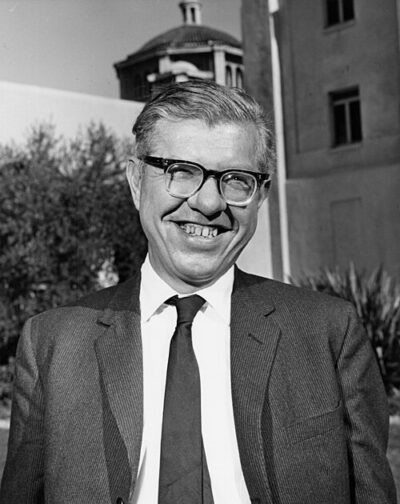
Fred Hoyle
Fred Hoyle was a British astronomer. Born June 24, 1915, in Bingley. Died August 20, 2001, in Bournemouth. Positions held include Plumian Professor of Astronomy and Experimental Philosophy (1957–1972) and President of the Royal Astronomical Society (1971–1973). Known for Hoyle's fallacy, The Black Cloud and A for Andromeda. Educated at Emmanuel College and Bingley Grammar School. Awards include Fellow of the Royal Society, Royal Medal and Kalinga Prize.
Facts
55 facts · 2 confirmed by two sources · 26 cited · 27 from one source
Where this comes from
Papalocal keeps its own record. It started from these sources; what each one said is kept here as it was copied, so a change on their side never changes this page by itself. Tap one to read its version.
What Wikidata says · copied November 16, 2026 · revision 2563696020
- Described as
- British astronomer (1915–2001)
- Other names
- Sir Fred Hoyle
- Born
- June 24, 1915 · 12 references
- Died
- August 20, 2001 · 12 references
- Born in
- Bingley · 1 reference
- Died in
- Bournemouth · 2 references
- Cause of death
- stroke
- Citizen of
- United Kingdom
- Occupation
- screenwriter; astronomer; writer; physicist; university teacher; mathematician · 1 reference; non-fiction writer; science fiction writer
- Positions held
- Plumian Professor of Astronomy and Experimental Philosophy (1957–1972) · 1 reference; President of the Royal Astronomical Society (1971–1973)
- Worked for
- Cardiff University (1975–2001) · 2 references; University of Cambridge (1945–1972) · 2 references; Victoria University of Manchester (1972–2001) · 2 references; British Admiralty Office (1939–1945) · 1 reference
- Education
- Emmanuel College (1933–1939) · 1 reference; Bingley Grammar School (1926–1932) · 1 reference
- Member of
- Royal Society of London; American Academy of Arts and Sciences; American Philosophical Society (1980–) · 1 reference; American Association for the Advancement of Science · 1 reference; National Academy of Sciences (1969–)
- Known for
- Hoyle's fallacy; The Black Cloud; A for Andromeda; Diseases from Space; Fifth Planet; Ossian's Ride; October the First Is Too Late; B²FH paper
- Awards
- Fellow of the Royal Society (1957) · 1 reference; Royal Medal (1974) · 1 reference; Kalinga Prize (1968) · 1 reference; Balzan Prize (1994) · 1 reference; Henry Norris Russell Lectureship (1971) · 1 reference; Gold Medal of the Royal Astronomical Society (1968) · 1 reference; Karl Schwarzschild Medal (1992) · 2 references; Bruce Medal (1970) · 1 reference; Richtmyer Memorial Lecture Award (1964) · 1 reference; Knight Bachelor (1972) · 1 reference; Royal Society Bakerian Medal (1968) · 1 reference; Mayhew Prize (1936) · 2 references; Crafoord Prize in Astronomy (1997) · 1 reference; Guthrie Lecture (1960) · 1 reference; Smith's Prize (1938) · 1 reference
- Field
- astronomy
- Children
- Geoffrey Hoyle
- Religion
- theism; irreligion
- Website
- https://www.hoyle.org.uk
- Wikipedias with a page
- 70
Wikidata item Q183397 (wikidata.org/wiki/Q183397), public domain (CC0). Copied November 16, 2026.
What Wikipedia says · copied November 16, 2026 · revision 1375629834
Sir Fred Hoyle (24 June 1915 – 20 August 2001) was an English astronomer. With Margaret and Geoffrey Burbidge and William Alfred Fowler, he formulated the theory of stellar nucleosynthesis in the influential B2FH paper.
He held controversial views on some scientific matters – in particular, in his rejection of the "Big Bang" theory (a term he jokingly coined on BBC Radio, though he later denied doing so in derision) in favour of a "steady-state model", and his promotion of panspermia as the origin of life on Earth.
He spent most of his working life at St John's College, Cambridge, and served as the founding director of the Institute of Theoretical Astronomy at Cambridge.
Hoyle also wrote science fiction novels, short stories, and radio plays, co-created television serials, and, with his son, Geoffrey Hoyle, co-authored twelve books.
- Born, in its opening lines
- June 24, 1915
- Died, in its opening lines
- August 20, 2001
From the Wikipedia article “Fred Hoyle” (en.wikipedia.org/wiki/Fred_Hoyle), by its contributors, under CC BY-SA 4.0 (creativecommons.org/licenses/by-sa/4.0/). Copied November 16, 2026; not changed.
Confirmed Two sources agree. Cited One source, and it names where it got it. One source One source, without a reference of its own. Sources disagree The sources disagree. We show the best-supported value and keep theirs below.
