
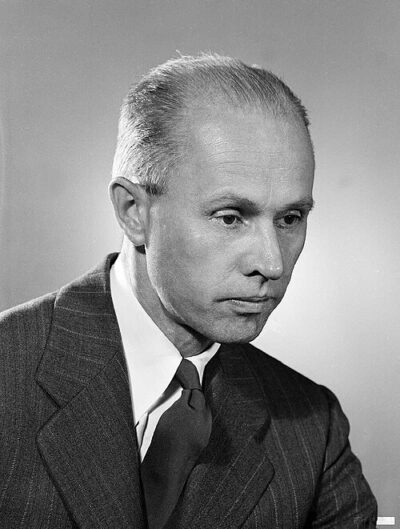
George Kistiakowsky
George Kistiakowsky was an Ukrainian-American physical chemistry professor. Born November 18, 1900, in Tarasivka. Died December 7, 1982, in Cambridge. Educated at Humboldt-Universität zu Berlin. Awards include Willard Gibbs Award, National Medal of Science and Centenary Prize.
Facts
32 facts · 1 confirmed by two sources · 8 cited · 22 from one source · 1 where the sources disagree
What’s different
- Born: we show November 18, 1900 (Sources disagree). Wikipedia says December 1, 1900
Where this comes from
Papalocal keeps its own record. It started from these sources; what each one said is kept here as it was copied, so a change on their side never changes this page by itself. Tap one to read its version.
What Wikidata says · copied November 16, 2026 · revision 2517490499
- Described as
- Ukrainian-American physical chemistry professor
- Other names
- George Bogdanovich Kistiakowsky, George B. Kistiakowsky
- Born
- November 18, 1900 · 1 reference
- Died
- December 7, 1982 · 2 references
- Born in
- Tarasivka · 1 reference
- Died in
- Cambridge
- Citizen of
- Russian Empire; United States
- Occupation
- physicist; chemist · 1 reference; university teacher · 1 reference; nuclear physicist · 1 reference
- Worked for
- Princeton University; Harvard University
- Education
- Humboldt-Universität zu Berlin
- Member of
- Royal Society of London (1960–); National Academy of Sciences (1939–); American Academy of Arts and Sciences; American Philosophical Society (1940–)
- Awards
- Willard Gibbs Award; National Medal of Science (1967); Centenary Prize (1961); Franklin Medal (1972); Fellow of the American Physical Society; Priestley Medal (1972) · 1 reference; Foreign Member of the Royal Society (1960) · 1 reference; Peter Debye Award in Physical Chemistry (1968) · 1 reference; Charles Lathrop Parsons Award (1961) · 1 reference; William H. Nichols Medal (1947) · 1 reference
- Field
- physical chemistry
- Children
- Vera Kistiakowsky
- Father
- Bogdan Kistyakovsky
- Mother
- Maria Berenstamm
- Siblings
- Alexander Kistiakowsky
- Wikipedias with a page
- 21
Wikidata item Q902967 (wikidata.org/wiki/Q902967), public domain (CC0). Copied November 16, 2026.
What Wikipedia says · copied November 16, 2026 · revision 1385789292
George Bogdanovich Kistiakowsky (Russian: Георгий Богданович Кистяковский, Ukrainian: Георгій Богданович Кістяківський, romanized: Heorhii Bohdanovych Kistiakivskyi; 1 December [O.S. 18 November] 1900 – December 7, 1982) was a Ukrainian-American physical chemistry professor at Harvard who participated in the Manhattan Project and later served as President Dwight D. Eisenhower's Science Advisor.
Born in Boyarka in the Russian Empire, into "an old Ukrainian Cossack family which was part of the intellectual elite in pre-revolutionary Russia", Kistiakowsky fled his homeland during the Russian Civil War. He made his way to Germany, where he earned his PhD in physical chemistry under the supervision of Max Bodenstein at the University of Berlin. He emigrated to the United States in 1926, where he joined the faculty of Harvard University in 1930, and became a citizen in 1933.
During World War II, Kistiakowsky was the head of the National Defense Research Committee (NDRC) section responsible for the development of explosives, and the technical director of the Explosives Research Laboratory (ERL), where he oversaw the development of new explosives, including RDX and HMX. He was involved in research into the hydrodynamic theory of explosions, and the development of shaped charges. In October 1943, he was brought into the Manhattan Project as a consultant. He was soon placed in charge of X Division, which was responsible for the development of the explosive lenses necessary for an implosion-type nuclear weapon. In July 1945, he watched the first atomic explosion in the Trinity test. A few weeks later, another implosion-type weapon (Fat Man) was dropped on Nagasaki.
From 1962 to 1965, Kistiakowsky chaired the National Academy of Sciences's Committee on Science, Engineering, and Public Policy (COSEPUP), and was its vice president from 1965 to 1973. He severed his connections with the government in protest against the war in Vietnam, and became active in an antiwar organization, the Council for a Livable World, becoming its chairman in 1977.
- Born, in its opening lines
- December 1, 1900
- Died, in its opening lines
- December 7, 1982
From the Wikipedia article “George Kistiakowsky” (en.wikipedia.org/wiki/George_Kistiakowsky), by its contributors, under CC BY-SA 4.0 (creativecommons.org/licenses/by-sa/4.0/). Copied November 16, 2026; not changed.
Confirmed Two sources agree. Cited One source, and it names where it got it. One source One source, without a reference of its own. Sources disagree The sources disagree. We show the best-supported value and keep theirs below.
