
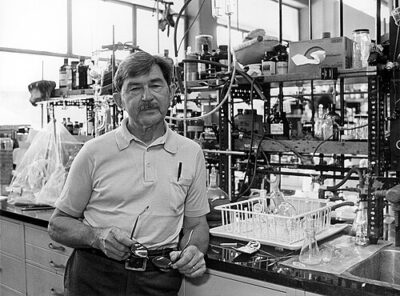
Henry Taube
Henry Taube was a Canadian-born American chemist. Born November 30, 1915, in Neudorf. Died November 16, 2005, in Palo Alto. Educated at University of Saskatchewan and University of California, Berkeley. Awards include Nobel Prize in Chemistry, Willard Gibbs Award and American Chemical Society Award in Inorganic Chemistry.
Facts
39 facts · 2 confirmed by two sources · 15 cited · 22 from one source
Where this comes from
Papalocal keeps its own record. It started from these sources; what each one said is kept here as it was copied, so a change on their side never changes this page by itself. Tap one to read its version.
What Wikidata says · copied November 13, 2026 · revision 2563200185
- Described as
- Canadian-born American chemist (1915–2005)
- Born
- November 30, 1915 · 7 references
- Died
- November 16, 2005 · 6 references
- Born in
- Neudorf
- Died in
- Palo Alto · 3 references
- Citizen of
- United States · 3 references
- Occupation
- chemist · 3 references; university teacher
- Worked for
- Cornell University; University of Chicago · 1 reference; Stanford University · 1 reference
- Education
- University of Saskatchewan; University of California, Berkeley (–1940); Luther College
- Member of
- Royal Society of London (1988–); National Academy of Sciences (1959–); Royal Society of Canada; American Academy of Arts and Sciences; Hungarian Academy of Sciences; Brazilian Academy of Sciences; American Philosophical Society (1981–) · 1 reference
- Awards
- Nobel Prize in Chemistry (1983) · 2 references; Willard Gibbs Award (1971) · 1 reference; American Chemical Society Award in Inorganic Chemistry (1981) · 1 reference; National Medal of Science (1976); NAS Award in Chemical Sciences (1983); Priestley Medal (1985) · 1 reference; National Order of Scientific Merit; Centenary Prize (1979); Remsen Award (1975) · 1 reference; Welch Award in Chemistry (1983) · 1 reference; Fellow of the Royal Society of Canada; Foreign Member of the Royal Society (1988) · 1 reference; Linus Pauling Award (1980) · 1 reference; Guggenheim Fellowship (2 times) (1949, 1955) · 1 reference; Oesper Award (1986) · 1 reference
- Field
- chemistry
- Children
- Karl Taube
- Lived in
- Palo Alto (–2005); Saskatchewan
- Wikipedias with a page
- 59
Wikidata item Q235983 (wikidata.org/wiki/Q235983), public domain (CC0). Copied November 13, 2026.
What Wikipedia says · copied November 13, 2026 · revision 1372006221
Henry Taube (November 30, 1915 – November 16, 2005) was a Canadian-born American chemist who was awarded the 1983 Nobel Prize in Chemistry for "his work in the mechanisms of electron-transfer reactions, especially in metal complexes." He was the second Canadian-born chemist to win the Nobel Prize, and remains the only Saskatchewanian-born Nobel laureate. Taube completed his undergraduate and master's degrees at the University of Saskatchewan, and his PhD from the University of California, Berkeley. After finishing graduate school, Taube worked at Cornell University, the University of Chicago and Stanford University.
In addition to the Nobel Prize, Taube also received many other major scientific awards, including the Priestley Medal in 1985 and two Guggenheim Fellowships early in his career (1949 and 1955), as well as numerous honorary doctorates. His research focused on redox reactions, transition metals and the use of isotopically labeled compounds to follow reactions. He had over 600 publications including one book, and had mentored over 200 students during his career. Taube and his wife Mary had three children; his son Karl is an anthropologist at the University of California Riverside.
- Born, in its opening lines
- November 30, 1915
- Died, in its opening lines
- November 16, 2005
From the Wikipedia article “Henry Taube” (en.wikipedia.org/wiki/Henry_Taube), by its contributors, under CC BY-SA 4.0 (creativecommons.org/licenses/by-sa/4.0/). Copied November 13, 2026; not changed.
Confirmed Two sources agree. Cited One source, and it names where it got it. One source One source, without a reference of its own. Sources disagree The sources disagree. We show the best-supported value and keep theirs below.
