
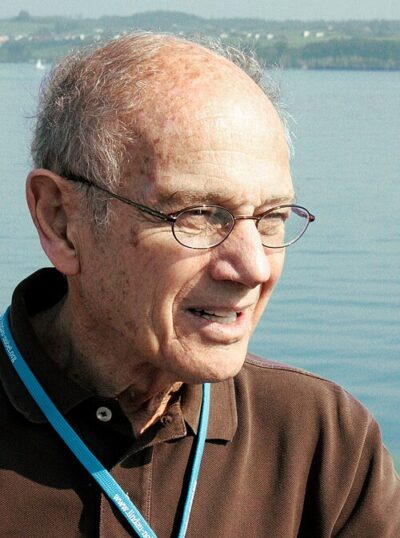
James Cronin
James Cronin was an American physicist. Born September 29, 1931, in Chicago. Died August 25, 2016, in Saint Paul. Educated at Southern Methodist University and University of Chicago. Awards include Nobel Prize in Physics, John Price Wetherill Medal and National Medal of Science.
Facts
36 facts · 2 confirmed by two sources · 13 cited · 21 from one source
Where this comes from
Papalocal keeps its own record. It started from these sources; what each one said is kept here as it was copied, so a change on their side never changes this page by itself. Tap one to read its version.
What Wikidata says · copied November 13, 2026 · revision 2567394484
- Described as
- American physicist
- Other names
- James Watson Cronin
- Born
- September 29, 1931 · 11 references
- Died
- August 25, 2016 · 7 references
- Born in
- Chicago · 1 reference
- Died in
- Saint Paul · 2 references
- Citizen of
- United States
- Occupation
- physicist · 1 reference; nuclear physicist; university teacher · 1 reference
- Worked for
- University of Chicago; Collège de France · 1 reference; University of Utah · 1 reference; Princeton University
- Education
- Southern Methodist University; University of Chicago; Highland Park High School · 1 reference
- Member of
- Royal Society of London (2007–); Accademia Nazionale dei Lincei (2009–) · 1 reference; National Academy of Sciences (1970–); American Academy of Arts and Sciences; Russian Academy of Sciences (2003–); American Physical Society · 1 reference; The World Academy of Sciences · 1 reference; Slovenian Academy of Sciences and Arts; Istituto Veneto di Scienze, Lettere ed Arti; American Philosophical Society (1999–)
- Awards
- Nobel Prize in Physics (1980) · 2 references; John Price Wetherill Medal (1976) · 1 reference; National Medal of Science (1999); doctor honoris causa from the Pierre and Marie Curie University (1994) · 1 reference; Fellow of the American Physical Society; honorary doctorate of the University of Santiago de Compostela (2009) · 1 reference; Foreign Member of the Royal Society (2007) · 1 reference; Ernest Orlando Lawrence Award (1976) · 1 reference; Guggenheim Fellowship · 1 reference; honorary doctor of the Marie and Louis Pasteur University (1998) · 1 reference
- Field
- nuclear physics · 1 reference
- Wikipedias with a page
- 66
Wikidata item Q193496 (wikidata.org/wiki/Q193496), public domain (CC0). Copied November 13, 2026.
What Wikipedia says · copied November 13, 2026 · revision 1372015911
James Watson Cronin (September 29, 1931 – August 25, 2016) was an American particle physicist.
Cronin and co-researcher Val Logsdon Fitch were awarded the 1980 Nobel Prize in Physics for a 1964 experiment that proved that certain subatomic reactions do not adhere to fundamental symmetry principles. Specifically, they proved, by examining the decay of kaons, that a reaction run in reverse does not merely retrace the path of the original reaction, which showed that the interactions of subatomic particles are not invariant under time reversal. Thus the phenomenon of CP violation was discovered.
Cronin received the Ernest Orlando Lawrence Award in 1976 for major experimental contributions to particle physics including fundamental work on weak interactions culminating in the discovery of asymmetry under time reversal. In 1999, he was awarded the National Medal of Science.
Cronin was Professor Emeritus at the University of Chicago winning the prestigious Quantrell Award and a spokesperson emeritus for the Auger project. He was a member of the Board of Sponsors of the Bulletin of the Atomic Scientists.
- Born, in its opening lines
- September 29, 1931
- Died, in its opening lines
- August 25, 2016
From the Wikipedia article “James Cronin” (en.wikipedia.org/wiki/James_Cronin), by its contributors, under CC BY-SA 4.0 (creativecommons.org/licenses/by-sa/4.0/). Copied November 13, 2026; not changed.
Confirmed Two sources agree. Cited One source, and it names where it got it. One source One source, without a reference of its own. Sources disagree The sources disagree. We show the best-supported value and keep theirs below.
