
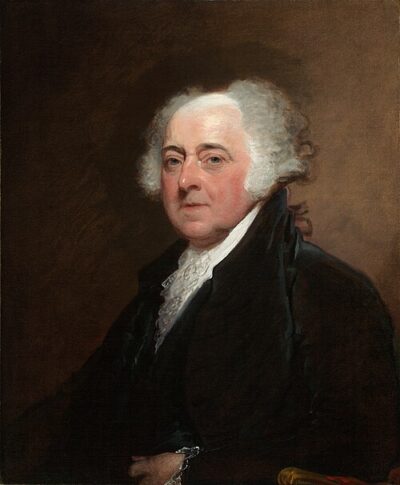
John Adams
John Adams was a Founding Father, U.S. president from 1797 to 1801. Born October 19, 1735, in Braintree. Died July 4, 1826, in Quincy. Positions held include United States Ambassador to the Netherlands (1782–1788), Vice President of the United States (1789–1797) and United States Ambassador to the United Kingdom (1785–1788). Educated at Harvard University and Harvard College. Awards include Fellow of the American Academy of Arts and Sciences.
Facts
44 facts · 1 confirmed by two sources · 24 cited · 18 from one source · 1 where the sources disagree
What’s different
- Born: we show October 19, 1735 (Sources disagree). Wikipedia says October 30, 1735
Where this comes from
Papalocal keeps its own record. It started from these sources; what each one said is kept here as it was copied, so a change on their side never changes this page by itself. Tap one to read its version.
What Wikidata says · copied November 13, 2026 · revision 2568242446
- Described as
- Founding Father, U.S. president from 1797 to 1801 (1735–1826)
- Other names
- J. Adams
- Born
- October 19, 1735 · 3 references
- Died
- July 4, 1826 · 13 references
- Born in
- Braintree · 1 reference
- Died in
- Quincy · 2 references
- Buried in
- United First Parish Church
- Citizen of
- United States · 2 references; Thirteen Colonies (–1776)
- Occupation
- lawyer; politician · 3 references; diplomat · 2 references; political philosopher · 1 reference; statesperson · 3 references; writer · 1 reference; ambassador · 1 reference
- Positions held
- United States Ambassador to the Netherlands (1782–1788); Vice President of the United States (1789–1797); United States Ambassador to the United Kingdom (1785–1788); United States Ambassador to France (1788); President of the United States (1797–1801); member of the Massachusetts House of Representatives (1770–); President-elect of the United States (1796–1797)
- Political party
- Federalist Party · 1 reference
- Education
- Harvard University; Harvard College
- Member of
- American Philosophical Society (1780–); American Academy of Arts and Sciences · 1 reference; American Antiquarian Society
- Awards
- Fellow of the American Academy of Arts and Sciences (1780–) · 1 reference
- Spouse
- Abigail Adams (1764–1818) · 2 references
- Children
- Abigail Adams Smith · 1 reference; John Quincy Adams · 3 references; Susanna Adams · 1 reference; Charles Adams · 1 reference; Thomas Boylston Adams · 1 reference
- Father
- John Adams, Sr. · 1 reference
- Mother
- Susanna Boylston · 1 reference
- Siblings
- Elihu Adams · 1 reference; Peter Boylston Adams · 1 reference
- Religion
- Unitarianism; Congregational churches
- Lived in
- Massachusetts; John Quincy Adams Birthplace · 1 reference; John Adams Birthplace · 1 reference
- Height
- 1.70 m (5 ft 7 in) · 1 reference
- Wikipedias with a page
- 188
Wikidata item Q11806 (wikidata.org/wiki/Q11806), public domain (CC0). Copied November 13, 2026.
What Wikipedia says · copied November 13, 2026 · revision 1385377828
John Adams (October 30, 1735 – July 4, 1826) was a Founding Father and the second president of the United States from 1797 to 1801. Before his presidency, he was a leader of the American Revolution that achieved independence from Great Britain. During the latter part of the Revolutionary War and in the early years of the new nation, he served the Continental Congress of the United States as a senior diplomat in Europe. Adams was the first vice president of the United States, serving from 1789 to 1797. He was a dedicated diarist and regularly corresponded with contemporaries, including his wife and advisor Abigail Adams and his friend and rival Thomas Jefferson.
A lawyer and political activist prior to the Revolution, Adams was devoted to the right to counsel and presumption of innocence. He defied anti-British sentiment and successfully defended British soldiers against murder charges arising from the Boston Massacre. Adams was a Massachusetts delegate to the Continental Congress and became a leader of the revolution. He seconded the Lee Resolution, which formally separated the United Colonies from Great Britain, and as a member of the Committee of Five assisted Jefferson in drafting the Declaration of Independence and was its primary advocate in Congress. As a diplomat, he represented the United States in France, and the Netherlands, during the war, and was the United States's first ambassador to Great Britain (a consequential position given the Revolutionary War). He helped negotiate the peace treaty with Great Britain and secured Dutch loans for the American government. Adams was the primary author of the Massachusetts Constitution in 1780, which, with his other political writings, influenced the United States Constitution.
Adams was elected to two terms as vice president under President George Washington and was elected as the United States' second president in 1796 under the banner of the Federalist Party. Adams's term was dominated by the issue of the French Revolutionary Wars, and his insistence on American neutrality led to fierce criticism from both the Jeffersonian Republicans and from some in his own party, led by his rival Alexander Hamilton. Adams signed the controversial Alien and Sedition Acts and built up the Army and Navy in an undeclared naval war with France. He was the first president to reside in the White House.
In his 1800 bid for reelection to the presidency, opposition from Federalists and accusations of despotism from Jeffersonians led to Adams losing to his vice president and former friend, Thomas Jefferson. After his defeat he retired to his Massachusetts home, Peacefield. He eventually resumed his friendship with Jefferson by initiating a continuing correspondence. John Adams died at Peacefield on July 4, 1826—the fiftieth anniversary of the adoption of the Declaration of Independence. The Adams political family included his son John Quincy Adams, the sixth president. Adams and his son are the only presidents of the first twelve who never owned slaves. Most historians have favorably ranked his presidency.
- Born, in its opening lines
- October 30, 1735
- Died, in its opening lines
- July 4, 1826
From the Wikipedia article “John Adams” (en.wikipedia.org/wiki/John_Adams), by its contributors, under CC BY-SA 4.0 (creativecommons.org/licenses/by-sa/4.0/). Copied November 13, 2026; not changed.
Confirmed Two sources agree. Cited One source, and it names where it got it. One source One source, without a reference of its own. Sources disagree The sources disagree. We show the best-supported value and keep theirs below.
