
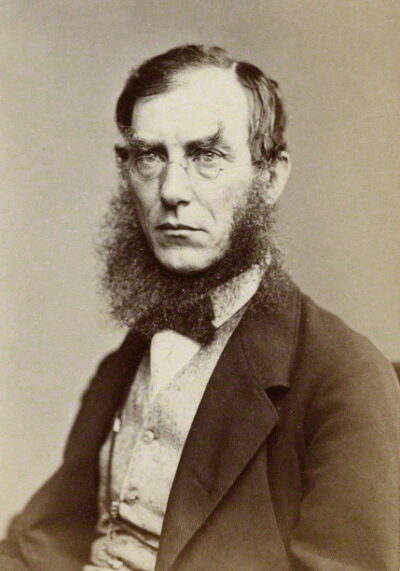
Joseph Dalton Hooker
Joseph Dalton Hooker was a British botanist, lichenologist, and surgeon. Born June 30, 1817, in Halesworth. Died December 10, 1911, in Sunningdale. Positions held include President of the Royal Society (1873–1878). Educated at University of Glasgow. Awards include Fellow of the Royal Society, Companion of the Order of the Bath and Copley Medal.
Facts
61 facts · 2 confirmed by two sources · 23 cited · 36 from one source
Where this comes from
Papalocal keeps its own record. It started from these sources; what each one said is kept here as it was copied, so a change on their side never changes this page by itself. Tap one to read its version.
What Wikidata says · copied November 16, 2026 · revision 2568761600
- Described as
- British botanist, lichenologist, and surgeon (1817–1911)
- Other names
- Joseph Hooker, Sir Joseph Hooker, Sir Hooker, J.D. Hooker, Hook.f., Hook.fil., Sir Joseph Dalton Hooker
- Born
- June 30, 1817 · 9 references
- Died
- December 10, 1911 · 9 references
- Born in
- Halesworth · 1 reference
- Died in
- Sunningdale · 1 reference
- Buried in
- St Anne's Church, Kew
- Citizen of
- United Kingdom of Great Britain and Ireland
- Occupation
- botanist · 1 reference; explorer; pteridologist; bryologist; mycologist; surgeon; writer · 1 reference; botanical collector · 8 references
- Positions held
- President of the Royal Society (1873–1878) · 1 reference
- Worked for
- Royal Botanic Gardens, Kew (1847–1885) · 1 reference; British Geological Survey (1845–1847) · 1 reference
- Education
- University of Glasgow
- Member of
- Royal Society of London; German Academy of Sciences Leopoldina; Royal Swedish Academy of Sciences; Göttingen Academy of Sciences and Humanities in Lower Saxony; Saint Petersburg Academy of Sciences; American Academy of Arts and Sciences; Hungarian Academy of Sciences; Accademia Nazionale dei Lincei (1875–) · 1 reference; Russian Academy of Sciences; Royal Prussian Academy of Sciences
- Awards
- Fellow of the Royal Society; Companion of the Order of the Bath (1869); Copley Medal (1887) · 1 reference; Pour le Mérite for Sciences and Arts order (1907); Royal Medal (1854); Knight Commander of the Order of the Star of India (1977–1897); Knight Grand Commander of the Order of the Star of India (1897); Darwin Medal (1892) · 1 reference; Albert Medal (1883); Cothenius Medal (1900); Darwin–Wallace Medal (1908) · 1 reference; Clarke Medal (1885); Linnean Medal (1888); Victoria Medal of Honour (1897); Fellow of the Ethnological Society of London
- Field
- botany
- Spouse
- Frances Hooker (1851–1874) · 1 reference; Hyacinth Symonds Hooker (1876–) · 3 references
- Children
- William Henslow Hooker · 1 reference; Harriet Anne Hooker Thiselton-Dyer · 1 reference; Charles Paget Hooker · 1 reference; Marie Elizabeth Hooker · 1 reference; Brian Harvey Hodgson Hooker · 1 reference; Reginald Hawthorn Hooker · 1 reference; Grace Ellen Hooker · 1 reference; Joseph Symonds Hooker · 1 reference; Richard Symonds Hooker · 1 reference
- Father
- William Jackson Hooker · 2 references
- Mother
- Maria Dawson Turner · 2 references
- Siblings
- William Dawson Hooker · 1 reference; Elizabeth Hooker · 1 reference; Maria Hooker; Mary Harriet Hooker
- Wikipedias with a page
- 54
Wikidata item Q157501 (wikidata.org/wiki/Q157501), public domain (CC0). Copied November 16, 2026.
What Wikipedia says · copied November 16, 2026 · revision 1381515926
Sir Joseph Dalton Hooker (30 June 1817 – 10 December 1911) was an English botanist and explorer in the 19th century. He was a founder of geographical botany and Charles Darwin's closest friend. For 20 years he served as director of the Royal Botanical Gardens, Kew, succeeding his father, William Jackson Hooker, and was awarded the highest honours of British science.
- Born, in its opening lines
- June 30, 1817
- Died, in its opening lines
- December 10, 1911
From the Wikipedia article “Joseph Dalton Hooker” (en.wikipedia.org/wiki/Joseph_Dalton_Hooker), by its contributors, under CC BY-SA 4.0 (creativecommons.org/licenses/by-sa/4.0/). Copied November 16, 2026; not changed.
Confirmed Two sources agree. Cited One source, and it names where it got it. One source One source, without a reference of its own. Sources disagree The sources disagree. We show the best-supported value and keep theirs below.
