
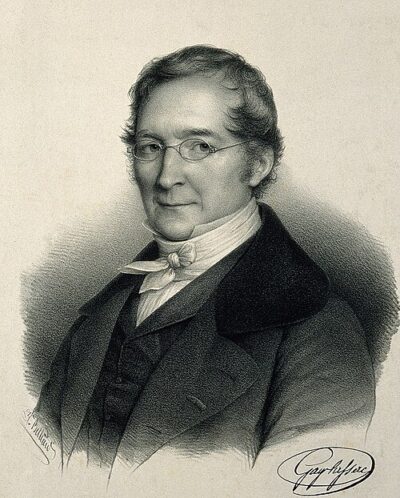
Joseph Louis Gay-Lussac
Joseph Louis Gay-Lussac was a French chemist and physicist. Born December 6, 1778, in Saint-Léonard-de-Noblat. Died May 9, 1850, in Paris. Positions held include member of the National Assembly (1831–1839), member of the Chamber of Peers and president of the French Academy of Sciences (2 times) (1822–1834). Known for Charles's law and Gay-Lussac's law. Educated at École polytechnique and University of Paris. Awards include Grand Officer of the Legion of Honour, Pour le Mérite for Sciences and Arts order and Galvanism Prize.
Facts
45 facts · 2 confirmed by two sources · 15 cited · 27 from one source · 1 where the sources disagree
What’s different
- Buried in: we show Père Lachaise Cemetery (Sources disagree). Wikidata also lists Grave of Joseph Louis Gay-Lussac
Where this comes from
Papalocal keeps its own record. It started from these sources; what each one said is kept here as it was copied, so a change on their side never changes this page by itself. Tap one to read its version.
What Wikidata says · copied November 16, 2026 · revision 2561393212
- Described as
- French chemist and physicist (1778–1850)
- Other names
- Louis Joseph Gay Lussac, Joseph Louis Gay–Lussac, Louis Gay-Lussac, Joseph Gay-Lussac, Louis Gay Lussac, Joseph-LGuy-Lussac, Joseph Louis Gay Lussac, Louis Joseph Gay-Lussac, Joseph-Louis Gay-Lussac
- Born
- December 6, 1778 · 3 references
- Died
- May 9, 1850 · 14 references
- Born in
- Saint-Léonard-de-Noblat · 1 reference
- Died in
- Paris · 2 references
- Buried in
- Père Lachaise Cemetery · 1 reference; Grave of Joseph Louis Gay-Lussac
- Citizen of
- France
- Occupation
- physicist · 1 reference; chemist · 1 reference; politician; engineer; university teacher; board member (1840–1850) · 1 reference
- Positions held
- member of the National Assembly (1831–1839) · 1 reference; member of the Chamber of Peers; president of the French Academy of Sciences (2 times) (1822–1834)
- Worked for
- University of Paris; École polytechnique; Manufacture royale de glaces de miroirs · 1 reference
- Education
- École polytechnique; University of Paris · 1 reference; École Nationale des Ponts et Chaussées · 1 reference
- Member of
- Royal Society of London (1815–) · 1 reference; Société Philomathique de Paris; Academy of Science for Public Utility; Royal Swedish Academy of Sciences; French Academy of Sciences (1806–) · 1 reference; American Academy of Arts and Sciences (1832–) · 1 reference; Russian Academy of Sciences (1829–) · 1 reference; Royal Prussian Academy of Sciences; Accademia Nazionale delle Scienze detta dei XL; Bavarian Academy of Sciences and Humanities · 1 reference
- Known for
- Charles's law; Gay-Lussac's law
- Awards
- Grand Officer of the Legion of Honour · 1 reference; Pour le Mérite for Sciences and Arts order; Galvanism Prize (1809); Fellow of the American Academy of Arts and Sciences; Foreign Member of the Royal Society (1815) · 1 reference; Pour le Mérite · 1 reference; 72 names on the Eiffel Tower · 1 reference; Knight of the Order of the Polar Star
- Field
- chemistry; physics
- Spouse
- Geneviève-Marie-Joseph Rojot (1809–) · 1 reference
- Children
- Jules-Alexandre Gay-Lussac
- Wikipedias with a page
- 83
Wikidata item Q153185 (wikidata.org/wiki/Q153185), public domain (CC0). Copied November 16, 2026.
What Wikipedia says · copied November 16, 2026 · revision 1372471473
Joseph Louis Gay-Lussac (6 December 1778 – 9 May 1850) was a French chemist and physicist. He is known mostly for his discovery that water is made of two parts hydrogen and one part oxygen by volume (with Alexander von Humboldt), for two laws related to gases, and for his work on alcohol–water mixtures, which led to the degrees Gay-Lussac used to measure alcoholic beverages in many countries.
- Born, in its opening lines
- December 6, 1778
- Died, in its opening lines
- May 9, 1850
From the Wikipedia article “Joseph Louis Gay-Lussac” (en.wikipedia.org/wiki/Joseph_Louis_Gay-Lussac), by its contributors, under CC BY-SA 4.0 (creativecommons.org/licenses/by-sa/4.0/). Copied November 16, 2026; not changed.
Confirmed Two sources agree. Cited One source, and it names where it got it. One source One source, without a reference of its own. Sources disagree The sources disagree. We show the best-supported value and keep theirs below.
