
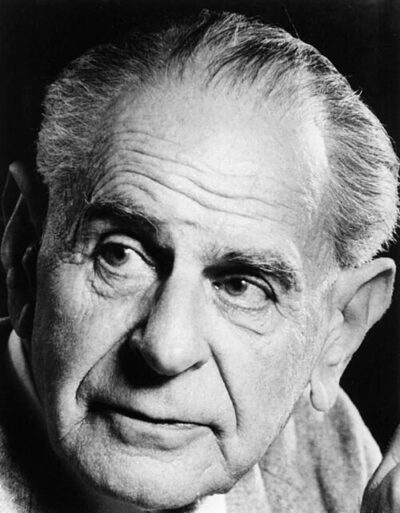
Karl Popper
Karl Popper was an Austrian-British philosopher of science and social and política e falsificationism and for criticism of Plato, Hegel and Marx as totalitarian opponents of open society. Born July 28, 1902, in Vienna. Died September 17, 1994, in Kenley. Known for The Logic of Scientific Discovery, The Open Society and Its Enemies and The Poverty of Historicism. Educated at University of Vienna and University of Cambridge. Awards include Pour le Mérite for Sciences and Arts order, Ring of Honour of the City of Vienna and Great Golden Medal of Honour for Services to the Republic of Austria.
Facts
65 facts · 2 confirmed by two sources · 38 cited · 25 from one source
Where this comes from
Papalocal keeps its own record. It started from these sources; what each one said is kept here as it was copied, so a change on their side never changes this page by itself. Tap one to read its version.
What Wikidata says · copied November 16, 2026 · revision 2568604944
- Described as
- Austrian-British philosopher of science and social and política e falsificationism and for criticism of Plato, Hegel and Marx as totalitarian opponents of open society (1902-1994)
- Other names
- Karl Raimund, Sir Popper, Karl Raimund Popper Sir, Karl Raimund Popper, Karl R. Popper, Popper, Sir Karl Raimund Popper
- Born
- July 28, 1902 · 16 references
- Died
- September 17, 1994 · 16 references
- Born in
- Vienna · 5 references
- Died in
- Kenley
- Buried in
- mortuary Lainzer Friedhof · 1 reference
- Name at birth
- Karl Raimund Popper
- Citizen of
- Cisleithania; Austria · 1 reference; United Kingdom (1945–) · 2 references; United Kingdom of Great Britain and Ireland (–1927)
- Occupation
- philosopher · 4 references; philosopher of science · 1 reference; writer; university teacher; sociologist; mathematician · 2 references; teacher · 2 references
- Worked for
- University of Canterbury (1937–1945) · 1 reference; London School of Economics and Political Science (1946–) · 1 reference; King's College London; University of London (1949–1969) · 1 reference
- Education
- University of Vienna (1918–) · 1 reference; University of Cambridge
- Member of
- Royal Society of London (1976–) · 1 reference; British Academy (1958–) · 2 references; American Academy of Arts and Sciences (1966–) · 1 reference; Accademia Nazionale dei Lincei (1982–) · 1 reference; Mont Pelerin Society · 1 reference; International Academy of the History of Science · 1 reference; National Academy of Sciences (1986–) · 1 reference
- Known for
- The Logic of Scientific Discovery · 1 reference; The Open Society and Its Enemies · 2 references; The Poverty of Historicism · 2 references; Conjectures and Refutations · 1 reference; Objective Knowledge · 1 reference; Unended Quest · 1 reference; The Self and Its Brain · 1 reference
- Awards
- Pour le Mérite for Sciences and Arts order (1980) · 1 reference; Ring of Honour of the City of Vienna; Great Golden Medal of Honour for Services to the Republic of Austria; Great Cross with Star and Sash of the Order of Merit of the Federal Republic of Germany; Otto Hahn Peace Medal (1993) · 1 reference; Catalonia International Prize (1989) · 1 reference; Dr. Leopold Lucas Prize (1981) · 1 reference; Montyon Prize (2003); Goethe Medal (1992) · 1 reference; honorary doctor of the University of Vienna (1977) · 1 reference; honorary doctor of the University of Madrid Complutense (1991) · 1 reference; honorary doctorate of Salzburg University; Kyoto Prize in Arts and Philosophy (1992) · 2 references; Fellow of the British Academy; Austrian Decoration for Science and Art (1980)
- Field
- philosophy · 1 reference; epistemology · 1 reference; rationality · 1 reference; philosophy of science · 1 reference; logic · 1 reference; political philosophy · 1 reference
- Spouse
- Josefine Anna Henninger (1906–1985) · 1 reference
- Father
- Simon Siegmund Carl Popper · 2 references
- Mother
- Jenny Popper · 1 reference
- Siblings
- Anne Day-Helveg · 2 references; Dora Popper · 2 references
- Religion
- Lutheranism
- Lived in
- Vienna
- Wikipedias with a page
- 130
Wikidata item Q81244 (wikidata.org/wiki/Q81244), public domain (CC0). Copied November 16, 2026.
What Wikipedia says · copied November 16, 2026 · revision 1383555097
Sir Karl Raimund Popper (28 July 1902 – 17 September 1994) was an Austrian–British philosopher, academic and social commentator. One of the 20th century's most influential philosophers of science, Popper is known for his rejection of the classical inductivist views on the scientific method in favour of empirical falsification made possible by his falsifiability criterion, and for founding the Department of Philosophy at the London School of Economics and Political Science. According to Popper, a theory in the empirical sciences can never be proven, but it can be falsified, meaning that it can (and should) be scrutinised with decisive experiments. Popper was opposed to the classical justificationist account of knowledge, which he replaced with "the first non-justificational philosophy of criticism in the history of philosophy", namely critical rationalism.
In political discourse, he is known for his vigorous defence of liberal democracy and the principles of social criticism that he believed made a flourishing open society possible. His political thought resides within the camp of Enlightenment rationalism and humanism. He was a dogged opponent of totalitarianism, communism, nationalism, fascism, historicism, and other kinds of (in Popper's view) reactionary and irrational ideas, and identified modern liberal democracies as the best-to-date embodiment of an open society.
- Born, in its opening lines
- July 28, 1902
- Died, in its opening lines
- September 17, 1994
From the Wikipedia article “Karl Popper” (en.wikipedia.org/wiki/Karl_Popper), by its contributors, under CC BY-SA 4.0 (creativecommons.org/licenses/by-sa/4.0/). Copied November 16, 2026; not changed.
Confirmed Two sources agree. Cited One source, and it names where it got it. One source One source, without a reference of its own. Sources disagree The sources disagree. We show the best-supported value and keep theirs below.
