
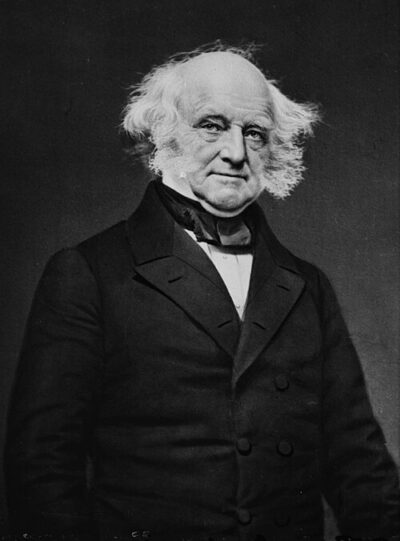
Martin Van Buren
Martin Van Buren was a president of the United States from 1837 to 1841. Born December 5, 1782, in Kinderhook. Died July 24, 1862, in Kinderhook. Positions held include President of the United States (1837–1841), member of the State Senate of New York and Vice President of the United States (1833–1837).
Facts
46 facts · 2 confirmed by two sources · 16 cited · 28 from one source
Where this comes from
Papalocal keeps its own record. It started from these sources; what each one said is kept here as it was copied, so a change on their side never changes this page by itself. Tap one to read its version.
What Wikidata says · copied November 13, 2026 · revision 2567583193
- Described as
- president of the United States from 1837 to 1841
- Other names
- M. van Buren, President Van Buren, Martin van Ruin, The Red Fox of Kinderhook, President van Buren, The Mistletoe Politician, President Martin Van Buren, Old Kinderhook, Buren, Van Buren, Maarten van Buren
- Born
- December 5, 1782 · 10 references
- Died
- July 24, 1862 · 11 references
- Born in
- Kinderhook
- Died in
- Kinderhook
- Buried in
- Kinderhook Cemetery
- Cause of death
- heart failure
- Name at birth
- Maarten van Buren
- Citizen of
- United States · 1 reference
- Occupation
- politician · 1 reference; lawyer; diplomat; statesperson; writer · 1 reference; ambassador · 1 reference; governor · 1 reference; jurist · 1 reference
- Positions held
- President of the United States (1837–1841) · 1 reference; member of the State Senate of New York; Vice President of the United States (1833–1837); United States Secretary of State (1829–1831); Governor of New York (1829); ambassador; Attorney General of New York (1815–1819); United States senator (1821–1828) · 1 reference; President-elect of the United States (1836–1837); president · 1 reference; senator · 1 reference
- Political party
- Free Soil Party; Democratic Party · 1 reference; Democratic-Republican Party · 1 reference
- Member of
- Royal Netherlands Academy of Arts and Sciences · 1 reference
- Spouse
- Hannah Van Buren (1807–1819) · 1 reference
- Children
- Abraham Van Buren; John Van Buren · 1 reference; Martin Van Buren Jr. · 1 reference; Winfield Scott Van Buren · 1 reference; Smith Thompson Van Buren · 1 reference
- Father
- Abraham Van Buren
- Mother
- Maria Hoes · 1 reference
- Siblings
- Abraham Van Buren; Derike Van Buren; Lawrence Van Buren; Hannah Van Buren
- Religion
- Reformed Christianity
- Nickname
- Old Kinderhook
- Height
- 1.68 m (5 ft 6 in) · 1 reference
- Wikipedias with a page
- 146
Wikidata item Q11820 (wikidata.org/wiki/Q11820), public domain (CC0). Copied November 13, 2026.
What Wikipedia says · copied November 13, 2026 · revision 1384807155
Martin Van Buren (December 5, 1782 – July 24, 1862) was the eighth president of the United States, serving from 1837 to 1841. He founded the Democratic Party with Andrew Jackson and served as Jackson's vice president from 1833 to 1837.
Van Buren was born in Kinderhook, New York, where most residents were of Dutch descent and spoke Dutch as their primary language. He is the only president to have spoken English as a second language. Van Buren entered politics as a member of the Democratic-Republican Party, won a seat in the New York State Senate in 1813, and was elected to the United States Senate eight years later. As the leader of the Bucktails faction of the party, he established the political machine known as the Albany Regency. Van Buren ran successfully for governor of New York to support Andrew Jackson's candidacy in the 1828 presidential election, but resigned shortly after Jackson was inaugurated so he could accept appointment as Jackson's secretary of state. In the cabinet, Van Buren was a key Jackson advisor and built the organizational structure for the coalescing Democratic Party. He ultimately resigned to help resolve the Petticoat affair and briefly served as ambassador to the United Kingdom. At Jackson's behest, the 1832 Democratic National Convention nominated Van Buren for vice president, and he took office after the Democratic ticket won the 1832 presidential election.
With Jackson's strong support and the organizational strength of the Democratic Party, Van Buren successfully ran for president in the 1836 presidential election. However, his popularity soon eroded because of his response to the Panic of 1837, which centered on his Independent Treasury system, a plan under which the federal government of the United States would store its funds in vaults rather than in banks. More conservative Democrats and Whigs in Congress ultimately delayed Van Buren's plan from being implemented until 1840. His presidency was further marred by the costly Second Seminole War and his refusal to admit Texas to the Union as a slave state. In 1840, Van Buren lost his re-election bid to William Henry Harrison. While Van Buren is praised for anti-slavery stances, in historical rankings, historians and political scientists often rank him as a below-average U.S. president, due to his handling of the Panic of 1837.
Van Buren was initially the leading candidate for the Democratic Party's nomination again in 1844, but his continued opposition to the annexation of Texas angered Southern Democrats, leading to the nomination of James K. Polk. Van Buren grew increasingly opposed to slavery, and was the presidential nominee of the newly formed Free Soil Party in the 1848 United States presidential election, and his candidacy helped Whig nominee Zachary Taylor defeat Democrat Lewis Cass. Worried about sectional tensions, Van Buren returned to the Democratic Party after 1848 but was disappointed with the pro-southern presidencies of Franklin Pierce and James Buchanan.
During the American Civil War, Van Buren was a War Democrat who supported the policies of President Abraham Lincoln, a Republican. Van Buren died of asthma at his home in Kinderhook in 1862, at age 79.
- Born, in its opening lines
- December 5, 1782
- Died, in its opening lines
- July 24, 1862
From the Wikipedia article “Martin Van Buren” (en.wikipedia.org/wiki/Martin_Van_Buren), by its contributors, under CC BY-SA 4.0 (creativecommons.org/licenses/by-sa/4.0/). Copied November 13, 2026; not changed.
Confirmed Two sources agree. Cited One source, and it names where it got it. One source One source, without a reference of its own. Sources disagree The sources disagree. We show the best-supported value and keep theirs below.
