
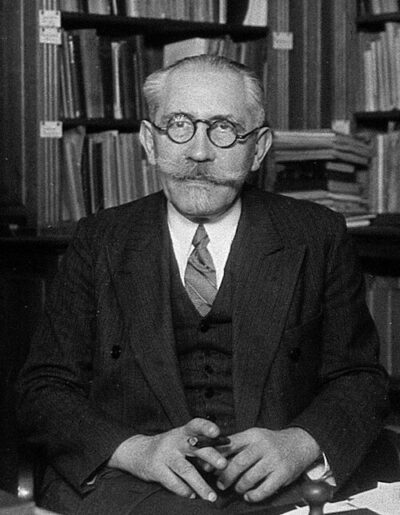
Paul Langevin
Paul Langevin was a French physicist, philosopher of science and pedagogue. Born January 23, 1872, in Paris. Died December 19, 1946, in Paris. Positions held include president (2 times) (1930–1946), professor (1909–1946) and director (1925–1946). Known for La Pensée et l'Action and La physique depuis vingt ans. Educated at University of Cambridge and University of Paris. Awards include Copley Medal, Hughes Medal and Grand Cross of the Legion of Honour.
Facts
55 facts · 2 confirmed by two sources · 13 cited · 40 from one source
Where this comes from
Papalocal keeps its own record. It started from these sources; what each one said is kept here as it was copied, so a change on their side never changes this page by itself. Tap one to read its version.
What Wikidata says · copied November 16, 2026 · revision 2568899505
- Described as
- French physicist, philosopher of science and pedagogue (1872-1946)
- Born
- January 23, 1872 · 11 references
- Died
- December 19, 1946 · 10 references
- Born in
- Paris · 1 reference
- Died in
- Paris · 1 reference
- Buried in
- Panthéon (1948–)
- Citizen of
- France
- Occupation
- physicist · 1 reference; chemist; philosopher of science; pedagogue; university teacher · 1 reference
- Positions held
- president (2 times) (1930–1946); professor (1909–1946); director (1925–1946); founder (1934–1939); member
- Political party
- French Communist Party (1944–)
- Worked for
- Collège de France (1909–1946) · 1 reference; ESPCI Paris, PSL University (1905–1946)
- Education
- University of Cambridge; University of Paris; École Normale Supérieure (1894–1897); ESPCI Paris, PSL University (1888–1893)
- Member of
- Royal Society of London (1928–); Human Rights League; French Academy of Sciences; Russian Academy of Sciences (1924–) · 1 reference; Göttingen Academy of Sciences and Humanities in Lower Saxony; Accademia Nazionale dei Lincei (1921–) · 1 reference
- Known for
- La Pensée et l'Action; La physique depuis vingt ans
- Awards
- Copley Medal (1940) · 1 reference; Hughes Medal (1915); Grand Cross of the Legion of Honour (1946); La Caze Prize of the Academy of Sciences (1924); Guthrie Lecture (1917) · 1 reference; Commander of the Order of the British Empire (1920) · 1 reference; Foreign Member of the Royal Society (1928) · 1 reference; Commander of the Military Order of Saint James of the Sword (1930) · 1 reference; Commander with Star of the Order of Polonia Restituta (1946) · 1 reference; Saintour Prize (1901)
- Field
- physics · 1 reference; chemistry; philosophy of science; theoretical physics · 1 reference; experimental physics · 1 reference; pedagogy
- Spouse
- Jeanne Desfosses
- Children
- Jean Langevin; André Langevin; Madeleine Varloteau; Hélène Solomon-Langevin; Paul-Gilbert Langevin
- Father
- Victor-Charles Langevin
- Mother
- Marie-Adélaïde Pinel
- Wikipedias with a page
- 59
Wikidata item Q25320 (wikidata.org/wiki/Q25320), public domain (CC0). Copied November 16, 2026.
What Wikipedia says · copied November 16, 2026 · revision 1385534710
Paul Langevin (French: [pɔl lɑ̃ʒvɛ̃]; 23 January 1872 – 19 December 1946) was a French physicist who developed Langevin dynamics and the Langevin equation. He was one of the founders of the Comité de vigilance des intellectuels antifascistes, an anti-fascist organization created after the 6 February 1934 far right riots. Being a public opponent of fascism in the 1930s resulted in his arrest and being held under house arrest by the Vichy government for most of World War II. Langevin was also president of the Human Rights League (LDH) from 1944 to 1946, having recently joined the French Communist Party.
He was a doctoral student of Pierre Curie and later a lover of widowed Marie Curie. He is also known for his two US patents with Constantin Chilowsky in 1916 and 1917 involving ultrasonic submarine detection. He is entombed at the Panthéon.
- Born, in its opening lines
- January 23, 1872
- Died, in its opening lines
- December 19, 1946
From the Wikipedia article “Paul Langevin” (en.wikipedia.org/wiki/Paul_Langevin), by its contributors, under CC BY-SA 4.0 (creativecommons.org/licenses/by-sa/4.0/). Copied November 16, 2026; not changed.
Confirmed Two sources agree. Cited One source, and it names where it got it. One source One source, without a reference of its own. Sources disagree The sources disagree. We show the best-supported value and keep theirs below.
