
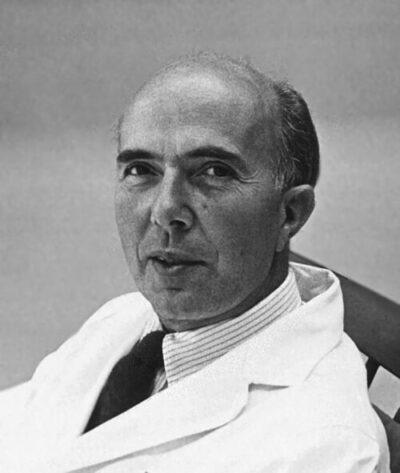
Renato Dulbecco
Renato Dulbecco was an Italian-born American virologist. Born February 22, 1914, in Catanzaro. Died February 19, 2012, in La Jolla. Educated at University of Turin. Awards include Guggenheim Fellowship, Albert Lasker Award for Basic Medical Research and Nobel Prize in Physiology or Medicine.
Facts
41 facts · 2 confirmed by two sources · 21 cited · 18 from one source
Where this comes from
Papalocal keeps its own record. It started from these sources; what each one said is kept here as it was copied, so a change on their side never changes this page by itself. Tap one to read its version.
What Wikipedia says · copied November 13, 2026 · revision 1384408611
Renato Dulbecco ( dul-BEK-oh, Italian: [reˈnaːto dulˈbɛkko, -ˈbek-]; February 22, 1914 – February 19, 2012) was an Italian–American virologist who won the 1975 Nobel Prize in Physiology or Medicine for his work on oncoviruses, which are viruses that can cause cancer when they infect animal cells. He studied at the University of Turin under Giuseppe Levi, along with fellow students Salvador Luria and Rita Levi-Montalcini, who also moved to the U.S. with him and won Nobel prizes. He was drafted into the Italian army in World War II, but later joined the resistance.
- Born, in its opening lines
- February 22, 1914
- Died, in its opening lines
- February 19, 2012
From the Wikipedia article “Renato Dulbecco” (en.wikipedia.org/wiki/Renato_Dulbecco), by its contributors, under CC BY-SA 4.0 (creativecommons.org/licenses/by-sa/4.0/). Copied November 13, 2026; not changed.
What Wikidata says · copied November 14, 2026 · revision 2569089792
- Described as
- Italian-born American virologist (1914-2012)
- Born
- February 22, 1914 · 8 references
- Died
- February 19, 2012 · 11 references
- Born in
- Catanzaro · 4 references
- Died in
- La Jolla · 3 references
- Citizen of
- Italy (1946–) · 3 references; United States · 3 references; Kingdom of Italy (–1946)
- Occupation
- virologist; physician · 1 reference; biologist · 1 reference
- Worked for
- California Institute of Technology; Human Genome Project (1992); University of California, San Diego (1977); Indiana University
- Education
- University of Turin (–1936)
- Member of
- Royal Society of London (1974–) · 1 reference; Accademia Nazionale dei Lincei (1968–) · 1 reference; National Academy of Sciences (1961–) · 1 reference; American Academy of Arts and Sciences (1965–) · 1 reference; American Philosophical Society (1993–); European Academy of Sciences (2004–) · 1 reference
- Awards
- Guggenheim Fellowship (1957) · 1 reference; Albert Lasker Award for Basic Medical Research (1964) · 1 reference; Nobel Prize in Physiology or Medicine (1975) · 2 references; Grand Officer of the Order of Merit of the Italian Republic (1981) · 1 reference; Knight Grand Cross of the Order of Merit of the Italian Republic (1991) · 1 reference; Selman A. Waksman Award in Microbiology (1974) · 1 reference; Marjory Stephenson Prize (1973); Paul Ehrlich and Ludwig Darmstaedter Prize (1967); Louisa Gross Horwitz Prize (1973) · 1 reference; Howard Taylor Ricketts Prize (1965) · 1 reference; John Scott Award (1958) · 1 reference; Leeuwenhoek Lecture (1974) · 1 reference; honorary doctorate of the University of Las Palmas, Gran Canaria (1996) · 1 reference; Foreign Member of the Royal Society (1974) · 1 reference; honorary doctorate of the Vrije Universiteit Brussel (1978) · 1 reference
- Field
- virology
- Lived in
- United States (1947–2012); Imperia; Milan; La Jolla (–2012)
- Wikipedias with a page
- 60
Wikidata item Q109553 (wikidata.org/wiki/Q109553), public domain (CC0). Copied November 14, 2026.
Confirmed Two sources agree. Cited One source, and it names where it got it. One source One source, without a reference of its own. Sources disagree The sources disagree. We show the best-supported value and keep theirs below.
