
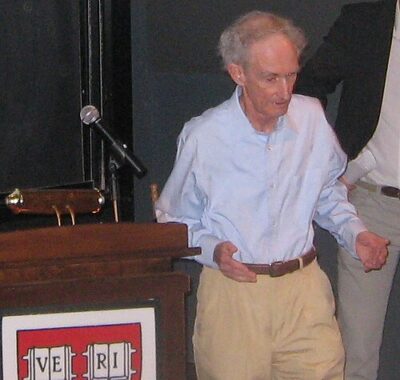
Robert May, Baron May of Oxford
Robert May, Baron May of Oxford was an Australian scientist who has been Chief Scientific Adviser to the UK Government. Born January 8, 1936, in Sydney. Died April 28, 2020, in Oxford. Positions held include President of the Royal Society (2000–2005), member of the House of Lords (2001–2017) and Government Chief Scientific Adviser (1995–2000). Educated at University of Sydney. Awards include Copley Medal, Lord Lewis Prize and Balzan Prize.
Facts
52 facts · 2 confirmed by two sources · 17 cited · 33 from one source
Where this comes from
Papalocal keeps its own record. It started from these sources; what each one said is kept here as it was copied, so a change on their side never changes this page by itself. Tap one to read its version.
What Wikidata says · copied November 16, 2026 · revision 2558226872
- Described as
- Australian scientist who has been Chief Scientific Adviser to the UK Government (1936-2020)
- Other names
- Robert McCredie May, Sir Robert May, The Lord May of Oxford, Robert M. May, Robert McCredie May, Baron May of Oxford, R. M. May, Bob May
- Born
- January 8, 1936 · 6 references
- Died
- April 28, 2020 · 4 references
- Born in
- Sydney · 1 reference
- Died in
- Oxford · 2 references
- Citizen of
- United Kingdom; United States · 1 reference
- Occupation
- physicist; engineer; zoologist; university teacher; ecologist · 1 reference; politician · 1 reference; biologist · 1 reference
- Positions held
- President of the Royal Society (2000–2005) · 1 reference; member of the House of Lords (2001–2017); Government Chief Scientific Adviser (1995–2000)
- Worked for
- Princeton University; Harvard University; Imperial College London; Santa Fe Institute; University of Sydney
- Education
- University of Sydney · 1 reference
- Member of
- Academia Europaea; National Academy of Sciences (1992–); Royal Society of London; American Academy of Arts and Sciences; Australian Academy of Science; Australian Academy of Technology and Engineering; Silwood circle; American Philosophical Society (2001–)
- Awards
- Copley Medal (2007) · 1 reference; Lord Lewis Prize; Balzan Prize (1998); Blue Planet Prize (2001) · 1 reference; Dirac Medal for the Advancement of Physics (2011) · 1 reference; Josiah Willard Gibbs Lectureship (1994); Robert H. MacArthur Award (1984); Frink Medal (1995); Linnean Medal (1991); Member of the Order of Merit (2002) · 1 reference; Croonian Medal and Lecture (1985); Corresponding Member of the Australian Academy of Science (1991); Fellow of the Australian Academy of Technology and Engineering (2001) · 1 reference; Fellow of the Royal Society of New South Wales; Crafoord Prize in Biosciences (1996) · 1 reference
- Field
- ecology; theoretical physics · 1 reference; mathematical analysis · 1 reference
- Spouse
- Judith Feiner (1962–) · 1 reference
- Children
- Naomi Felicity May · 1 reference
- Father
- Henry Wilkinson May · 1 reference
- Religion
- atheism
- Wikipedias with a page
- 23
Wikidata item Q336397 (wikidata.org/wiki/Q336397), public domain (CC0). Copied November 16, 2026.
What Wikipedia says · copied November 16, 2026 · revision 1381282642
Robert McCredie May, Baron May of Oxford (8 January 1936 – 28 April 2020) was an Australian scientist who was Chief Scientific Adviser to the UK Government, President of the Royal Society, and a professor at the University of Sydney and Princeton University. He held joint professorships at the University of Oxford and Imperial College London. He was also a crossbench member of the House of Lords from 2001 until his retirement in 2017.
May was a Fellow of Merton College, Oxford, and an appointed member of the council of the British Science Association. He was also a member of the advisory council for the Campaign for Science and Engineering.
- Born, in its opening lines
- January 8, 1936
- Died, in its opening lines
- April 28, 2020
From the Wikipedia article “Robert May, Baron May of Oxford” (en.wikipedia.org/wiki/Robert_May,_Baron_May_of_Oxford), by its contributors, under CC BY-SA 4.0 (creativecommons.org/licenses/by-sa/4.0/). Copied November 16, 2026; not changed.
Confirmed Two sources agree. Cited One source, and it names where it got it. One source One source, without a reference of its own. Sources disagree The sources disagree. We show the best-supported value and keep theirs below.
