
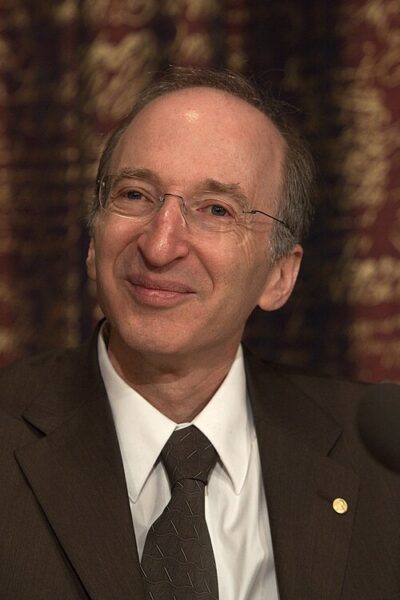
Saul Perlmutter
Saul Perlmutter is an American astrophysicist and Nobel laureate. Born September 22, 1959, in Champaign. Educated at Harvard University and University of California, Berkeley. Awards include Nobel Prize in Physics, Fellow of the American Physical Society and Fellow of the American Association for the Advancement of Science.
Facts
35 facts · 1 confirmed by two sources · 20 cited · 14 from one source
Where this comes from
Papalocal keeps its own record. It started from these sources; what each one said is kept here as it was copied, so a change on their side never changes this page by itself. Tap one to read its version.
What Wikidata says · copied November 13, 2026 · revision 2567595445
- Described as
- American astrophysicist and Nobel laureate
- Born
- September 22, 1959 · 2 references
- Born in
- Champaign · 1 reference
- Citizen of
- United States · 3 references
- Occupation
- physicist · 1 reference; astronomer · 1 reference; professor · 3 references; astrophysicist; researcher
- Worked for
- University of California, Berkeley · 1 reference
- Education
- Harvard University; University of California, Berkeley (–1986); Germantown Friends School · 1 reference; Greene Street Friends School · 1 reference
- Member of
- National Academy of Sciences (2002–); American Academy of Arts and Sciences (2007–) · 1 reference; American Astronomical Society · 1 reference; American Association for the Advancement of Science · 1 reference; American Physical Society · 1 reference
- Awards
- Nobel Prize in Physics (2011) · 2 references; Fellow of the American Physical Society; Fellow of the American Association for the Advancement of Science (2003) · 1 reference; Fellow of the American Academy of Arts and Sciences · 1 reference; Ernest Orlando Lawrence Award (2002) · 1 reference; John Scott Award (2005) · 1 reference; The Shaw Prize in Astronomy (2006) · 1 reference; Feltrinelli Prize (2006); Gruber Prize in Cosmology (2007) · 1 reference; Dickson Prize in Science (2010); Clarivate Citation Laureates (2010) · 1 reference; Albert Einstein Medal (2011) · 1 reference; Breakthrough Prize in Fundamental Physics (2015); honorary doctorate from the University of Paris-VII (2017) · 1 reference; honorary doctorate of Barcelona University (2019)
- Field
- astrophysics
- Lived in
- Berkeley · 1 reference
- Wikipedias with a page
- 74
Wikidata item Q106949 (wikidata.org/wiki/Q106949), public domain (CC0). Copied November 13, 2026.
What Wikipedia says · copied November 13, 2026 · revision 1383251612
Saul Perlmutter (born September 22, 1959) is an American astrophysicist who is a professor of physics at the University of California, Berkeley, where he holds the Franklin W. and Karen Weber Dabby Chair, and is head of the International Supernova Cosmology Project at the Lawrence Berkeley National Laboratory. He is a member of both the American Academy of Arts & Sciences and the American Philosophical Society, and was elected a Fellow of the American Association for the Advancement of Science in 2003. He is a member of the National Academy of Sciences. Perlmutter shared the 2006 Shaw Prize in Astronomy, the 2011 Nobel Prize in Physics, and the 2015 Breakthrough Prize in Fundamental Physics with Brian P. Schmidt and Adam Riess for providing evidence that the expansion of the universe is accelerating. Since 2021, he has been a member of the President’s Council of Advisors on Science and Technology (PCAST).
- Born, in its opening lines
- September 22, 1959
From the Wikipedia article “Saul Perlmutter” (en.wikipedia.org/wiki/Saul_Perlmutter), by its contributors, under CC BY-SA 4.0 (creativecommons.org/licenses/by-sa/4.0/). Copied November 13, 2026; not changed.
Confirmed Two sources agree. Cited One source, and it names where it got it. One source One source, without a reference of its own. Sources disagree The sources disagree. We show the best-supported value and keep theirs below.
