
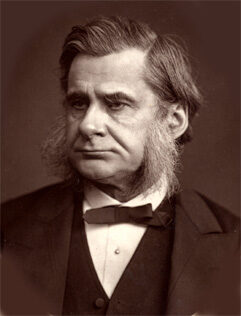
Thomas Henry Huxley
Thomas Henry Huxley was a British biologist and comparative anatomist. Born May 4, 1825, in Ealing. Died June 29, 1895, in Eastbourne. Positions held include President of the Geological Society of London (1868–1870), Member of the Privy Council of the United Kingdom and President of the Royal Society (1883–1885). Educated at University College London and Charing Cross Hospital. Awards include Copley Medal, Royal Medal and Darwin Medal.
Facts
67 facts · 2 confirmed by two sources · 30 cited · 35 from one source
Where this comes from
Papalocal keeps its own record. It started from these sources; what each one said is kept here as it was copied, so a change on their side never changes this page by itself. Tap one to read its version.
What Wikidata says · copied November 16, 2026 · revision 2558256369
- Described as
- British biologist and comparative anatomist (1825–1895)
- Other names
- Huxley, Prof. Huxley, T. H. Huxley
- Born
- May 4, 1825 · 16 references
- Died
- June 29, 1895 · 15 references
- Born in
- Ealing · 3 references
- Died in
- Eastbourne · 2 references
- Buried in
- East Finchley Cemetery · 1 reference
- Citizen of
- United Kingdom of Great Britain and Ireland
- Occupation
- biologist · 1 reference; linguist; paleontologist; translator; ichthyologist; zoologist · 1 reference; carcinologist; anatomist · 1 reference
- Positions held
- President of the Geological Society of London (1868–1870) · 1 reference; Member of the Privy Council of the United Kingdom; President of the Royal Society (1883–1885) · 1 reference; rector (1872–1875)
- Worked for
- Imperial College London
- Education
- University College London; Charing Cross Hospital · 1 reference; Charing Cross Hospital Medical School; Imperial College School of Medicine; Great Ealing School
- Member of
- Royal Society of London; German Academy of Sciences Leopoldina; Accademia Nazionale dei Lincei (1878–) · 1 reference; Saint Petersburg Academy of Sciences; Royal Swedish Academy of Sciences; Linnean Society of London; Geological Society of London; American Academy of Arts and Sciences; Royal Prussian Academy of Sciences; Royal Netherlands Academy of Arts and Sciences
- Awards
- Copley Medal (1888) · 1 reference; Royal Medal (1852); Darwin Medal (1894) · 1 reference; Knight of the Order of the Polar Star; Clarke Medal (1880); Linnean Medal (1890) · 1 reference; Hayden Memorial Geological Award (1893); Croonian Medal and Lecture (1858); Fellow of the Linnean Society of London (1858) · 1 reference; Wollaston Medal (1876) · 1 reference; Honorary Fellow of the Royal Society Te Apārangi (1872–) · 1 reference
- Field
- zoology; Vertebrata; evolution
- Spouse
- Henrietta Anne Heathorn Huxley (1855–) · 3 references
- Children
- Leonard Huxley · 2 references; Marian Huxley · 2 references; Noel Huxley · 1 reference; Jessie Orianna Huxley · 1 reference; Rachel Huxley · 1 reference; Henrietta Huxley · 2 references; Henry Huxley · 2 references; Ethel Gladys Huxley · 2 references
- Father
- George Huxley · 1 reference
- Mother
- Rachel Withers · 1 reference
- Siblings
- Eliza Huxley · 1 reference; Ellen Huxley · 1 reference; James Edward Huxley · 1 reference; George Knight Huxley · 1 reference; William Huxley · 1 reference
- Religion
- agnosticism
- Lived in
- London · 1 reference
- Nickname
- Darwin’s Bulldog
- Wikipedias with a page
- 110
Wikidata item Q184366 (wikidata.org/wiki/Q184366), public domain (CC0). Copied November 16, 2026.
What Wikipedia says · copied November 16, 2026 · revision 1384978861
Thomas Henry Huxley (4 May 1825 – 29 June 1895) was an English biologist and anthropologist who specialised in comparative anatomy. He has become known as "Darwin's Bulldog" for his advocacy of Charles Darwin's theory of evolution.
The stories regarding Huxley's famous 1860 Oxford evolution debate with Samuel Wilberforce were a key moment in the wider acceptance of evolution and in his own career, although some historians think that aspects of the surviving story of the debate are a later fabrication. Huxley had been planning to leave Oxford on the previous day, but, after an encounter with Robert Chambers, the author of Vestiges, he changed his mind and decided to join the debate. Wilberforce was coached by Richard Owen, against whom Huxley also debated about whether humans were closely related to apes.
Huxley was slow to accept some of Darwin's ideas, such as gradualism, and was undecided about natural selection, but despite this, he was wholehearted in his public support of Darwin. Instrumental in developing scientific education in Britain, he fought against the more extreme versions of religious tradition. Huxley coined the term agnosticism in 1869 and elaborated on it in 1889 to frame the nature of claims in terms of what is knowable and what is not.
Huxley had little formal schooling and was virtually self-taught. According to Edward Poulton, he became perhaps the finest comparative anatomist of the later 19th century. He worked on invertebrates, clarifying relationships between groups previously little understood. Later, he worked on vertebrates, especially on the relationship between non-human apes and humans. After comparing Archaeopteryx with Compsognathus, he correctly concluded that birds evolved from small carnivorous dinosaurs.
Huxley was best known for his controversial and energetic advocacy of evolution, which had significant effects on society in Britain and elsewhere. Huxley's 1893 Romanes Lecture, "Evolution and Ethics", is influential in China; the Chinese translation of Huxley's lecture transformed the Chinese translation of Darwin's On the Origin of Species.
Huxley was a member of the Huxley family, a prominent British family of scientists, writers, and public figures. He married Henrietta Anne Heathorn in 1855, and the couple had eight children.
- Born, in its opening lines
- May 4, 1825
- Died, in its opening lines
- June 29, 1895
From the Wikipedia article “Thomas Henry Huxley” (en.wikipedia.org/wiki/Thomas_Henry_Huxley), by its contributors, under CC BY-SA 4.0 (creativecommons.org/licenses/by-sa/4.0/). Copied November 16, 2026; not changed.
Confirmed Two sources agree. Cited One source, and it names where it got it. One source One source, without a reference of its own. Sources disagree The sources disagree. We show the best-supported value and keep theirs below.
