
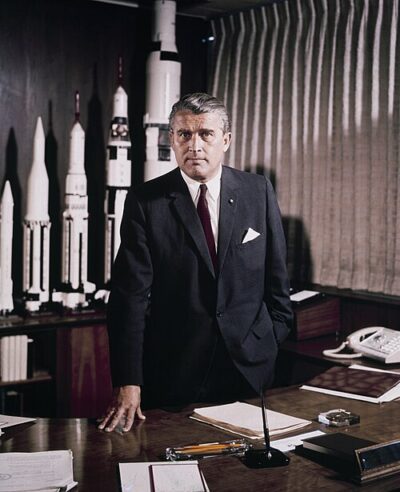
Wernher von Braun
Wernher von Braun was a German and later American aerospace engineer and space architect. Born March 23, 1912, in Wyrzysk. Died June 16, 1977, in Alexandria. Educated at ETH Zurich and Technische Universität Berlin. Awards include Commander's Cross of the Order of Merit of the Federal Republic of Germany, Werner von Siemens Ring and Rudolf-Diesel-Medaille.
Facts
62 facts · 2 confirmed by two sources · 16 cited · 43 from one source · 1 where the sources disagree
What’s different
- Cause of death: we show pancreatic cancer (Sources disagree). Wikidata also lists liver cancer
Where this comes from
Papalocal keeps its own record. It started from these sources; what each one said is kept here as it was copied, so a change on their side never changes this page by itself. Tap one to read its version.
What Wikipedia says · copied November 13, 2026 · revision 1385478864
Wernher Magnus Maximilian Freiherr von Braun (US: VUR-nər von BROWN; German: [ˈvɛʁnheːɐ̯ fɔn ˈbʁaʊn]; 23 March 1912 – 16 June 1977) was a German-American aerospace engineer and space architect. He led the development of German rocket technology in World War II, during which time he became a member of the Nazi Party and later the Allgemeine SS. Following the war, he relocated to the United States, developing missiles for the US Army and later designing rockets for NASA's Apollo program.
As a young man, von Braun worked in Nazi Germany's rocket development program. He helped design and co-developed the V-2 rocket at Peenemünde Army Research Center during World War II. The V-2 became the first artificial object to travel into space by crossing the Kármán line on 20 June 1944. Following the war, he was secretly moved to the United States, along with about 1,600 other German scientists, engineers, and technicians, as part of Operation Paperclip. He worked for the United States Army on an intermediate-range ballistic missile program, and he developed the rockets that launched the United States' first space satellite Explorer 1 in 1958. He worked with Walt Disney on a series of films, which popularized the idea of human space travel in the US and beyond from 1955 to 1957.
In 1960, his group was assimilated into NASA, where he served as director of the newly formed Marshall Space Flight Center and as the chief architect of the Saturn V super heavy-lift launch vehicle that propelled the Apollo spacecraft to the Moon. In 1967, von Braun was inducted into the National Academy of Engineering, and in 1975, he received the National Medal of Science.
Von Braun is seen by some as escaping justice for his participation in Nazi war crimes due to the Americans' desire to beat the Soviets in the Cold War. He is also sometimes described as the "father of space travel", the "father of rocket science", or the "father of the American lunar program". Towards the end of his career, he also advocated a human mission to Mars.
- Born, in its opening lines
- March 23, 1912
- Died, in its opening lines
- June 16, 1977
From the Wikipedia article “Wernher von Braun” (en.wikipedia.org/wiki/Wernher_von_Braun), by its contributors, under CC BY-SA 4.0 (creativecommons.org/licenses/by-sa/4.0/). Copied November 13, 2026; not changed.
What Wikidata says · copied November 14, 2026 · revision 2569127684
- Described as
- German and later American aerospace engineer and space architect (1912–1977)
- Other names
- Werner von Braun, Wernher Magnus Maximilian Freiherr von Braun
- Born
- March 23, 1912 · 15 references
- Died
- June 16, 1977 · 14 references
- Born in
- Wyrzysk · 2 references
- Died in
- Alexandria · 1 reference
- Buried in
- Ivy Hill Cemetery
- Cause of death
- pancreatic cancer; liver cancer
- Name at birth
- Wernher Magnus Maximilian Freiherr von Braun
- Citizen of
- Nazi Germany; United States (1955–); German Empire; Weimar Republic
- Occupation
- physicist; military flight engineer; non-fiction writer; inventor; military personnel; design engineer · 1 reference; engineer · 1 reference
- Political party
- Nazi Party (1937–1945)
- Worked for
- United States Army · 1 reference; National Aeronautics and Space Administration · 1 reference; Fairchild · 1 reference; Wehrmacht; Waffenamt
- Education
- ETH Zurich (1930–); Technische Universität Berlin (1930–1932); Humboldt-Universität zu Berlin (–1934); Französisches Gymnasium Berlin; Hermann Lietz-Schule Spiekeroog (–1930)
- Member of
- Schutzstaffel (1940–1945) · 1 reference
- Instrument
- cello; piano
- Awards
- Commander's Cross of the Order of Merit of the Federal Republic of Germany (1959) · 1 reference; Werner von Siemens Ring (1975); Rudolf-Diesel-Medaille; National Medal of Science (1975); Elliott Cresson Medal (1962) · 1 reference; NASA Distinguished Service Medal (1969) · 1 reference; Dr. Robert H. Goddard Memorial Trophy (1958); Langley Gold Medal (1967); Wilhelm Exner Medal (1969) · 1 reference; National Aviation Hall of Fame (1982) · 1 reference; Honorary doctor of the Technical University of Berlin; Knight's Cross of the War Merit Cross with Swords (1944) · 1 reference; Knight Commander's Cross of the Order of Merit of the Federal Republic of Germany (1970); Maxwell Lecture (1974); International Space Hall of Fame (1976) · 2 references
- Field
- aerospace engineering
- Spouse
- Maria von Braun
- Children
- Margrit von Braun
- Father
- Magnus von Braun · 1 reference
- Mother
- Emmy von Braun
- Siblings
- Magnus von Braun; Sigismund von Braun · 1 reference
- Religion
- Lutheranism (–1946)
- Military branch
- Schutzstaffel (1937–1945)
- Military rank
- Sturmbannführer (1943–)
- Lived in
- Washington, D.C. (1970–); Berlin; Huntsville; Peenemünde; Alexandria
- Wikipedias with a page
- 108
Wikidata item Q57384 (wikidata.org/wiki/Q57384), public domain (CC0). Copied November 14, 2026.
Confirmed Two sources agree. Cited One source, and it names where it got it. One source One source, without a reference of its own. Sources disagree The sources disagree. We show the best-supported value and keep theirs below.
