
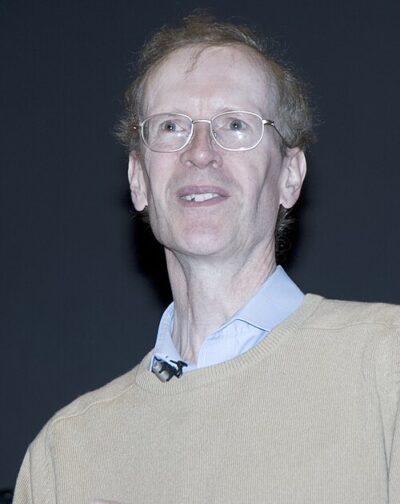
Andrew Wiles
Andrew Wiles is an English mathematician. Born April 11, 1953, in Cambridge. Known for Modular Elliptic Curves and Fermat's Last Theorem. Educated at Clare College and Merton College. Awards include Whitehead Prize, Fellow of the Royal Society and Fermat Prize.
Facts
42 facts · 1 confirmed by two sources · 22 cited · 19 from one source
Where this comes from
Papalocal keeps its own record. It started from these sources; what each one said is kept here as it was copied, so a change on their side never changes this page by itself. Tap one to read its version.
What Wikidata says · copied November 16, 2026 · revision 2568210471
- Described as
- English mathematician (1953–)
- Other names
- Sir Andrew John Wiles, Andrew John Wiles, Andrew J. Wiles, Dr. Andrew Wiles, Prof. Sir Andrew Wiles FRS
- Born
- April 11, 1953 · 5 references
- Born in
- Cambridge · 3 references
- Citizen of
- United Kingdom
- Occupation
- mathematician; university teacher
- Worked for
- Princeton University; University of Cambridge (1975–1981); Harvard University (1977–1980); Institute for Advanced Study · 1 reference
- Education
- Clare College; Merton College (1971–1974) · 1 reference; University of Cambridge (–1980) · 2 references; King's College School · 1 reference; The Leys School · 1 reference
- Member of
- Royal Society of London (1989–) · 1 reference; French Academy of Sciences (1998–) · 1 reference; National Academy of Sciences (1996–) · 1 reference; American Academy of Arts and Sciences (1994–) · 1 reference; Academia Europaea (2015–) · 1 reference; American Philosophical Society (1997–) · 1 reference
- Known for
- Modular Elliptic Curves and Fermat's Last Theorem · 1 reference
- Awards
- Whitehead Prize (1988) · 1 reference; Fellow of the Royal Society (1989) · 1 reference; Fermat Prize (1995) · 1 reference; Rolf Schock Prize in Mathematics (1995) · 1 reference; Ostrowski Prize (1996) · 1 reference; Royal Medal (1996) · 1 reference; Wolf Prize in Mathematics · 1 reference; MacArthur Fellows Program (1997); King Faisal Prize in Science (1998) · 1 reference; Clay Research Award (1999) · 1 reference; Knight Commander of the Order of the British Empire (1999) · 1 reference; Abel Prize (2016) · 1 reference; Copley Medal (2017) · 1 reference; Guggenheim Fellowship (1985) · 1 reference; Cole Prize in Number Theory (1997) · 1 reference
- Field
- number theory
- Father
- Maurice Wiles
- Mother
- Paddy Mowll · 1 reference
- Lived in
- United Kingdom (–1982) · 1 reference; United States (1982–); Princeton · 1 reference
- Wikipedias with a page
- 69
Wikidata item Q184433 (wikidata.org/wiki/Q184433), public domain (CC0). Copied November 16, 2026.
What Wikipedia says · copied November 16, 2026 · revision 1384512534
Sir Andrew John Wiles (born 11 April 1953) is an English mathematician and a Royal Society research professor at the University of Oxford, specialising in number theory. He is best known for proving Fermat's Last Theorem, for which he was awarded the 2016 Abel Prize and the 2017 Copley Medal and for which he was appointed a Knight Commander of the Order of the British Empire in 2000. In 2018, Wiles was appointed the first Regius Professor of Mathematics at Oxford. Wiles is also a 1997 MacArthur Fellow.
Wiles was born in Cambridge to theologian Maurice Frank Wiles and Patricia Wiles. While spending much of his childhood in Nigeria, Wiles developed an interest in mathematics and in Fermat's Last Theorem in particular. After moving to Oxford and graduating from there in 1974, he worked on unifying Galois representations, elliptic curves and modular forms, starting with Barry Mazur's generalizations of Iwasawa theory. In the early 1980s, Wiles spent a few years at the University of Cambridge before moving to Princeton University, where he worked on expanding out and applying Hilbert modular forms. In 1986, upon reading Ken Ribet's seminal work on Fermat's Last Theorem, Wiles set out to prove the modularity theorem for semistable elliptic curves, which implied Fermat's Last Theorem. By 1993, he had been able to convince a knowledgeable colleague that he had a proof of Fermat's Last Theorem, though a flaw was subsequently discovered. After an insight on 19 September 1994, Wiles and his student Richard Taylor were able to circumvent the flaw, and published the results in 1995, to widespread acclaim.
In proving Fermat's Last Theorem, Wiles developed new tools for mathematicians to begin unifying disparate ideas and theorems. His former student Taylor along with three other mathematicians were able to prove the full modularity theorem by 2000, using Wiles's work. Upon receiving the Abel Prize in 2016, Wiles reflected on his legacy, expressing his belief that he did not just prove Fermat's Last Theorem, but pushed the whole of mathematics as a field towards the Langlands program of unifying number theory.
- Born, in its opening lines
- April 11, 1953
From the Wikipedia article “Andrew Wiles” (en.wikipedia.org/wiki/Andrew_Wiles), by its contributors, under CC BY-SA 4.0 (creativecommons.org/licenses/by-sa/4.0/). Copied November 16, 2026; not changed.
Confirmed Two sources agree. Cited One source, and it names where it got it. One source One source, without a reference of its own. Sources disagree The sources disagree. We show the best-supported value and keep theirs below.
