
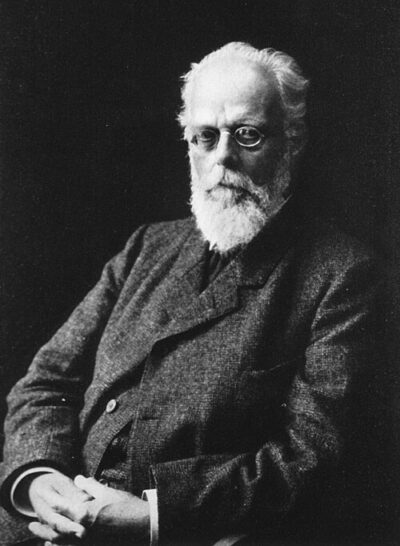
August Weismann
August Weismann was a German evolutionary biologist. Born January 17, 1834, in Frankfurt. Died November 5, 1914, in Freiburg im Breisgau. Positions held include Geheimrat. Educated at University of Göttingen. Awards include Darwin Medal, Cothenius Medal and Darwin–Wallace Medal.
Facts
40 facts · 2 confirmed by two sources · 16 cited · 22 from one source
Where this comes from
Papalocal keeps its own record. It started from these sources; what each one said is kept here as it was copied, so a change on their side never changes this page by itself. Tap one to read its version.
What Wikidata says · copied November 16, 2026 · revision 2568901098
- Described as
- German evolutionary biologist (1834-1914)
- Other names
- August Friedrich Leopold Weismann, Friedrich Leopold August Weismann, Weism.
- Born
- January 17, 1834 · 8 references
- Died
- November 5, 1914 · 6 references
- Born in
- Frankfurt · 3 references
- Died in
- Freiburg im Breisgau · 2 references
- Buried in
- Hauptfriedhof Freiburg
- Name at birth
- Friedrich Leopold August Weismann
- Citizen of
- Kingdom of Prussia
- Occupation
- zoologist · 1 reference; geneticist; physician · 2 references; evolutionary biologist · 1 reference; botanist; director · 1 reference
- Positions held
- Geheimrat
- Worked for
- University of Freiburg
- Education
- University of Göttingen
- Member of
- Royal Society of London (1910–); German Academy of Sciences Leopoldina; Royal Swedish Academy of Sciences; Heidelberg Academy of Sciences and Humanities (1909–) · 1 reference; Royal Physiographic Society in Lund; Austrian Academy of Sciences; Bavarian Academy of Sciences and Humanities (1884–); Royal Prussian Academy of Sciences (1897–); National Academy of Sciences (1913–); Academy of Sciences of Turin (1905–) · 1 reference
- Awards
- Darwin Medal (1908) · 1 reference; Cothenius Medal (1876); Darwin–Wallace Medal (1908) · 1 reference; Bavarian Maximilian Order for Science and Art (1894); Foreign Member of the Royal Society (1910) · 1 reference
- Field
- biology; medicine · 1 reference; zoology · 1 reference; evolutionary biology · 1 reference; genetics
- Children
- Julius Weismann · 1 reference; Theresia Schepp
- Father
- Jean Weismann · 1 reference
- Mother
- Elise Lübbren · 1 reference
- Wikipedias with a page
- 51
Wikidata item Q76465 (wikidata.org/wiki/Q76465), public domain (CC0). Copied November 16, 2026.
What Wikipedia says · copied November 16, 2026 · revision 1370696963
August Friedrich Leopold Weismann (German: [ˈvaɪsman]; 17 January 1834 – 5 November 1914) was a German evolutionary biologist. Fellow German Ernst Mayr ranked him as the second most notable evolutionary theorist of the 19th century, after Charles Darwin. Weismann became the Director of the Zoological Institute and the first Professor of Zoology at Freiburg.
His main contribution involved germ plasm theory, at one time also known as Weismannism, according to which inheritance (in a multicellular animal) only takes place by means of the germ cells—the gametes such as egg cells and sperm cells. Other cells of the body—somatic cells—do not function as agents of heredity. The effect is one-way: germ cells produce somatic cells and are not affected by anything the somatic cells learn or therefore any ability an individual acquires during its life. Genetic information cannot pass from soma to germ plasm and on to the next generation. Biologists refer to this concept as the Weismann barrier. This idea, if true, rules out the inheritance of acquired characteristics as proposed by Jean-Baptiste Lamarck. However, a careful reading of Weismann's work over the span of his entire career shows that he had more nuanced views, insisting, like Darwin, that a variable environment was necessary to cause variation in the hereditary material.
The idea of the Weismann barrier is central to the modern synthesis of the early 20th century, though scholars do not express it today in the same terms. In Weismann's opinion the largely random process of mutation, which must occur in the gametes (or stem cells that make them) is the only source of change for natural selection to work on. Weismann became one of the first biologists to deny Lamarckism entirely. Weismann's ideas preceded the rediscovery of Gregor Mendel's work, and though Weismann was cagey about accepting Mendelism, younger workers soon made the connection.
- Born, in its opening lines
- January 17, 1834
- Died, in its opening lines
- November 5, 1914
From the Wikipedia article “August Weismann” (en.wikipedia.org/wiki/August_Weismann), by its contributors, under CC BY-SA 4.0 (creativecommons.org/licenses/by-sa/4.0/). Copied November 16, 2026; not changed.
Confirmed Two sources agree. Cited One source, and it names where it got it. One source One source, without a reference of its own. Sources disagree The sources disagree. We show the best-supported value and keep theirs below.
