
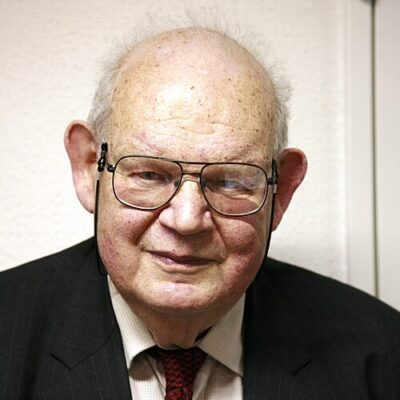
Benoit Mandelbrot
Benoit Mandelbrot was a Polish-born, French and American mathematician. Born November 20, 1924, in Warsaw. Died October 14, 2010, in Cambridge. Known for Mandelbrot set, Fractals: Form, Chance and Dimension and The Fractal Geometry of Nature. Educated at lycée du Parc and École polytechnique. Awards include Officer of the Legion of Honour, IBM Fellow and William Procter Prize for Scientific Achievement.
Facts
56 facts · 2 confirmed by two sources · 30 cited · 24 from one source
Where this comes from
Papalocal keeps its own record. It started from these sources; what each one said is kept here as it was copied, so a change on their side never changes this page by itself. Tap one to read its version.
What Wikipedia says · copied November 13, 2026 · revision 1383842883
Benoit B. Mandelbrot (20 November 1924 – 14 October 2010) was a Polish-born French-American mathematician and polymath with broad interests in the practical sciences, especially regarding what he labeled as "the art of roughness" of physical phenomena and "the uncontrolled element in life". He referred to himself as a "fractalist" and is recognized for his contribution to the field of fractal geometry, which included coining the word "fractal", as well as developing a theory of "roughness and self-similarity" in nature.
In 1936, at the age of 11, Mandelbrot and his family emigrated from Warsaw, Poland, to France. After World War II ended, Mandelbrot studied mathematics, graduating from universities in Paris and in the United States and receiving a master's degree in aeronautics from the California Institute of Technology. He spent most of his career in both the United States and France, having dual French and American citizenship. In 1958, he began a 35-year career at IBM, where he became an IBM Fellow, and periodically took leaves of absence to teach at Harvard University. At Harvard, following the publication of his study of U.S. commodity markets in relation to cotton futures, he taught economics and applied sciences.
Because of his access to IBM's computers, Mandelbrot was one of the first to use computer graphics to create and display fractal geometric images, leading to his discovery of the Mandelbrot set in 1979–1980. He showed how visual complexity can be created from simple rules. He said that things typically considered to be "rough", a "mess", or "chaotic", such as clouds or shorelines, actually had a "degree of order". His math- and geometry-centered research included contributions to such fields as statistical physics, meteorology, hydrology, geomorphology, anatomy, taxonomy, neurology, linguistics, information technology, computer graphics, economics, geology, medicine, physical cosmology, engineering, chaos theory, econophysics, metallurgy, and the social sciences.
Toward the end of his career, he was the Sterling Professor of Mathematical Sciences at Yale University, where he was the oldest professor in Yale's history to receive tenure.
Mandelbrot also held positions at the Pacific Northwest National Laboratory, Université Lille Nord de France, Institute for Advanced Study and Centre National de la Recherche Scientifique. During his career he received over 15 honorary doctorates, served on many science journals, and won numerous awards. His autobiography, The Fractalist: Memoir of a Scientific Maverick, was published posthumously in 2012.
- Born, in its opening lines
- November 20, 1924
- Died, in its opening lines
- October 14, 2010
From the Wikipedia article “Benoit Mandelbrot” (en.wikipedia.org/wiki/Benoit_Mandelbrot), by its contributors, under CC BY-SA 4.0 (creativecommons.org/licenses/by-sa/4.0/). Copied November 13, 2026; not changed.
What Wikidata says · copied November 14, 2026 · revision 2569023317
- Described as
- Polish-born, French and American mathematician (1924–2010)
- Other names
- Benoit B. Mandelbrot, Benoît Mandelbrot, Mandelbrot, B. B., Benoît B. Mandelbrot
- Born
- November 20, 1924 · 9 references
- Died
- October 14, 2010 · 9 references
- Born in
- Warsaw · 3 references
- Died in
- Cambridge · 3 references
- Buried in
- Grove Street Cemetery · 2 references
- Cause of death
- pancreatic cancer · 1 reference
- Citizen of
- Poland · 1 reference; France; United States
- Occupation
- mathematician · 5 references; economist; professor · 1 reference; scientist · 3 references; writer; computer scientist; engineer; university teacher · 2 references
- Worked for
- IBM (1958–1987) · 2 references; Yale University (1987–) · 1 reference; Institute for Advanced Study (1953–1954) · 2 references; University of Lille (1952–1953) · 1 reference; National Center for Scientific Research (1954–1958) · 1 reference; Pacific Northwest National Laboratory (2005–) · 1 reference
- Education
- lycée du Parc (1944); École polytechnique (1945–1947) · 1 reference; California Institute of Technology (1947–1949) · 1 reference; University of Paris (–1952) · 1 reference
- Member of
- College of 'Pataphysics; National Academy of Sciences (1987–) · 2 references; American Academy of Arts and Sciences (1982–) · 2 references; American Association for the Advancement of Science · 1 reference; Institute of Mathematical Statistics (1968–) · 1 reference; Econometric Society (1967–) · 1 reference; American Philosophical Society (2004–)
- Known for
- Mandelbrot set; Fractals: Form, Chance and Dimension; The Fractal Geometry of Nature; Zipf–Mandelbrot law
- Awards
- Officer of the Legion of Honour (1989) · 1 reference; IBM Fellow (1958) · 1 reference; William Procter Prize for Scientific Achievement (2002) · 1 reference; Wolf Prize in Physics (1993) · 2 references; Franklin Medal (1986) · 1 reference; Harvey Prize (1989) · 1 reference; John Scott Award (1999) · 1 reference; Japan Prize (2003) · 2 references; Humboldt Research Fellowship (1987) · 1 reference; honorary doctor of the University of St Andrews; Sterling Professor (1999) · 1 reference; honorary doctor of Tel Aviv University; Fellow of the American Physical Society; Humboldt Prize (1987) · 1 reference; Fellow of the Econometric Society (1967) · 1 reference
- Field
- fractal
- Spouse
- Aliette Kagan (1955–2010) · 3 references
- Website
- https://users.math.yale.edu/mandelbrot/
- Wikipedias with a page
- 82
Wikidata item Q101740 (wikidata.org/wiki/Q101740), public domain (CC0). Copied November 14, 2026.
Confirmed Two sources agree. Cited One source, and it names where it got it. One source One source, without a reference of its own. Sources disagree The sources disagree. We show the best-supported value and keep theirs below.
