
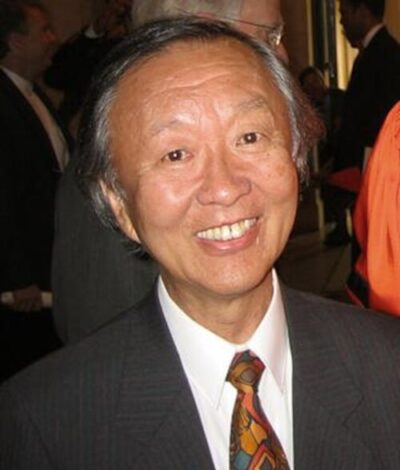
Charles K. Kao
Charles K. Kao was a Hong Kong-British-American physicist. Born November 4, 1933, in Shanghai. Died September 23, 2018, in Bradbury Hospice. Educated at University College London and University of Greenwich. Awards include IEEE Morris N. Liebmann Memorial Award, IEEE Alexander Graham Bell Medal and Marconi Prize.
Facts
54 facts · 2 confirmed by two sources · 30 cited · 22 from one source
Where this comes from
Papalocal keeps its own record. It started from these sources; what each one said is kept here as it was copied, so a change on their side never changes this page by itself. Tap one to read its version.
What Wikidata says · copied November 13, 2026 · revision 2563199506
- Described as
- Hong Kong-British-American physicist
- Other names
- Charles Kao, Charles Kuen Kao, Kuen Kao, Kao Kuen, Gao Kun, Sir Charles Kuen Kao, Sir Charles Kao Kuen
- Born
- November 4, 1933 · 7 references
- Died
- September 23, 2018 · 3 references
- Born in
- Shanghai · 2 references
- Died in
- Bradbury Hospice
- Cause of death
- Alzheimer's disease · 1 reference
- Citizen of
- United Kingdom · 1 reference; United States · 1 reference
- Occupation
- physicist · 1 reference; inventor; entrepreneur; electrical engineer · 1 reference; scientist · 1 reference; university teacher · 1 reference; executive · 1 reference
- Worked for
- Yale University; Imperial College London; Queen Mary University of London; The Chinese University of Hong Kong
- Education
- University College London; University of Greenwich; University of London · 1 reference
- Member of
- Royal Society of London (1997–) · 1 reference; Institute of Electrical and Electronics Engineers (1979–); European Academy of Sciences and Arts; Chinese Academy of Sciences (1996–) · 1 reference; Royal Swedish Academy of Engineering Sciences; Academia Sinica (1992–) · 1 reference; National Academy of Engineering (1990–) · 1 reference
- Awards
- IEEE Morris N. Liebmann Memorial Award (1978) · 1 reference; IEEE Alexander Graham Bell Medal (1985) · 1 reference; Marconi Prize (1985) · 1 reference; C&C Prize (1987) · 1 reference; Faraday Medal (1989) · 1 reference; James C. McGroddy Prize for New Materials (1989) · 1 reference; SPIE Gold Medal (1992) · 1 reference; Prince Philip Medal (1996) · 1 reference; Japan Prize (1996) · 1 reference; 3463 Kaokuen; Charles Stark Draper Prize (1999) · 1 reference; Asian of the Century; Nobel Prize in Physics (2009) · 2 references; Grand Bauhinia Medal (2010) · 1 reference; Knight Commander of the Order of the British Empire
- Field
- electrical engineering; telecommunications · 1 reference; optical fiber · 1 reference; glass fiber · 1 reference; data transmission · 1 reference; history of technology · 1 reference
- Father
- Kao Chun-Hsiang
- Lived in
- Hong Kong; Shanghai; London; Mountain View
- Wikipedias with a page
- 75
Wikidata item Q16389 (wikidata.org/wiki/Q16389), public domain (CC0). Copied November 13, 2026.
What Wikipedia says · copied November 13, 2026 · revision 1384631797
Sir Charles Kuen Kao (November 4, 1933 – September 23, 2018) was a Hong Kong electrical engineer who contributed to the development and use of fibre optics in telecommunications. In the 1960s, Kao created various methods to combine glass fibres with lasers in order to transmit digital data, which laid the groundwork for the evolution of the Internet and the eventual creation of the World Wide Web.
Born in 1933 in Shanghai, Kao and his family settled in Hong Kong in 1949. He graduated from St. Joseph's College in Hong Kong in 1952 and went to London to study electrical engineering. In the 1960s, he worked at Standard Telecommunication Laboratories, the research center of Standard Telephones and Cables (STC) in Harlow, and it was here in 1966 that he laid the groundwork for fibre optics in communication. Known as the "godfather of broadband," the "father of fibre optics," and the "father of fibre optic communications," he continued his work in Hong Kong at the Chinese University of Hong Kong, and in the United States at ITT (the parent corporation of STC) and Yale University.
In 2009, Kao was awarded the Nobel Prize in Physics "for groundbreaking achievements concerning the transmission of light in fibres for optical communication." The following year, he was knighted by Queen Elizabeth II "for services to fibre-optic communications."
Kao was a permanent resident of Hong Kong, and was a citizen of both the United Kingdom and the United States.
- Born, in its opening lines
- November 4, 1933
- Died, in its opening lines
- September 23, 2018
From the Wikipedia article “Charles K. Kao” (en.wikipedia.org/wiki/Charles_K._Kao), by its contributors, under CC BY-SA 4.0 (creativecommons.org/licenses/by-sa/4.0/). Copied November 13, 2026; not changed.
Confirmed Two sources agree. Cited One source, and it names where it got it. One source One source, without a reference of its own. Sources disagree The sources disagree. We show the best-supported value and keep theirs below.
