
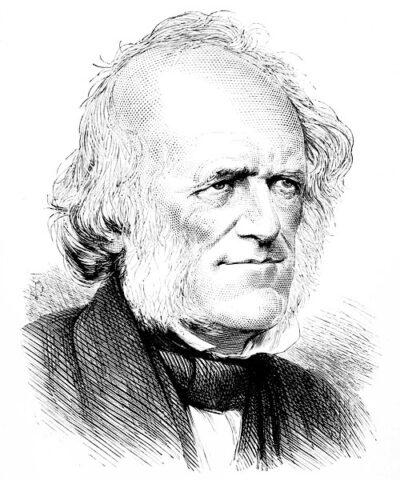
Charles Lyell
Charles Lyell was a British geologist. Born November 14, 1797, in Angus. Died February 22, 1875, in London. Positions held include President of the Geological Society of London (2 times) (1835–1851). Known for Principles of Geology. Educated at Exeter College. Awards include Fellow of the Royal Society, Copley Medal and Pour le Mérite for Sciences and Arts order.
Facts
48 facts · 2 confirmed by two sources · 17 cited · 29 from one source
Where this comes from
Papalocal keeps its own record. It started from these sources; what each one said is kept here as it was copied, so a change on their side never changes this page by itself. Tap one to read its version.
What Wikidata says · copied November 16, 2026 · revision 2568844730
- Described as
- British geologist (1797–1875)
- Other names
- Sir Charles Lyell, 1st Baronet, Sir Charles Lyell of Kinnordy, 1st and last Bt., Sir Charles Lyell
- Born
- November 14, 1797 · 11 references
- Died
- February 22, 1875 · 9 references
- Born in
- Angus · 1 reference
- Died in
- London · 2 references
- Buried in
- Westminster Abbey (1875–)
- Citizen of
- United Kingdom of Great Britain and Ireland
- Occupation
- geologist · 1 reference; lawyer; university teacher; paleontologist · 1 reference; writer · 1 reference; scientific collector · 1 reference; jurist · 1 reference
- Positions held
- President of the Geological Society of London (2 times) (1835–1851) · 1 reference
- Worked for
- King's College London; Lincoln's Inn (1825–)
- Education
- Exeter College (1816–1821)
- Member of
- Royal Society of London (1826–); German Academy of Sciences Leopoldina; Royal Swedish Academy of Sciences; Saint Petersburg Academy of Sciences; Hungarian Academy of Sciences; American Academy of Arts and Sciences; Russian Academy of Sciences; Royal Prussian Academy of Sciences; Bavarian Academy of Sciences and Humanities; Royal Netherlands Academy of Arts and Sciences · 1 reference
- Known for
- Principles of Geology
- Awards
- Fellow of the Royal Society; Copley Medal (1858) · 1 reference; Pour le Mérite for Sciences and Arts order; Royal Medal (1834); honorary doctor of the University of Vienna (1865) · 1 reference; Royal Society Bakerian Medal (1835) · 1 reference; Fellow of the American Academy of Arts and Sciences; Knight Bachelor; Wollaston Medal (1866) · 1 reference; Honorary Fellow of the Royal Society Te Apārangi (1873–) · 1 reference
- Field
- geology; archaeology
- Spouse
- Mary Horner Lyell (1832–) · 2 references
- Father
- Charles Lyell · 2 references
- Mother
- Frances Smith · 2 references
- Siblings
- Sophia Georgina Lyell · 1 reference; Marianne Lyell · 1 reference; Henry Lyell · 1 reference; Mary Lyell; Thomas Lyell
- Wikipedias with a page
- 61
Wikidata item Q5333 (wikidata.org/wiki/Q5333), public domain (CC0). Copied November 16, 2026.
What Wikipedia says · copied November 16, 2026 · revision 1382259136
Sir Charles Lyell, 1st Baronet (14 November 1797 – 22 February 1875) was a Scottish geologist who demonstrated the power of known natural causes in explaining the earth's history. He is best known today for his association with Charles Darwin and as the author of Principles of Geology (1830–33), which presented to a wide public audience the idea that the earth was shaped by the same natural processes still in operation today, operating at similar intensities. The philosopher William Whewell dubbed this gradualistic view "uniformitarianism" and contrasted it with catastrophism, which had been championed by Georges Cuvier and was better accepted in Europe. The combination of evidence and eloquence in Principles convinced a wide range of readers of the significance of "deep time" for understanding the earth and environment.
Lyell's scientific contributions included a pioneering explanation of climate change, in which shifting boundaries between oceans and continents could be used to explain long-term variations in temperature and rainfall. Lyell also gave influential explanations of earthquakes and developed the theory of gradual "backed up-building" of volcanoes. In stratigraphy his division of the Tertiary period into the Pliocene, Miocene, and Eocene was highly influential. He incorrectly conjectured that icebergs were the impetus behind the transport of glacial erratics, and that silty loess deposits might have settled out of flood waters. His creation of a separate period for human history, entitled the 'Recent', is widely cited as providing the foundations for the modern discussion of the Anthropocene.
Building on the innovative work of James Hutton and his follower John Playfair, Lyell favoured an indefinitely long age for the earth, despite evidence suggesting an old but finite age. He was a close friend of Charles Darwin, and contributed significantly to Darwin's thinking on the processes involved in evolution. As Darwin wrote in On the Origin of Species, "He who can read Sir Charles Lyell's grand work on the Principles of Geology, which the future historian will recognise as having produced a revolution in natural science, yet does not admit how incomprehensibly vast have been the past periods of time, may at once close this volume." Lyell helped to arrange the simultaneous publication in 1858 of papers by Darwin and Alfred Russel Wallace on natural selection, despite his personal religious qualms about the theory. He later published evidence from geology of the time man had existed on the earth.
- Born, in its opening lines
- November 14, 1797
- Died, in its opening lines
- February 22, 1875
From the Wikipedia article “Charles Lyell” (en.wikipedia.org/wiki/Charles_Lyell), by its contributors, under CC BY-SA 4.0 (creativecommons.org/licenses/by-sa/4.0/). Copied November 16, 2026; not changed.
Confirmed Two sources agree. Cited One source, and it names where it got it. One source One source, without a reference of its own. Sources disagree The sources disagree. We show the best-supported value and keep theirs below.
