
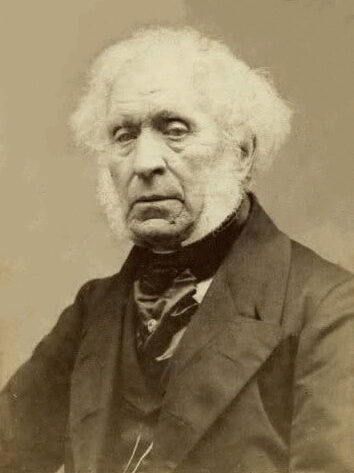
David Brewster
David Brewster was a Scottish astronomer and mathematician. Born December 11, 1781, in Jedburgh. Died February 10, 1868, in Melrose. Positions held include President of the Royal Society of Edinburgh (1864–1868). Known for Brewster stereoscope. Educated at University of Edinburgh. Awards include Fellow of the Royal Society, Copley Medal and Pour le Mérite for Sciences and Arts order.
Facts
51 facts · 2 confirmed by two sources · 13 cited · 36 from one source
Where this comes from
Papalocal keeps its own record. It started from these sources; what each one said is kept here as it was copied, so a change on their side never changes this page by itself. Tap one to read its version.
What Wikidata says · copied November 16, 2026 · revision 2557851075
- Described as
- Scottish astronomer and mathematician (1781–1868)
- Other names
- Brewster, Sir David Brewster
- Born
- December 11, 1781 · 10 references
- Died
- February 10, 1868 · 9 references
- Born in
- Jedburgh · 2 references
- Died in
- Melrose · 1 reference
- Buried in
- Melrose Abbey · 1 reference
- Citizen of
- United Kingdom of Great Britain and Ireland; United Kingdom · 1 reference
- Occupation
- botanist; civil engineer; physicist · 1 reference; mathematician; astronomer; philosopher; inventor; writer
- Positions held
- President of the Royal Society of Edinburgh (1864–1868)
- Worked for
- University of St Andrews
- Education
- University of Edinburgh
- Member of
- Royal Society of London; Royal Swedish Academy of Sciences; French Academy of Sciences; Saint Petersburg Academy of Sciences; American Academy of Arts and Sciences; Royal Irish Academy; Russian Academy of Sciences; Royal Prussian Academy of Sciences; Royal Society of Edinburgh; American Antiquarian Society
- Known for
- Brewster stereoscope
- Awards
- Fellow of the Royal Society; Copley Medal (1815) · 1 reference; Pour le Mérite for Sciences and Arts order; Royal Medal (1830); Rumford Medal (1818) · 1 reference; Grand prix des sciences mathématiques (1816); Keith Medal (1829); Fellow of the American Academy of Arts and Sciences; Knight Bachelor; Fellow of the Society of Antiquaries of Scotland
- Field
- botany; physics · 1 reference; mathematics · 1 reference; astronomy · 1 reference
- Spouse
- Jane Kirke Pernell · 1 reference; Juliet Macpherson · 1 reference
- Children
- Constance Marion Brewster · 1 reference; David Brewster Macpherson · 1 reference; Margaret Maria Gordon; Henry Craigie Brewster · 1 reference
- Father
- James Brewster · 1 reference
- Mother
- Margaret Key · 1 reference
- Wikipedias with a page
- 64
Wikidata item Q168468 (wikidata.org/wiki/Q168468), public domain (CC0). Copied November 16, 2026.
What Wikipedia says · copied November 16, 2026 · revision 1382985924
Sir David Brewster (11 December 1781 – 10 February 1868) was a British scientist, inventor, author, and academic administrator. In science he is principally remembered for his experimental work in physical optics, mostly concerned with the study of the polarization of light and including the discovery of Brewster's angle. He studied the birefringence of crystals under compression and discovered photoelasticity, thereby creating the field of optical mineralogy. For this work, William Whewell dubbed him the "father of modern experimental optics" and "the Johannes Kepler of optics."
Brewster was a pioneer in photography. He invented an improved stereoscope, which he called "lenticular stereoscope" and which became the first portable 3D-viewing device. He also invented the stereoscopic camera, two types of polarimeters, the polyzonal lens, the lighthouse illuminator, and the kaleidoscope.
Brewster was a devout Presbyterian and marched arm-in-arm with his brother during the events of the Disruption of 1843, which led to the formation of the Free Church of Scotland. As a historian of science, Brewster focused on the life and work of his hero, Isaac Newton. Brewster published a detailed biography of Newton in 1831 and later became the first scholar to examine many of the papers in Newton's Nachlass (the unpublished documents left after his death). Brewster also wrote numerous works of popular science, and was one of the founders of the British Science Association, of which he was elected president in 1849. He became the public face of higher education in Scotland, serving as Principal of the University of St Andrews (1837–1859) and later of the University of Edinburgh (1859–1868). Brewster also edited the 18-volume Edinburgh Encyclopædia.
- Born, in its opening lines
- December 11, 1781
- Died, in its opening lines
- February 10, 1868
From the Wikipedia article “David Brewster” (en.wikipedia.org/wiki/David_Brewster), by its contributors, under CC BY-SA 4.0 (creativecommons.org/licenses/by-sa/4.0/). Copied November 16, 2026; not changed.
Confirmed Two sources agree. Cited One source, and it names where it got it. One source One source, without a reference of its own. Sources disagree The sources disagree. We show the best-supported value and keep theirs below.
