
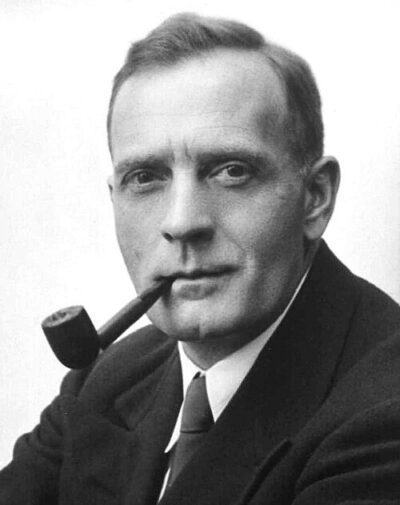
Edwin Hubble
Edwin Hubble was an American astronomer. Born November 20, 1889, in Marshfield. Died September 28, 1953, in San Marino. Known for Hubble–Lemaître law and Hubble sequence. Teams include Chicago Maroons baseball and Chicago Maroons men's basketball. Educated at University of Chicago and The Queen's College. Awards include Legionnaire of Legion of Merit, Gold Medal of the Royal Astronomical Society and Bruce Medal.
Facts
33 facts · 2 confirmed by two sources · 11 cited · 19 from one source · 1 where the sources disagree
What’s different
- Cause of death: we show silent stroke (Sources disagree). Wikidata also lists stroke
Where this comes from
Papalocal keeps its own record. It started from these sources; what each one said is kept here as it was copied, so a change on their side never changes this page by itself. Tap one to read its version.
What Wikidata says · copied November 13, 2026 · revision 2564646145
- Described as
- American astronomer (1889–1953)
- Other names
- E.P. Hubble, E. P. Hubble, Edwin P Hubble, Edwin Powell Hubble, Hubble, Edwin P. Hubble
- Born
- November 20, 1889 · 11 references
- Died
- September 28, 1953 · 9 references
- Born in
- Marshfield · 1 reference
- Died in
- San Marino · 1 reference
- Cause of death
- silent stroke; stroke
- Citizen of
- United States
- Occupation
- astronomer · 1 reference; astrophysicist; cosmologist
- Worked for
- Yerkes Observatory; Mount Wilson Observatory
- Education
- University of Chicago · 1 reference; The Queen's College; Wheaton Warrenville South High School · 1 reference
- Member of
- American Philosophical Society (1929–) · 1 reference; National Academy of Sciences (1927–); International Astronomical Union
- Teams
- Chicago Maroons baseball · 1 reference; Chicago Maroons men's basketball · 1 reference
- Known for
- Hubble–Lemaître law · 1 reference; Hubble sequence
- Awards
- Legionnaire of Legion of Merit (1946) · 1 reference; Gold Medal of the Royal Astronomical Society (1940) · 1 reference; Bruce Medal (1938) · 1 reference; Franklin Medal (1939) · 1 reference; Rhodes Scholarship (1910) · 1 reference; Indiana Basketball Hall of Fame (2017) · 1 reference; Barnard Medal for Meritorious Service to Science (1935) · 1 reference; Newcomb Cleveland Prize (1924) · 1 reference; Silliman Memorial Lectures (1935); International Space Hall of Fame (2001) · 2 references
- Field
- astronomy
- Spouse
- Grace Lillian Burke
- Wikipedias with a page
- 106
Wikidata item Q43027 (wikidata.org/wiki/Q43027), public domain (CC0). Copied November 13, 2026.
What Wikipedia says · copied November 13, 2026 · revision 1382501827
Edwin Powell Hubble (November 20, 1889 – September 28, 1953) was an American astronomer. He played a crucial role in establishing the fields of extragalactic astronomy and observational cosmology. Hubble proved that many objects previously thought to be clouds of dust and gas and classified as "nebulae" were actually galaxies beyond the Milky Way. He used the strong direct relationship between a classical Cepheid variable's luminosity and pulsation period (discovered in 1908 by Henrietta Swan Leavitt) for scaling galactic and extragalactic distances.
Hubble confirmed in 1929 that the recessional velocity of a galaxy increases with its distance from Earth, a behavior that became known as Hubble's law, although it had been proposed two years earlier by Georges Lemaître. The Hubble law implies that the universe is expanding. A decade before, American astronomer Vesto Slipher had provided the first evidence that the light from many of these nebulae was strongly red-shifted, indicative of high recession velocities.
Hubble's name is most widely recognized for the Hubble Space Telescope, which was named in his honor, with a model prominently displayed in his hometown of Marshfield, Missouri.
- Born, in its opening lines
- November 20, 1889
- Died, in its opening lines
- September 28, 1953
From the Wikipedia article “Edwin Hubble” (en.wikipedia.org/wiki/Edwin_Hubble), by its contributors, under CC BY-SA 4.0 (creativecommons.org/licenses/by-sa/4.0/). Copied November 13, 2026; not changed.
Confirmed Two sources agree. Cited One source, and it names where it got it. One source One source, without a reference of its own. Sources disagree The sources disagree. We show the best-supported value and keep theirs below.
