
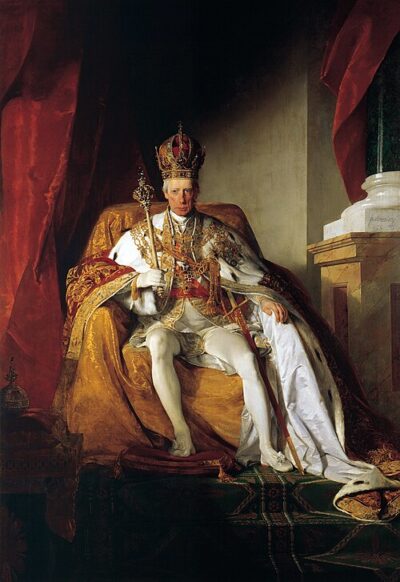
Francis II, Holy Roman Emperor
Francis II, Holy Roman Emperor was an also known as Francis I, Emperor of Austria. Born February 12, 1768, in Florence. Died March 2, 1835, in Vienna. Positions held include Holy Roman Emperor (1792–1806), Emperor of Austria (1804–1835) and Apostolic King of Hungary (1792–1835). Awards include Knight of the Order of the Holy Spirit, Knight of the Order of Saint Michael and Knight of the Order of the Golden Fleece.
Facts
57 facts · 2 confirmed by two sources · 14 cited · 41 from one source
Where this comes from
Papalocal keeps its own record. It started from these sources; what each one said is kept here as it was copied, so a change on their side never changes this page by itself. Tap one to read its version.
What Wikidata says · copied November 16, 2026 · revision 2569987075
- Described as
- also known as Francis I, Emperor of Austria (1768-1835)
- Other names
- Francis II, Francis I of Austria
- Born
- February 12, 1768 · 5 references
- Died
- March 2, 1835 · 10 references
- Born in
- Florence · 2 references
- Died in
- Vienna · 3 references
- Buried in
- Imperial Crypt
- Name at birth
- Franz Joseph Karl von Habsburg-Lothringen
- Citizen of
- Austrian Empire
- Occupation
- head of state
- Positions held
- Holy Roman Emperor (1792–1806) · 1 reference; Emperor of Austria (1804–1835) · 1 reference; Apostolic King of Hungary (1792–1835); King of Bohemia (1792–1835); Prince-Elector
- Awards
- Knight of the Order of the Holy Spirit; Knight of the Order of Saint Michael; Knight of the Order of the Golden Fleece; Grand Cross of the Military Order of Maria Theresa; Order of Saint Alexander Nevsky; Order of St. Andrew; Grand Cross of the Legion of Honour · 1 reference; Order of the Garter · 1 reference; Order of the Elephant · 1 reference; Order of Saint Januarius · 1 reference; Knight Grand Cross of the Order of Saint Joseph; Order of the Golden Fleece · 1 reference; Order of Saint Stephen of Hungary · 1 reference; Order of Leopold · 1 reference; Order of the Iron Crown (Kingdom of Italy) · 1 reference
- Spouse
- Duchess Elisabeth of Württemberg (1788–1790) · 2 references; Maria Theresa of Naples and Sicily (1790–1807) · 2 references; Maria Ludovika of Austria-Este (1808–1816) · 1 reference; Caroline Augusta of Bavaria (1816–1835) · 1 reference
- Children
- Marie Louise, Duchess of Parma; Ferdinand I of Austria · 1 reference; Maria Leopoldina of Austria; Archduchess Maria Clementina, Princess of Salerno; Archduke Joseph Franz of Austria · 1 reference; Archduchess Marie Caroline Ferdinanda of Austria; Archduke Franz Karl of Austria; Archduke Johann Nepomuk of Austria · 1 reference; Archduchess Ludovika Elisabeth of Austria · 1 reference; Archduchess Marie Caroline of Austria · 1 reference; Archduchess Caroline Ludovika of Austria · 1 reference; Archduchess Amalie Theresa of Austria · 1 reference
- Father
- Leopold II, Holy Roman Emperor
- Mother
- Maria Luisa of Spain
- Siblings
- Archduchess Maria Anna of Austria; Maria Clementina of Austria, Duchess of Calabria; Maria Theresa of Austria, Queen of Saxony; Louis of Austria; Ferdinand III, Grand Duke of Tuscany; Archduke Joseph, Palatine of Hungary; Archduke Rainer Joseph of Austria; Archduke Anton Victor of Austria; Archduke Alexander Leopold of Austria; Archduke Charles, Duke of Teschen
- Religion
- Catholic Church
- Wikipedias with a page
- 90
Wikidata item Q130834 (wikidata.org/wiki/Q130834), public domain (CC0). Copied November 16, 2026.
What Wikipedia says · copied November 16, 2026 · revision 1385607382
Francis II and I (German: Franz II; 12 February 1768 – 2 March 1835) was the last Holy Roman Emperor (as Francis II) from 1792 to 1806, and the first Emperor of Austria (as Francis I) from 1804 to 1835. He was also King of Germany, Hungary, Croatia and Bohemia, and served as the first president of the German Confederation following its establishment in 1815.
The eldest son of future Emperor Leopold II and Maria Luisa of Spain, Francis was born in Florence, where his father ruled as Grand Duke of Tuscany. Leopold became Holy Roman Emperor in 1790 but died two years later, and Francis succeeded him. At the time of Francis's accession, his empire was already embroiled in the French Revolutionary Wars, the first of which ended in Austrian defeat and the loss of the left bank of the Rhine to France. After another French victory in the War of the Second Coalition, Napoleon crowned himself Emperor of the French. In response, Francis assumed the title of Emperor of Austria. He continued his leading role as Napoleon's adversary in the Napoleonic Wars, and suffered successive defeats that greatly weakened Austria as a European power. In 1806, after Napoleon created the Confederation of the Rhine, Francis abdicated as Holy Roman Emperor, which in effect marked the dissolution of the Holy Roman Empire. Following the defeat of the Fifth Coalition, Francis ceded more territory to France and was forced to wed his daughter Marie Louise to Napoleon.
In 1813, Francis turned against Napoleon and finally defeated him in the War of the Sixth Coalition, forcing the French emperor to abdicate. Austria took part as a leading member of the Holy Alliance at the Congress of Vienna, which was largely dominated by Francis's chancellor Klemens von Metternich, culminating in a new European order and the restoration of most of Francis's ancient dominions. Due to the establishment of the Concert of Europe, which resisted popular nationalist and liberal tendencies, Francis was viewed as a reactionary later in his reign. Francis died in 1835 at the age of 67 and was succeeded by his son, Ferdinand I of Austria.
- Born, in its opening lines
- February 12, 1768
- Died, in its opening lines
- March 2, 1835
From the Wikipedia article “Francis II, Holy Roman Emperor” (en.wikipedia.org/wiki/Francis_II,_Holy_Roman_Emperor), by its contributors, under CC BY-SA 4.0 (creativecommons.org/licenses/by-sa/4.0/). Copied November 16, 2026; not changed.
Confirmed Two sources agree. Cited One source, and it names where it got it. One source One source, without a reference of its own. Sources disagree The sources disagree. We show the best-supported value and keep theirs below.
