
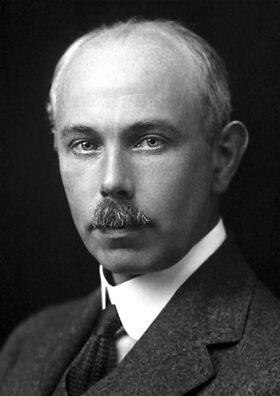
Francis William Aston
Francis William Aston was a British chemist. Born September 1, 1877, in Harborne. Died November 20, 1945, in Cambridge. Known for mass spectrometry. Educated at University of Birmingham and Trinity College. Awards include Nobel Prize in Chemistry, Hughes Medal and John Scott Award.
Facts
29 facts · 2 confirmed by two sources · 7 cited · 20 from one source
Where this comes from
Papalocal keeps its own record. It started from these sources; what each one said is kept here as it was copied, so a change on their side never changes this page by itself. Tap one to read its version.
What Wikidata says · copied November 16, 2026 · revision 2568703274
- Described as
- British chemist (1877-1945)
- Other names
- Francis Aston
- Born
- September 1, 1877 · 9 references
- Died
- November 20, 1945 · 11 references
- Born in
- Harborne · 1 reference
- Died in
- Cambridge · 5 references
- Citizen of
- United Kingdom · 3 references
- Occupation
- physicist; chemist · 3 references
- Worked for
- University of Oxford; University of Birmingham (1903–) · 1 reference
- Education
- University of Birmingham (1893–); Trinity College; Malvern College; University of London · 1 reference
- Member of
- Royal Society of London (1921–); Academy of Sciences of the USSR; Russian Academy of Sciences (1924–) · 1 reference; Accademia Nazionale dei Lincei (1927–) · 1 reference
- Known for
- mass spectrometry · 1 reference
- Awards
- Nobel Prize in Chemistry (1922) · 2 references; Hughes Medal (1922); John Scott Award (1923) · 1 reference; Royal Society Bakerian Medal (1927) · 1 reference; Dennis Gabor Medal and Prize (1944); Fellow of the Royal Society (1921) · 1 reference; Royal Medal (1938) · 1 reference; Liversidge Award (1932) · 1 reference; honorary doctor of the University of Calcutta
- Field
- chemistry · 1 reference; physics · 1 reference
- Wikipedias with a page
- 78
Wikidata item Q102291 (wikidata.org/wiki/Q102291), public domain (CC0). Copied November 16, 2026.
What Wikipedia says · copied November 16, 2026 · revision 1373307539
Francis William Aston FRS (1 September 1877 – 20 November 1945) was a British chemist and physicist who won the 1922 Nobel Prize in Chemistry for his discovery, by means of his mass spectrograph, of isotopes in many non-radioactive elements and for his enunciation of the whole number rule. He was a fellow of the Royal Society and Fellow of Trinity College, Cambridge.
- Born, in its opening lines
- September 1, 1877
- Died, in its opening lines
- November 20, 1945
From the Wikipedia article “Francis William Aston” (en.wikipedia.org/wiki/Francis_William_Aston), by its contributors, under CC BY-SA 4.0 (creativecommons.org/licenses/by-sa/4.0/). Copied November 16, 2026; not changed.
Confirmed Two sources agree. Cited One source, and it names where it got it. One source One source, without a reference of its own. Sources disagree The sources disagree. We show the best-supported value and keep theirs below.
