
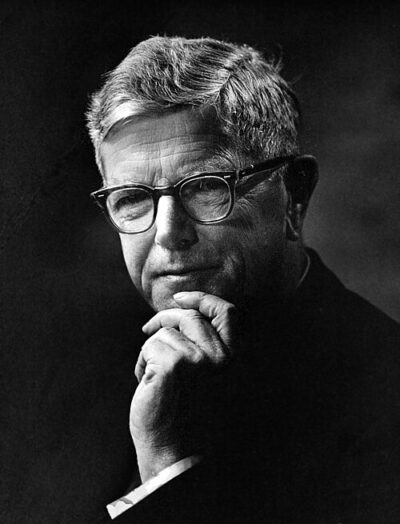
Frank Macfarlane Burnet
Frank Macfarlane Burnet was an Australian virologist. Born September 3, 1899, in Traralgon. Died August 31, 1985, in Melbourne. Educated at University of Melbourne and University of London. Awards include Albert Lasker Award for Basic Medical Research, Knight Commander of the Order of the British Empire and Copley Medal.
Facts
40 facts · 2 confirmed by two sources · 11 cited · 27 from one source
Where this comes from
Papalocal keeps its own record. It started from these sources; what each one said is kept here as it was copied, so a change on their side never changes this page by itself. Tap one to read its version.
What Wikidata says · copied November 16, 2026 · revision 2567725312
- Described as
- Australian virologist (1899-1985)
- Other names
- Frank Burnet, F. Macfarlane Burnet, Macfarlane Burnet, Sir Frank Macfarlane Burnet
- Born
- September 3, 1899 · 8 references
- Died
- August 31, 1985 · 7 references
- Born in
- Traralgon · 1 reference
- Died in
- Melbourne · 1 reference
- Cause of death
- cancer
- Citizen of
- Australia · 2 references
- Occupation
- immunologist · 1 reference; virologist; physician · 2 references; chemist; researcher
- Worked for
- University of Melbourne
- Education
- University of Melbourne; University of London · 1 reference
- Member of
- Royal Society of London; Royal Swedish Academy of Sciences; Australian Academy of Science · 1 reference; American Academy of Arts and Sciences; American Philosophical Society (1960–) · 1 reference; American Association for the Advancement of Science · 1 reference; National Academy of Sciences (1954–)
- Awards
- Albert Lasker Award for Basic Medical Research (1952) · 1 reference; Knight Commander of the Order of the British Empire (1969) · 1 reference; Copley Medal (1959) · 1 reference; Royal Medal (1947); Nobel Prize in Physiology or Medicine (1960) · 3 references; Emil-von-Behring-Prize (1952); Australian of the Year (1960); James Cook Medal (1954) · 1 reference; Mueller Medal (1962); Order of Merit (1958) · 1 reference; Order of the Rising Sun (1961); Queen Elizabeth II Coronation Medal (1953); Queen Elizabeth II Silver Jubilee Medal (1977); Knight Bachelor (1951) · 1 reference; Croonian Medal and Lecture (1950)
- Field
- immunology · 1 reference; virology · 1 reference
- Military rank
- knight
- Lived in
- Canterbury · 1 reference
- Wikipedias with a page
- 64
Wikidata item Q193550 (wikidata.org/wiki/Q193550), public domain (CC0). Copied November 16, 2026.
What Wikipedia says · copied November 16, 2026 · revision 1384050828
Sir Frank Macfarlane Burnet (3 September 1899 – 31 August 1985), usually known as Macfarlane or Mac Burnet, was an Australian virologist known for his contributions to immunology. He won a Nobel Prize in 1960 for predicting acquired immune tolerance. He also developed the theory of clonal selection.
Burnet received his Doctor of Medicine degree from the University of Melbourne in 1924, and his PhD from the University of London in 1928. He went on to conduct pioneering research in microbiology and immunology at the Walter and Eliza Hall Institute of Medical Research, Melbourne, and served as director of the Institute from 1944 to 1965. From 1965 until his retirement in 1978, Burnet worked at the University of Melbourne. Throughout his career he played an active role in the development of public policy for the medical sciences in Australia and was a founding member of the Australian Academy of Science (AAS), and served as its president from 1965 to 1969.
Burnet's major achievements in microbiology included discovering the causative agents of Q-fever and psittacosis; developing assays for the isolation, culture and detection of influenza virus; describing the recombination of influenza strains; demonstrating that the myxomatosis virus does not cause disease in humans. Modern methods for producing influenza vaccines are still based on Burnet's work improving virus growing processes in hen's eggs.
For his contributions to Australian science, Burnet was made the first Australian of the Year in 1960, and in 1978 a Knight of the Order of Australia. He was recognised internationally for his achievements: in addition to the Nobel, he received the Lasker Award and the Royal and Copley Medal from the Royal Society, honorary doctorates, and distinguished service honours from the Commonwealth of Nations and Japan.
- Born, in its opening lines
- September 3, 1899
- Died, in its opening lines
- August 31, 1985
From the Wikipedia article “Macfarlane Burnet” (en.wikipedia.org/wiki/Macfarlane_Burnet), by its contributors, under CC BY-SA 4.0 (creativecommons.org/licenses/by-sa/4.0/). Copied November 16, 2026; not changed.
Confirmed Two sources agree. Cited One source, and it names where it got it. One source One source, without a reference of its own. Sources disagree The sources disagree. We show the best-supported value and keep theirs below.
