
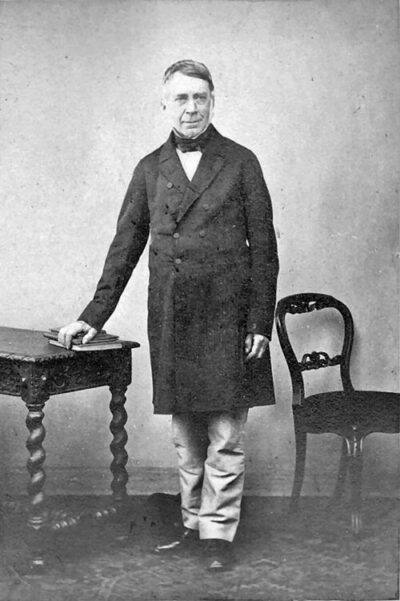
George Biddell Airy
George Biddell Airy was an English mathematician and astronomer. Born July 27, 1801, in Alnwick. Died January 2, 1892, in Greenwich. Positions held include Astronomer Royal (1835–1881), President of the Royal Society (1871–1873) and Lucasian Professor of Mathematics (1826–1828). Known for Airy beam, Airy disk and Airy function. Educated at Colchester Royal Grammar School and Trinity College. Awards include Fellow of the Royal Society, Knight Commander of the Order of the Bath and Copley Medal.
Facts
56 facts · 2 confirmed by two sources · 22 cited · 32 from one source
Where this comes from
Papalocal keeps its own record. It started from these sources; what each one said is kept here as it was copied, so a change on their side never changes this page by itself. Tap one to read its version.
What Wikidata says · copied November 16, 2026 · revision 2566135422
- Described as
- English mathematician and astronomer (1801-1892)
- Other names
- George Airy, Sir George Biddell Airy, Sir G. B. Airy
- Born
- July 27, 1801 · 13 references
- Died
- January 2, 1892 · 11 references
- Born in
- Alnwick · 1 reference
- Died in
- Greenwich · 1 reference
- Buried in
- Church of St Mary · 2 references
- Citizen of
- United Kingdom of Great Britain and Ireland
- Occupation
- mathematician · 1 reference; astronomer · 1 reference; physicist; university teacher; writer · 1 reference
- Positions held
- Astronomer Royal (1835–1881) · 2 references; President of the Royal Society (1871–1873) · 1 reference; Lucasian Professor of Mathematics (1826–1828); Plumian Professor of Astronomy and Experimental Philosophy (1828–1835) · 1 reference; President of the Royal Astronomical Society (4 times) (1835–1855)
- Worked for
- University of Cambridge (1823–1835) · 1 reference; Royal Observatory (1835–1881) · 1 reference
- Education
- Colchester Royal Grammar School (1814–1819) · 1 reference; Trinity College (1819–1823) · 1 reference
- Member of
- Royal Society of London (1836–); Royal Prussian Academy of Sciences; Royal Swedish Academy of Sciences; Bavarian Academy of Sciences and Humanities; Saint Petersburg Academy of Sciences; American Academy of Arts and Sciences; Royal Irish Academy; Russian Academy of Sciences; Royal Netherlands Academy of Arts and Sciences; Accademia Nazionale delle Scienze detta dei XL
- Known for
- Airy beam; Airy disk; Airy function; Airy points; Airy wave theory; Airy zeta function; Airy spheroid; Airy-Formel
- Awards
- Fellow of the Royal Society (1836) · 1 reference; Knight Commander of the Order of the Bath; Copley Medal (1831) · 1 reference; Pour le Mérite for Sciences and Arts order; Royal Medal (1845) · 1 reference; Gold Medal of the Royal Astronomical Society (1846) · 1 reference; Lalande Prize (1834) · 1 reference; Albert Medal (1876); Royal Society Bakerian Medal (1840) · 2 references; Fellow of the Royal Society of Edinburgh (1835) · 1 reference; Fellow of the American Academy of Arts and Sciences (1832) · 1 reference; Smith's Prize (1823) · 1 reference
- Field
- astronomy · 1 reference
- Children
- Wilfrid Airy · 1 reference; Hubert Airy · 1 reference; Christabel Airy · 1 reference; Hilda Routh; Osmund Airy · 1 reference
- Wikipedias with a page
- 53
Wikidata item Q20018 (wikidata.org/wiki/Q20018), public domain (CC0). Copied November 16, 2026.
What Wikipedia says · copied November 16, 2026 · revision 1384285178
Sir George Biddell Airy (; 27 July 1801 – 2 January 1892) was an English mathematician and astronomer, as well as the Lucasian Professor of Mathematics from 1826 to 1828 and the seventh Astronomer Royal from 1835 to 1881. His many achievements include work on planetary orbits, measuring the mean density of the Earth, a method of solution of two-dimensional problems in solid mechanics and, in his role as Astronomer Royal, establishing Greenwich as the location of the prime meridian.
- Born, in its opening lines
- July 27, 1801
- Died, in its opening lines
- January 2, 1892
From the Wikipedia article “George Biddell Airy” (en.wikipedia.org/wiki/George_Biddell_Airy), by its contributors, under CC BY-SA 4.0 (creativecommons.org/licenses/by-sa/4.0/). Copied November 16, 2026; not changed.
Confirmed Two sources agree. Cited One source, and it names where it got it. One source One source, without a reference of its own. Sources disagree The sources disagree. We show the best-supported value and keep theirs below.
