
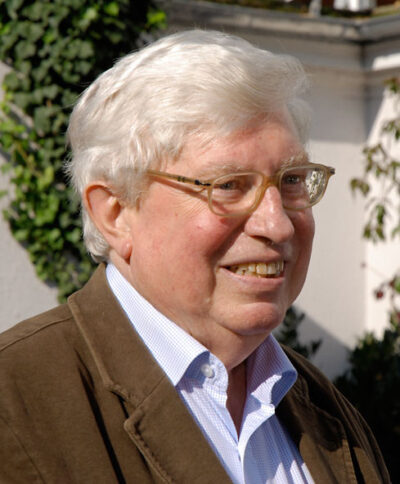
Gerhard Ertl
Gerhard Ertl is a German physicist. Born October 10, 1936, in Stuttgart. Educated at University of Stuttgart (2 times) and University of Paris. Awards include Order of Merit of Baden-Württemberg, Knight Commander's Cross of the Order of Merit of the Federal Republic of Germany and Faraday Lectureship Prize.
Facts
44 facts · 1 confirmed by two sources · 12 cited · 31 from one source
Where this comes from
Papalocal keeps its own record. It started from these sources; what each one said is kept here as it was copied, so a change on their side never changes this page by itself. Tap one to read its version.
What Wikidata says · copied November 16, 2026 · revision 2568185028
- Described as
- German physicist
- Other names
- Gerhard Ludwig Ertl, Gerhard L. Ertl, Gerhard L Ertl, G. L. Ertl, G L Ertl, G. Ertl, G Ertl, Ertl, Ertl G, Ertl G., Ertl G. L., Ertl GL
- Born
- October 10, 1936 · 5 references
- Born in
- Stuttgart · 4 references
- Citizen of
- Germany · 2 references
- Occupation
- physicist · 2 references; chemist · 3 references; university teacher · 1 reference
- Worked for
- LMU Munich; Leibniz University Hannover; Humboldt-Universität zu Berlin · 1 reference; Freie Universität Berlin · 1 reference
- Education
- University of Stuttgart (2 times) (1955–1961); University of Paris (1957–1958); LMU Munich (1958–1959); Technical University of Munich (–1965); Max Planck Institute for Intelligent Systems; Johannes-Kepler-Gymnasium
- Member of
- German Academy of Sciences Leopoldina (1986–) · 1 reference; Austrian Academy of Sciences; Pontifical Academy of Sciences (2010–); National Academy of Sciences (2002–); Bavarian Academy of Sciences and Humanities; North Rhine-Westphalia Academy for Sciences and Arts; Berlin-Brandenburg Academy of Sciences and Humanities; Academia Europaea (1992–) · 1 reference; Polish Academy of Sciences (2009–) · 1 reference; American Academy of Arts and Sciences
- Awards
- Order of Merit of Baden-Württemberg (2008); Knight Commander's Cross of the Order of Merit of the Federal Republic of Germany (2008) · 1 reference; Faraday Lectureship Prize (2007); Rudolf-Diesel-Medaille (2008); Nobel Prize in Chemistry (2007) · 2 references; Otto Hahn Prize (2007); Alwin Mittasch Prize (1990); Bavarian Maximilian Order for Science and Art (2014); Wolf Prize in Chemistry (1998) · 1 reference; Gottfried Wilhelm Leibniz Prize (1991); Honorary doctor of the Humboldt University of Berlin (2009) · 1 reference; Bunsen Medal (1992); Carl Engler Medal (1996) · 1 reference; Carl Friedrich Gauss Medal (1985); Liebig Medal (1987) · 1 reference
- Field
- chemistry · 1 reference
- Religion
- Christianity
- Lived in
- Germany
- Wikipedias with a page
- 65
Wikidata item Q60066 (wikidata.org/wiki/Q60066), public domain (CC0). Copied November 16, 2026.
What Wikipedia says · copied November 16, 2026 · revision 1383460024
Gerhard Ertl (German pronunciation: [ˈɡeːɐ̯haʁt ˈʔɛʁtl̩] ; born 10 October 1936) is a German physicist and a Professor emeritus at the Department of Physical Chemistry, Fritz-Haber-Institut der Max-Planck-Gesellschaft in Berlin, Germany. Ertl's research laid the foundation of modern surface chemistry, which has helped explain how fuel cells produce energy without pollution, how catalytic converters clean up car exhausts and even why iron rusts, the Royal Swedish Academy of Sciences said.
His work has paved the way for development of cleaner energy sources and will guide the development of fuel cells, said Astrid Graslund, secretary of the Nobel Committee for Chemistry.
He was awarded the 2007 Nobel Prize in Chemistry for his studies of chemical processes on solid surfaces. The Nobel academy said Ertl provided a detailed description of how chemical reactions take place on surfaces. His findings applied in both academic studies and industrial development, the academy said. “Surface chemistry can even explain the destruction of the ozone layer, as vital steps in the reaction actually take place on the surfaces of small crystals of ice in the stratosphere,” the award citation reads.
In 2015, Ertl signed the Mainau Declaration 2015 on Climate Change on the final day of the 65th Lindau Nobel Laureate Meeting. The declaration was signed by a total of 76 Nobel Laureates and handed to then-President of the French Republic, François Hollande, as part of the COP21 climate summit in Paris.
- Born, in its opening lines
- October 10, 1936
From the Wikipedia article “Gerhard Ertl” (en.wikipedia.org/wiki/Gerhard_Ertl), by its contributors, under CC BY-SA 4.0 (creativecommons.org/licenses/by-sa/4.0/). Copied November 16, 2026; not changed.
Confirmed Two sources agree. Cited One source, and it names where it got it. One source One source, without a reference of its own. Sources disagree The sources disagree. We show the best-supported value and keep theirs below.
