
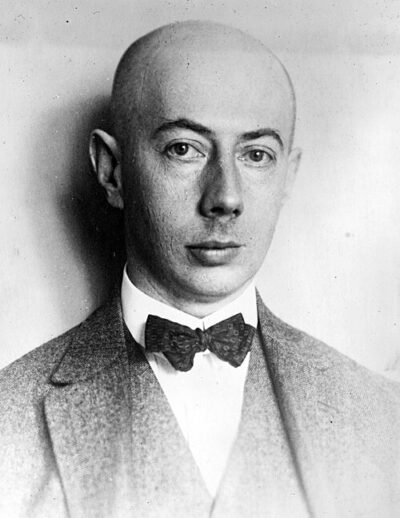
Gustav Ludwig Hertz
Gustav Ludwig Hertz was a German physicist. Born July 22, 1887, in Hamburg. Died October 30, 1975, in East Berlin. Known for Franck–Hertz experiment. Educated at Frederick William University Berlin and LMU Munich. Awards include Stalin Prize, Patriotic Order of Merit in Gold and Hervorragender Wissenschaftler des Volkes.
Facts
44 facts · 2 confirmed by two sources · 19 cited · 23 from one source
Where this comes from
Papalocal keeps its own record. It started from these sources; what each one said is kept here as it was copied, so a change on their side never changes this page by itself. Tap one to read its version.
What Wikidata says · copied November 16, 2026 · revision 2568752500
- Described as
- German physicist (1887–1975)
- Other names
- Gustav Hertz
- Born
- July 22, 1887 · 12 references
- Died
- October 30, 1975 · 12 references
- Born in
- Hamburg · 2 references
- Died in
- East Berlin · 1 reference
- Buried in
- Ohlsdorf Cemetery · 2 references
- Name at birth
- Gustav Ludwig Hertz
- Citizen of
- East Germany; Soviet Union; German Reich
- Occupation
- physicist · 1 reference; university teacher · 1 reference; mathematician · 1 reference
- Worked for
- Technische Universität Berlin (1928–1935) · 1 reference; Martin Luther University Halle-Wittenberg (1925–1928) · 1 reference; Humboldt-Universität zu Berlin (1913–1920) · 1 reference; Leipzig University (1954–1961) · 2 references; Koninklijke Philips NV (1920–1925) · 1 reference; Siemens (1935–1945) · 1 reference; Sokhumi Institute of Physics and Technology (1945–1954) · 1 reference
- Education
- Frederick William University Berlin (1909–1911) · 1 reference; LMU Munich (1908–1909) · 1 reference; University of Göttingen (1906–1908) · 2 references; Humboldt-Universität zu Berlin · 1 reference; Gelehrtenschule des Johanneums
- Member of
- German Academy of Sciences at Berlin; Saxon Academy of Sciences and Humanities (1955–); German Academy of Sciences Leopoldina; Academy of Sciences of the USSR; Hungarian Academy of Sciences; Russian Academy of Sciences; Göttingen Academy of Sciences and Humanities in Lower Saxony; Romanian Academy
- Known for
- Franck–Hertz experiment · 1 reference
- Awards
- Stalin Prize (1951); Patriotic Order of Merit in Gold; Hervorragender Wissenschaftler des Volkes (1959); National Prize of East Germany; Nobel Prize in Physics (1925) · 2 references; Max Planck Medal (1951); Helmholtz Medal (1959); Order of the Red Banner of Labour · 1 reference
- Field
- physics
- Spouse
- Ellen Dihlmann
- Children
- Carl Hellmuth Hertz · 1 reference
- Wikipedias with a page
- 89
Wikidata item Q57070 (wikidata.org/wiki/Q57070), public domain (CC0). Copied November 16, 2026.
What Wikipedia says · copied November 16, 2026 · revision 1372001875
Gustav Ludwig Hertz (German: [ˈɡʊstaf ˈluːtvɪç ˈhɛʁts] ; 22 July 1887 – 30 October 1975) was a German experimental physicist who shared the 1925 Nobel Prize in Physics with James Franck "for their discovery of the laws governing the impact of an electron upon an atom."
- Born, in its opening lines
- July 22, 1887
- Died, in its opening lines
- October 30, 1975
From the Wikipedia article “Gustav Ludwig Hertz” (en.wikipedia.org/wiki/Gustav_Ludwig_Hertz), by its contributors, under CC BY-SA 4.0 (creativecommons.org/licenses/by-sa/4.0/). Copied November 16, 2026; not changed.
Confirmed Two sources agree. Cited One source, and it names where it got it. One source One source, without a reference of its own. Sources disagree The sources disagree. We show the best-supported value and keep theirs below.
