
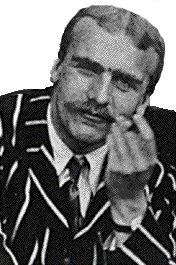
J.B.S. Haldane
J.B.S. Haldane was a Geneticist and evolutionary biologist. Born November 5, 1892, in Oxford. Died December 1, 1964, in Bhubaneswar. Known for population genetics. Educated at Dragon School and University of Oxford. Awards include Honorary doctor of the University of Groningen, Baly Medal and Croonian Medal and Lecture.
Facts
42 facts · 2 confirmed by two sources · 14 cited · 26 from one source
Where this comes from
Papalocal keeps its own record. It started from these sources; what each one said is kept here as it was copied, so a change on their side never changes this page by itself. Tap one to read its version.
What Wikidata says · copied November 16, 2026 · revision 2568781729
- Described as
- Geneticist and evolutionary biologist (1892-1964)
- Other names
- John Burdon Sanderson Haldane, J. B. S. Haldane
- Born
- November 5, 1892 · 15 references
- Died
- December 1, 1964 · 13 references
- Born in
- Oxford · 2 references
- Died in
- Bhubaneswar · 2 references
- Cause of death
- cancer
- Citizen of
- United Kingdom; India (1961–)
- Occupation
- biologist · 2 references; geneticist; physiologist · 1 reference; biochemist · 1 reference; university teacher; philosopher · 1 reference; scientific collector · 1 reference
- Worked for
- University College London
- Education
- Dragon School; University of Oxford
- Member of
- Royal Society of London; German Academy of Sciences at Berlin; German Academy of Sciences Leopoldina; Linnean Society of London; Russian Academy of Sciences (1942–) · 1 reference; National Academy of Sciences (1964–)
- Known for
- population genetics · 1 reference
- Awards
- Honorary doctor of the University of Groningen; Baly Medal (1913); Croonian Medal and Lecture (1946); doctor honoris causa from the University of Paris (1947) · 2 references; Darwin Medal (1952) · 1 reference; Darwin–Wallace Medal (1958) · 1 reference; honorary doctor of the University of Poitiers (1958) · 1 reference; Kimber Genetics Award (1961)
- Field
- biology
- Spouse
- Charlotte Haldane (1926–1945) · 1 reference; Helen Spurway (1946–) · 1 reference
- Father
- John Scott Haldane · 1 reference
- Mother
- Louisa Kathleen Trotter · 2 references
- Siblings
- Naomi Mitchison · 1 reference
- Religion
- Catholicism
- Military branch
- British Army
- Military rank
- captain · 1 reference
- Lived in
- Saumur · 1 reference
- Wikipedias with a page
- 62
Wikidata item Q156333 (wikidata.org/wiki/Q156333), public domain (CC0). Copied November 16, 2026.
What Wikipedia says · copied November 16, 2026 · revision 1384676826
John Burdon Sanderson Haldane (; 5 November 1892 – 1 December 1964), nicknamed "Jack" or "JBS", was a British-born scientist and polymath, and a foundational figure in the modern synthesis of evolutionary biology. He worked in the fields of physiology, genetics, evolutionary biology, and mathematics. With innovative use of statistics in biology, he was one of the founders of neo-Darwinism. Largely self-taught in biology, he held professorships at the University of Cambridge, the Royal Institution, and University College London. Renouncing his British citizenship, he became an Indian citizen in 1961 and worked at the Indian Statistical Institute until his death in 1964.
Haldane's article on abiogenesis in 1929 introduced the "primordial soup theory", which became the foundation for the concept of the chemical origin of life. He established human gene maps for haemophilia and colour blindness on the X chromosome, and codified Haldane's rule on sterility in the heterogametic sex of hybrids in species. He correctly proposed that sickle-cell disease confers some immunity to malaria. He was the first to suggest the central idea of in vitro fertilisation, as well as concepts such as hydrogen economy, cis and trans-acting regulation, coupling reaction, molecular repulsion, the darwin (as a unit of evolution), and organismal cloning.
In 1957, Haldane articulated Haldane's dilemma, a limit on the speed of beneficial evolution, an idea that is still debated today. He is also remembered for his work in human biology, having coined "clone", "cloning", and "ectogenesis". With his sister, Naomi Mitchison, Haldane was the first to demonstrate genetic linkage in mammals. Subsequent works established a unification of Mendelian genetics and Darwinian evolution by natural selection whilst laying the groundwork for modern synthesis, and helped to create population genetics.
Haldane served in World War I, and obtained the rank of captain. He was a professed socialist, Marxist, atheist, and secular humanist whose political dissent led him to leave England in 1956 and live in India, becoming a naturalised Indian citizen in 1961. Arthur C. Clarke credited him as "perhaps the most brilliant science populariser of his generation". Brazilian-British biologist and Nobel laureate Peter Medawar called Haldane "the cleverest man I ever knew". According to Theodosius Dobzhansky, "Haldane was always recognized as a singular case"; Ernst Mayr described him as a "polymath" (as did others); Michael J. D. White described him as "the most erudite biologist of his generation, and perhaps of the century"; James Watson described him as "England's most clever and eccentric biologist", and Sahotra Sarkar described him as "probably the most prescient biologist of this [20th] century". According to a Cambridge student, "he seemed to be the last man who might know all there was to be known". He willed his body for medical studies, as he wanted to remain useful even in death.
- Born, in its opening lines
- November 5, 1892
- Died, in its opening lines
- December 1, 1964
From the Wikipedia article “J. B. S. Haldane” (en.wikipedia.org/wiki/J._B._S._Haldane), by its contributors, under CC BY-SA 4.0 (creativecommons.org/licenses/by-sa/4.0/). Copied November 16, 2026; not changed.
Confirmed Two sources agree. Cited One source, and it names where it got it. One source One source, without a reference of its own. Sources disagree The sources disagree. We show the best-supported value and keep theirs below.
