
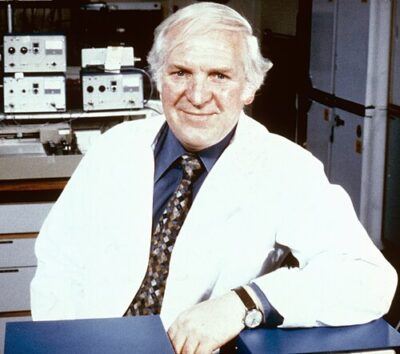
James Black
James Black was a Scottish doctor and pharmacologist. Born June 14, 1924, in Uddingston. Died March 21, 2010, in London. Positions held include chancellor (1992–2006). Educated at University of St Andrews and University of Dundee. Awards include InBev-Baillet Latour Health Prize, Lasker-DeBakey Clinical Medical Research Award and Canada Gairdner International Award.
Facts
45 facts · 1 confirmed by two sources · 11 cited · 32 from one source · 1 where the sources disagree
What’s different
- Died: we show March 21, 2010 (Sources disagree). Wikipedia says March 22, 2010
Where this comes from
Papalocal keeps its own record. It started from these sources; what each one said is kept here as it was copied, so a change on their side never changes this page by itself. Tap one to read its version.
What Wikidata says · copied November 16, 2026 · revision 2568990693
- Described as
- Scottish doctor and pharmacologist (1924–2010)
- Other names
- Sir James Whyte Black, James Whyte Black, Sir James Black, J. Black, J.W. Black
- Born
- June 14, 1924 · 8 references
- Died
- March 21, 2010 · 1 reference
- Born in
- Uddingston
- Died in
- London · 1 reference
- Buried in
- Burial Ground, Ardclach Old Parish Church · 1 reference
- Cause of death
- prostate cancer
- Name at birth
- James Whyte Black
- Citizen of
- United Kingdom
- Occupation
- physician; pharmacologist · 1 reference; pharmacist; inventor; cardiologist; university teacher; chemist · 1 reference
- Positions held
- chancellor (1992–2006)
- Worked for
- University College London; King's College London; University of Glasgow; Imperial Chemical Industries; University of St Andrews
- Education
- University of St Andrews; University of Dundee; Beath High School
- Member of
- Royal Society of London; National Academy of Sciences (1991–) · 1 reference; Royal Society of Edinburgh; Royal College of Physicians, London; Academia Europaea (1989–) · 1 reference
- Awards
- InBev-Baillet Latour Health Prize (1979) · 1 reference; Lasker-DeBakey Clinical Medical Research Award (1976) · 1 reference; Canada Gairdner International Award (1979); Wolf Prize in Medicine (1982) · 1 reference; Nobel Prize in Physiology or Medicine (1988) · 2 references; Royal Medal (2004); Scheele Award (1983); Order of Merit; Knight Bachelor; Cameron Prize of the University of Edinburgh (1980); honorary doctorate of the University of Salamanca (1996) · 1 reference; Fellow of the Royal Society of Edinburgh; Fellow of the Royal College of Physicians of London; Fellow of the Royal Society · 1 reference; Ellison–Cliffe Lecture (1994) · 1 reference
- Field
- pharmacology
- Wikipedias with a page
- 60
Wikidata item Q110974 (wikidata.org/wiki/Q110974), public domain (CC0). Copied November 16, 2026.
What Wikipedia says · copied November 16, 2026 · revision 1383654032
Sir James Whyte Black born (14 June 1924 – Died 22 March 2010) was a Scottish physician and pharmacologist. Together with Gertrude B. Elion and George H. Hitchings, he shared the Nobel Prize for Medicine in 1988 for pioneering strategies for rational drug-design, which, in his case, led to the development of propranolol and cimetidine. Black established a Veterinary Physiology department at the University of Glasgow, where he became interested in the effects of adrenaline on the human heart. He went to work for ICI Pharmaceuticals in 1958 and, while there, developed propranolol, a beta blocker used for the treatment of heart disease. Black was also responsible for the development of cimetidine, an H2 receptor antagonist, a drug used to treat stomach ulcers.
- Born, in its opening lines
- June 14, 1924
- Died, in its opening lines
- March 22, 2010
From the Wikipedia article “James Black (pharmacologist)” (en.wikipedia.org/wiki/James_Black_(pharmacologist)), by its contributors, under CC BY-SA 4.0 (creativecommons.org/licenses/by-sa/4.0/). Copied November 16, 2026; not changed.
Confirmed Two sources agree. Cited One source, and it names where it got it. One source One source, without a reference of its own. Sources disagree The sources disagree. We show the best-supported value and keep theirs below.
