
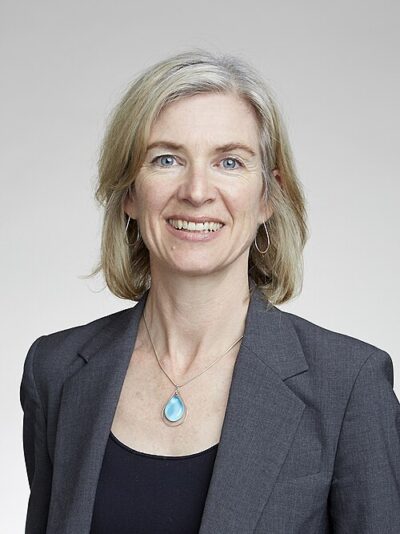
Jennifer Doudna
Jennifer Doudna is an American biochemist. Born February 19, 1964, in Washington, D.C.. Positions held include board of directors member (2018–). Known for Jennifer Doudna: We can now edit our DNA. But let's do it wisely. Educated at Harvard University and Pomona College. Awards include Princess of Asturias Award for Technical and Scientific Research, Breakthrough Prize in Life Sciences and Dr. Paul Janssen Award for Biomedical Research.
Facts
46 facts · 1 confirmed by two sources · 36 cited · 9 from one source
Where this comes from
Papalocal keeps its own record. It started from these sources; what each one said is kept here as it was copied, so a change on their side never changes this page by itself. Tap one to read its version.
What Wikidata says · copied November 13, 2026 · revision 2568286648
- Described as
- American biochemist
- Other names
- Jennifer Anne Doudna, Jennifer A. Doudna, Jennifer A Doudna, J. A. Doudna, J A Doudna, J. Doudna, J Doudna, Doudna, Doudna J, Doudna J., Doudna J. A., Doudna JA
- Born
- February 19, 1964 · 2 references
- Born in
- Washington, D.C.
- Name at birth
- Jennifer Anne Doudna
- Citizen of
- United States
- Occupation
- biochemist · 1 reference; molecular biologist · 1 reference; university teacher · 1 reference; chemist · 1 reference; crystallographer · 1 reference
- Positions held
- board of directors member (2018–) · 1 reference
- Worked for
- University of California, Berkeley (2002–) · 2 references; University of California, San Francisco · 1 reference; Howard Hughes Medical Institute · 1 reference; Yale University (1994–2002) · 1 reference
- Education
- Harvard University (–1989) · 1 reference; Pomona College (–1985) · 1 reference; Hilo High School
- Member of
- National Academy of Sciences (2002–) · 1 reference; American Academy of Arts and Sciences; National Academy of Medicine; Royal Society of London (2016–) · 1 reference; Pontifical Academy of Sciences (2021–)
- Known for
- Jennifer Doudna: We can now edit our DNA. But let's do it wisely
- Awards
- Princess of Asturias Award for Technical and Scientific Research (2015) · 1 reference; Breakthrough Prize in Life Sciences (2015) · 3 references; Dr. Paul Janssen Award for Biomedical Research (2014) · 2 references; Gruber Prize in Genetics (2015) · 2 references; Paul Ehrlich and Ludwig Darmstaedter Prize (2016) · 1 reference; Dickson Prize in Medicine (2016) · 1 reference; Canada Gairdner International Award (2016) · 1 reference; Dr H.P. Heineken Prize for Biochemistry and Biophysics (2016) · 1 reference; Massry Prize (2015) · 1 reference; Tang Prize (2016) · 1 reference; L'Oréal-UNESCO Award For Women in Science (2016) · 2 references; BBVA Foundation Frontiers of Knowledge Award (2016) · 1 reference; Alan T. Waterman Award (2000) · 1 reference; Gabbay Award (2014) · 1 reference; Lurie Prize in Biomedical Sciences (2014) · 1 reference
- Field
- biochemistry · 1 reference; molecular biology · 1 reference; transcription · 1 reference; Hepatitis C virus · 1 reference; RNA interference · 1 reference; ribosome · 1 reference
- Spouse
- Jamie H. D. Cate · 1 reference
- Lived in
- Hilo · 1 reference
- Wikipedias with a page
- 87
Wikidata item Q56068 (wikidata.org/wiki/Q56068), public domain (CC0). Copied November 13, 2026.
What Wikipedia says · copied November 13, 2026 · revision 1384989268
Jennifer Anne Doudna (; born February 19, 1964) is an American biochemist who has pioneered work in CRISPR gene editing, and made other fundamental contributions in biochemistry and genetics. She received the 2020 Nobel Prize in Chemistry, with Emmanuelle Charpentier, "for the development of a method for genome editing." She is the Li Ka Shing Chancellor's Chair Professor at the University of California, Berkeley. She has been an investigator with the Howard Hughes Medical Institute since 1997.
In 2012, Doudna and Emmanuelle Charpentier were the first to propose that CRISPR-Cas9 (enzymes from bacteria that control microbial immunity) could be used for programmable editing of genomes, which has been called one of the most significant discoveries in the history of biology. Since then, Doudna has been a leading figure in what is referred to as the "CRISPR revolution" for her fundamental work and leadership in developing CRISPR-mediated genome editing.Doudna's awards and fellowships include the 2000 Alan T. Waterman Award for her research on the structure of a ribozyme, as determined by X-ray crystallography and the 2015 Breakthrough Prize in Life Sciences for CRISPR-Cas9 genome editing technology, with Charpentier. She has been a co-recipient of the Gruber Prize in Genetics (2015), the Tang Prize (2016), the Canada Gairdner International Award (2016), and the Japan Prize (2017). She was named one of the Time 100 most influential people in 2015, and in 2023 was inducted into the National Inventors Hall of Fame.
- Born, in its opening lines
- February 19, 1964
From the Wikipedia article “Jennifer Doudna” (en.wikipedia.org/wiki/Jennifer_Doudna), by its contributors, under CC BY-SA 4.0 (creativecommons.org/licenses/by-sa/4.0/). Copied November 13, 2026; not changed.
Confirmed Two sources agree. Cited One source, and it names where it got it. One source One source, without a reference of its own. Sources disagree The sources disagree. We show the best-supported value and keep theirs below.
