
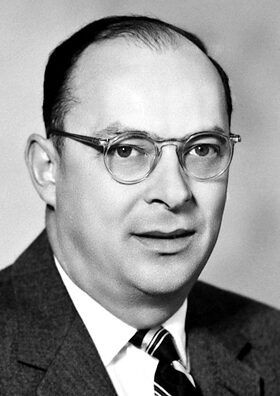
John Bardeen
John Bardeen was an American physicist and engineer. Born May 23, 1908, in Madison. Died January 30, 1991, in Boston. Positions held include professor. Educated at Princeton University and University of Wisconsin–Madison. Awards include Nobel Prize in Physics (2 times), Stuart Ballantine Medal and Harold Pender Award.
Facts
49 facts · 2 confirmed by two sources · 30 cited · 17 from one source
Where this comes from
Papalocal keeps its own record. It started from these sources; what each one said is kept here as it was copied, so a change on their side never changes this page by itself. Tap one to read its version.
What Wikipedia says · copied November 13, 2026 · revision 1385322407
John Bardeen (May 23, 1908 – January 30, 1991) was an American theoretical physicist and electrical engineer. He is the only person to be awarded the Nobel Prize in Physics twice: first in 1956 with Walter Brattain and William Shockley for their invention of the transistor; and again in 1972 with Leon Cooper and John Robert Schrieffer for their microscopic theory of superconductivity, known as the BCS theory.
Born and raised in Wisconsin, Bardeen earned both his bachelor's and master's degrees in electrical engineering from the University of Wisconsin, before receiving a Ph.D. in physics from Princeton University. After serving in World War II, he was a researcher at Bell Labs and a professor at the University of Illinois.
The transistor revolutionized the electronics industry, making possible the development of almost every modern electronic device, from telephones to computers, and ushering in the Information Age. Bardeen's developments in superconductivity, for which he was awarded his second Nobel Prize, are used in nuclear magnetic resonance (NMR) spectroscopy, medical magnetic resonance imaging (MRI), and superconducting quantum circuits.
Bardeen is the first of only three people to have won multiple Nobel Prizes in the same category (the others being Frederick Sanger and Karl Barry Sharpless in chemistry), and one of five persons with two Nobel Prizes. In 1990, Bardeen appeared on Life magazine's list of "100 Most Influential Americans of the Century."
- Born, in its opening lines
- May 23, 1908
- Died, in its opening lines
- January 30, 1991
From the Wikipedia article “John Bardeen” (en.wikipedia.org/wiki/John_Bardeen), by its contributors, under CC BY-SA 4.0 (creativecommons.org/licenses/by-sa/4.0/). Copied November 13, 2026; not changed.
What Wikidata says · copied November 14, 2026 · revision 2569131783
- Described as
- American physicist and engineer (1908–1991)
- Born
- May 23, 1908 · 9 references
- Died
- January 30, 1991 · 10 references
- Born in
- Madison · 2 references
- Died in
- Boston · 1 reference
- Buried in
- Forest Hill Cemetery · 1 reference
- Cause of death
- myocardial infarction
- Citizen of
- United States
- Occupation
- physicist · 1 reference; inventor · 1 reference; university teacher; electrical engineer
- Positions held
- professor
- Worked for
- University of Illinois Urbana-Champaign · 1 reference; University of Minnesota · 1 reference
- Education
- Princeton University (–1936) · 1 reference; University of Wisconsin–Madison; Madison Central High School · 1 reference; University of Wisconsin High School
- Member of
- Royal Society of London (1973–) · 1 reference; Academy of Sciences of the USSR (1982–) · 1 reference; Hungarian Academy of Sciences; National Academy of Sciences (1954–) · 1 reference; American Academy of Arts and Sciences (1959–) · 1 reference; Russian Academy of Sciences; American Physical Society (1938–) · 1 reference; Japan Academy (1977–) · 1 reference; American Philosophical Society (1958–); National Academy of Engineering (1972–) · 1 reference
- Awards
- Nobel Prize in Physics (2 times) (1956, 1972) · 2 references; Stuart Ballantine Medal (1952) · 1 reference; Harold Pender Award (1988) · 1 reference; Lomonosov Gold Medal (1987) · 1 reference; Oliver E. Buckley Condensed Matter Prize (1954) · 1 reference; IEEE Medal of Honor (1971) · 1 reference; Fritz London Award (1962) · 1 reference; National Medal of Science (1965) · 1 reference; National Inventors Hall of Fame (1974) · 1 reference; Presidential Medal of Freedom (1977) · 1 reference; Franklin Medal (1975) · 1 reference; Fellow of the American Physical Society (1938) · 1 reference; Foreign Member of the Royal Society (1973) · 1 reference; James Madison Medal (1973) · 1 reference; John Scott Award (1954) · 1 reference
- Field
- physics
- Spouse
- Jane Maxwell (1938–)
- Children
- James M. Bardeen; William A. Bardeen
- Father
- Charles Russell Bardeen
- Lived in
- Madison
- Wikipedias with a page
- 95
Wikidata item Q949 (wikidata.org/wiki/Q949), public domain (CC0). Copied November 14, 2026.
Confirmed Two sources agree. Cited One source, and it names where it got it. One source One source, without a reference of its own. Sources disagree The sources disagree. We show the best-supported value and keep theirs below.
