
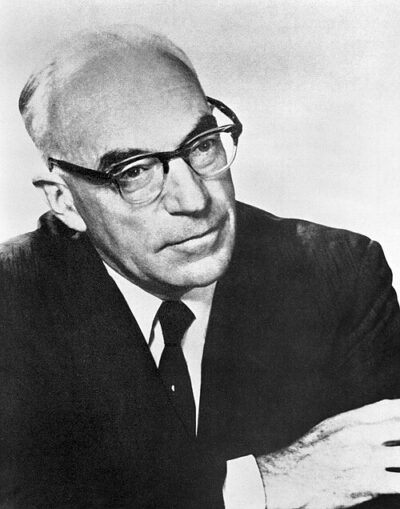
John Carew Eccles
John Carew Eccles was an Australian neurophysiologist. Born January 27, 1903, in Melbourne. Died May 2, 1997, in Tenero-Contra. Positions held include professor. Educated at Magdalen College and Melbourne High School. Awards include Fellow of the Royal Society, Nobel Prize in Physiology or Medicine and Royal Medal.
Facts
45 facts · 2 confirmed by two sources · 16 cited · 27 from one source
Where this comes from
Papalocal keeps its own record. It started from these sources; what each one said is kept here as it was copied, so a change on their side never changes this page by itself. Tap one to read its version.
What Wikidata says · copied November 16, 2026 · revision 2563064019
- Described as
- Australian neurophysiologist (1903–1997)
- Other names
- John Eccles, Sir John Carew Eccles, J. C. Eccles
- Born
- January 27, 1903 · 12 references
- Died
- May 2, 1997 · 10 references
- Born in
- Melbourne
- Died in
- Tenero-Contra
- Citizen of
- Australia
- Occupation
- philosopher; neuroscientist; physician; professor; neurologist · 1 reference; physiologist · 2 references; researcher
- Positions held
- professor
- Worked for
- University of Otago; University at Buffalo; Australian National University
- Education
- Magdalen College · 1 reference; Melbourne High School; University of Melbourne · 1 reference; Warrnambool College
- Member of
- Royal Society of London; German Academy of Sciences Leopoldina (1961–) · 1 reference; Pontifical Academy of Sciences · 1 reference; Australian Academy of Science; American Academy of Arts and Sciences; Bavarian Academy of Sciences and Humanities; National Academy of Sciences (1966–); American Philosophical Society (1964–); Accademia Nazionale dei Lincei (1963–) · 1 reference
- Awards
- Fellow of the Royal Society · 1 reference; Nobel Prize in Physiology or Medicine (1963) · 2 references; Royal Medal (1962); Australian of the Year (1963); Knight Bachelor (1958) · 1 reference; Annual Review Prize Lecture (1972) · 1 reference; James Cook Medal (1961) · 1 reference; honorary doctor of the University of Madrid Complutense (1992); Fellow of the Australian Academy of Science (1953) · 1 reference; Fellow of the Royal Society Te Apārangi (1950) · 1 reference; Rhodes Scholarship (1925) · 1 reference; Baly Medal (1961); Companion of the Order of Australia (1990) · 1 reference; Fellow of the Royal Australasian College of Physicians · 1 reference; Matthew Flinders Medal and Lecture (1963) · 1 reference
- Field
- neurophysiology
- Wikipedias with a page
- 59
Wikidata item Q273223 (wikidata.org/wiki/Q273223), public domain (CC0). Copied November 16, 2026.
What Wikipedia says · copied November 16, 2026 · revision 1381481233
Sir John Carew Eccles (27 January 1903 – 2 May 1997) was an Australian neurophysiologist and philosopher who won the 1963 Nobel Prize in Physiology or Medicine for his work on the synapse. He shared the prize with Andrew Huxley and Alan Lloyd Hodgkin.
- Born, in its opening lines
- January 27, 1903
- Died, in its opening lines
- May 2, 1997
From the Wikipedia article “John Eccles (neurophysiologist)” (en.wikipedia.org/wiki/John_Eccles_(neurophysiologist)), by its contributors, under CC BY-SA 4.0 (creativecommons.org/licenses/by-sa/4.0/). Copied November 16, 2026; not changed.
Confirmed Two sources agree. Cited One source, and it names where it got it. One source One source, without a reference of its own. Sources disagree The sources disagree. We show the best-supported value and keep theirs below.
