
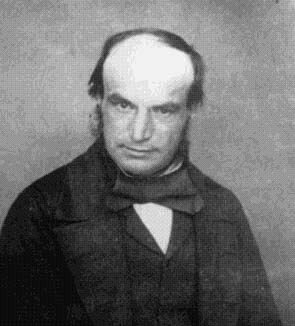
John Couch Adams
John Couch Adams was an English mathematician and astronomer. Born June 5, 1819, in Laneast. Died January 21, 1892, in Cambridge. Positions held include Regius Professor of Mathematics (1857–1858), Lowndean Professor of Astronomy and Geometry (1858–1892) and President of the Royal Astronomical Society (2 times) (1851–1876). Known for discovery of Neptune, Adams–Bashforth methods and tidal acceleration. Educated at St John's College. Awards include Fellow of the Royal Society, Copley Medal and Gold Medal of the Royal Astronomical Society.
Facts
38 facts · 2 confirmed by two sources · 21 cited · 15 from one source
Where this comes from
Papalocal keeps its own record. It started from these sources; what each one said is kept here as it was copied, so a change on their side never changes this page by itself. Tap one to read its version.
What Wikidata says · copied November 16, 2026 · revision 2569119835
- Described as
- English mathematician and astronomer (1819–1892)
- Born
- June 5, 1819 · 5 references
- Died
- January 21, 1892 · 6 references
- Born in
- Laneast · 3 references
- Died in
- Cambridge · 3 references
- Buried in
- Ascension Parish Burial Ground · 1 reference
- Citizen of
- United Kingdom of Great Britain and Ireland
- Occupation
- mathematician · 1 reference; astronomer · 1 reference; university teacher
- Positions held
- Regius Professor of Mathematics (1857–1858) · 1 reference; Lowndean Professor of Astronomy and Geometry (1858–1892) · 1 reference; President of the Royal Astronomical Society (2 times) (1851–1876) · 1 reference; director (1861–1891) · 1 reference
- Worked for
- University of Cambridge (1859–1891) · 1 reference; University of St Andrews (1857–1859) · 1 reference; St John's College (1843–1852) · 1 reference; Pembroke College (1853–1857) · 1 reference
- Education
- St John's College (1839–1843) · 1 reference
- Member of
- Royal Society of London (1849–); Royal Swedish Academy of Sciences; American Academy of Arts and Sciences; Russian Academy of Sciences; National Academy of Sciences (1883–); Göttingen Academy of Sciences and Humanities in Lower Saxony; Accademia Nazionale dei Lincei (1872–) · 1 reference
- Known for
- discovery of Neptune; Adams–Bashforth methods; tidal acceleration
- Awards
- Fellow of the Royal Society (1849) · 1 reference; Copley Medal (1848) · 1 reference; Gold Medal of the Royal Astronomical Society (1866) · 1 reference; Honorary Fellow of the Royal Society of Edinburgh (1849) · 1 reference; Fellow of the American Academy of Arts and Sciences (1847) · 1 reference; Smith's Prize (1843) · 1 reference
- Field
- astronomy · 1 reference; mathematics · 1 reference
- Spouse
- Elizabeth Eliza Bruce (1863–) · 1 reference
- Siblings
- William Grylls Adams
- Wikipedias with a page
- 70
Wikidata item Q20015 (wikidata.org/wiki/Q20015), public domain (CC0). Copied November 16, 2026.
What Wikipedia says · copied November 16, 2026 · revision 1383536084
John Couch Adams ( KOOTCH; 5 June 1819 – 21 January 1892) was a British celestial mechanician and astronomer. He was born in Laneast, near Launceston, Cornwall, and died in Cambridge.
His most famous achievement was predicting the existence and position of Neptune, using only mathematics. The calculations were made to explain discrepancies with Uranus's orbit and the laws of Kepler and Newton. At the same time, but unknown to each other, the same calculations were made by Urbain Le Verrier. Le Verrier sent his co-ordinates to Berlin Observatory astronomer Johann Gottfried Galle, who confirmed the existence of the planet on 23 September 1846, finding it within 1° of Le Verrier's predicted location. (There was, and to some extent still is, some controversy over the apportionment of credit for the discovery; see Discovery of Neptune.) Later, Adams explained the origin of meteor showers, which holds to the present day.
Adams was Lowndean Professor in the University of Cambridge from 1859 until his death. He won the Gold Medal of the Royal Astronomical Society in 1866. In 1884, he attended the International Meridian Conference as a delegate for Britain.
A crater on the Moon is jointly named after him, Walter Sydney Adams and Charles Hitchcock Adams. Neptune's outermost known ring and the asteroid 1996 Adams are also named after him. The Adams Prize, presented by the University of Cambridge, commemorates his prediction of the position of Neptune. His personal library is held at Cambridge University Library.
- Born, in its opening lines
- June 5, 1819
- Died, in its opening lines
- January 21, 1892
From the Wikipedia article “John Couch Adams” (en.wikipedia.org/wiki/John_Couch_Adams), by its contributors, under CC BY-SA 4.0 (creativecommons.org/licenses/by-sa/4.0/). Copied November 16, 2026; not changed.
Confirmed Two sources agree. Cited One source, and it names where it got it. One source One source, without a reference of its own. Sources disagree The sources disagree. We show the best-supported value and keep theirs below.
