
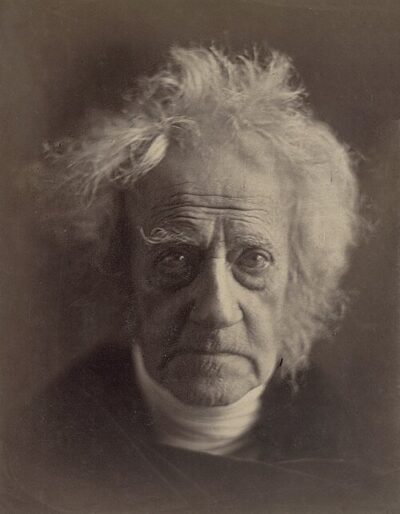
John Frederick William Herschel
John Frederick William Herschel was an English polymath, mathematician, astronomer, chemist, inventor and photographer. Born March 7, 1792, in Slough. Died May 11, 1871, in Hawkhurst. Positions held include Master of the Mint (1850–1855), President of the British Science Association (1845–1846) and Rector of Marischal College, Aberdeen (1842–1843). Known for General Catalogue of Nebulae and Clusters of Stars, Preliminary Discourse on the Study of Natural Philosophy and On the aberrations of compound lenses and object-glasses. Educated at Eton College and St John's College. Awards include Fellow of the Royal Society, Copley Medal (2 times) and Pour le Mérite for Sciences and Arts order.
Facts
61 facts · 2 confirmed by two sources · 40 cited · 19 from one source
Where this comes from
Papalocal keeps its own record. It started from these sources; what each one said is kept here as it was copied, so a change on their side never changes this page by itself. Tap one to read its version.
What Wikidata says · copied November 16, 2026 · revision 2568856880
- Described as
- English polymath, mathematician, astronomer, chemist, inventor and photographer (1792–1871)
- Other names
- John Herschel, John F. W. Herschel, Sir John Herschel, J. F. W. Herschel, John Frederick Herschel, Sir John Frederick William Herschel
- Born
- March 7, 1792 · 17 references
- Died
- May 11, 1871 · 16 references
- Born in
- Slough · 2 references
- Died in
- Hawkhurst · 1 reference
- Buried in
- Westminster Abbey · 1 reference
- Name at birth
- John Frederick William Herschel · 1 reference
- Citizen of
- United Kingdom of Great Britain and Ireland
- Occupation
- astronomer · 3 references; photographer · 1 reference; mathematician · 2 references; chemist · 1 reference; physicist · 2 references; writer · 1 reference
- Positions held
- Master of the Mint (1850–1855); President of the British Science Association (1845–1846) · 2 references; Rector of Marischal College, Aberdeen (1842–1843) · 1 reference; President of the Royal Astronomical Society (3 times) (1827–1849) · 1 reference
- Education
- Eton College (1800–1801) · 1 reference; St John's College (1809–1813) · 1 reference; Lincoln's Inn (1813) · 1 reference
- Member of
- Royal Society of London (1813–); German Academy of Sciences Leopoldina; Royal Swedish Academy of Sciences; Göttingen Academy of Sciences and Humanities in Lower Saxony; Saint Petersburg Academy of Sciences; French Academy of Sciences; American Academy of Arts and Sciences; Hungarian Academy of Sciences; Royal Astronomical Society; Royal Prussian Academy of Sciences
- Known for
- General Catalogue of Nebulae and Clusters of Stars; Preliminary Discourse on the Study of Natural Philosophy; On the aberrations of compound lenses and object-glasses
- Awards
- Fellow of the Royal Society (1813) · 1 reference; Copley Medal (2 times) (1821, 1847) · 1 reference; Pour le Mérite for Sciences and Arts order; Royal Medal (1833) · 1 reference; Gold Medal of the Royal Astronomical Society (1826) · 1 reference; Lalande Prize (1825) · 1 reference; Royal Society Bakerian Medal (1823) · 1 reference; Fellow of the American Academy of Arts and Sciences (1832) · 1 reference
- Field
- mathematics · 1 reference; astronomy · 1 reference; chemistry · 1 reference; photography · 1 reference
- Spouse
- Lady Margaret Brodie Stewart (1829–) · 2 references
- Children
- John Herschel; Alexander Stewart Herschel · 2 references; Caroline Emilia Mary Herschel · 1 reference; Isabella Herschel · 1 reference; Sir William Herschel, 2nd Baronet · 2 references; Margaret Louisa Marshall · 1 reference; Maria Sophie Herschel · 2 references; Amelia Herschel · 1 reference; Julia Mary Herschel · 1 reference; Matilda Rose Herschel · 1 reference; Francisca Herschel · 1 reference; Constance Anne Herschel · 2 references
- Father
- William Herschel · 1 reference
- Mother
- Mary Baldwin · 1 reference
- Lived in
- Cape of Good Hope (1833–1838) · 1 reference
- Wikipedias with a page
- 88
Wikidata item Q14278 (wikidata.org/wiki/Q14278), public domain (CC0). Copied November 16, 2026.
What Wikipedia says · copied November 16, 2026 · revision 1381508232
Sir John Frederick William Herschel, 1st Baronet (; 7 March 1792 – 11 May 1871) was an English polymath active as a mathematician, astronomer, chemist, inventor and experimental photographer who invented the blueprint and did botanical work.
Herschel originated the use of the Julian day system in astronomy. He named seven moons of Saturn and four moons of Uranus – the seventh planet, discovered by his father Sir William Herschel. He made many contributions to the science of photography, and investigated colour blindness and the chemical power of ultraviolet rays. His Preliminary Discourse (1831), which advocated an inductive approach to scientific experiment and theory-building, was an important contribution to the philosophy of science.
- Born, in its opening lines
- March 7, 1792
- Died, in its opening lines
- May 11, 1871
From the Wikipedia article “John Herschel” (en.wikipedia.org/wiki/John_Herschel), by its contributors, under CC BY-SA 4.0 (creativecommons.org/licenses/by-sa/4.0/). Copied November 16, 2026; not changed.
Confirmed Two sources agree. Cited One source, and it names where it got it. One source One source, without a reference of its own. Sources disagree The sources disagree. We show the best-supported value and keep theirs below.
