
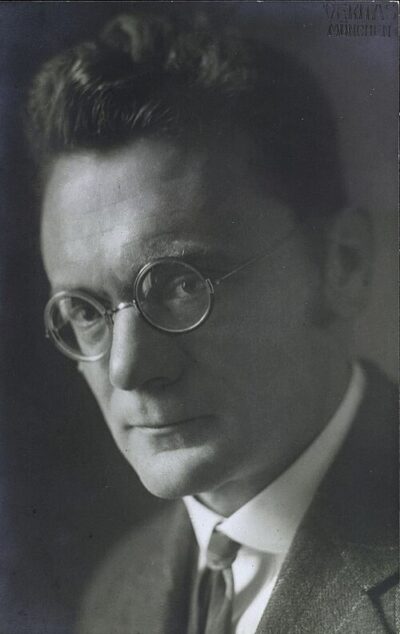
Karl von Frisch
Karl von Frisch was a German-Austrian ethologist. Born November 20, 1886, in Vienna. Died June 12, 1982, in Munich. Educated at University of Vienna and LMU Munich. Awards include Pour le Mérite for Sciences and Arts order, Nobel Prize in Physiology or Medicine and Bavarian Order of Merit.
Facts
50 facts · 2 confirmed by two sources · 16 cited · 32 from one source
Where this comes from
Papalocal keeps its own record. It started from these sources; what each one said is kept here as it was copied, so a change on their side never changes this page by itself. Tap one to read its version.
What Wikidata says · copied November 16, 2026 · revision 2569137687
- Described as
- German-Austrian ethologist (1886-1982)
- Born
- November 20, 1886 · 13 references
- Died
- June 12, 1982 · 12 references
- Born in
- Vienna · 2 references
- Died in
- Munich · 2 references
- Buried in
- Perlacher Forst Cemetery · 1 reference
- Citizen of
- Austria
- Occupation
- beekeeper; ethologist; university teacher · 1 reference; entomologist · 1 reference; zoologist · 1 reference; biologist · 1 reference; scientist · 1 reference
- Worked for
- LMU Munich (–1958); University of Graz (–1950); University of Wrocław (–1925); University of Rostock (–1923)
- Education
- University of Vienna; LMU Munich
- Member of
- Royal Society of London (1954–); German Academy of Sciences Leopoldina; Royal Swedish Academy of Sciences; American Academy of Arts and Sciences; Royal Netherlands Academy of Arts and Sciences; Bavarian Academy of Sciences and Humanities; National Academy of Sciences (1951–); Zoologisch-Botanische Gesellschaft (1909–) · 1 reference; Göttingen Academy of Sciences and Humanities in Lower Saxony
- Awards
- Pour le Mérite for Sciences and Arts order (1952); Nobel Prize in Physiology or Medicine (1973) · 2 references; Bavarian Order of Merit; Ring of Honour of the City of Vienna; Great Cross with Star and Sash of the Order of Merit of the Federal Republic of Germany; Kalinga Prize (1958) · 1 reference; Balzan Prize (1962); Lieben Prize (1921); Bavarian Maximilian Order for Science and Art (1981); Magellanic Premium (1956); honorary doctorate of the University of Graz; honorary doctor of Harvard University; Fellow of the American Academy of Arts and Sciences; Foreign Member of the Royal Society (1954) · 1 reference; Austrian Decoration for Science and Art (1960)
- Field
- ethology
- Children
- Otto von Frisch · 1 reference
- Father
- Anton von Frisch · 1 reference
- Mother
- Marie von Frisch · 1 reference
- Siblings
- Hans von Frisch · 1 reference; Otto Frisch; Ernst Frisch · 1 reference
- Wikipedias with a page
- 63
Wikidata item Q60060 (wikidata.org/wiki/Q60060), public domain (CC0). Copied November 16, 2026.
What Wikipedia says · copied November 16, 2026 · revision 1378700713
Karl Ritter von Frisch (20 November 1886 – 12 June 1982) was a German-Austrian ethologist who received the Nobel Prize in Physiology or Medicine in 1973, along with Nikolaas Tinbergen and Konrad Lorenz.
His work centered on investigations of the sensory perceptions of the honey bee and he was one of the first to translate the meaning of the waggle dance. His theory, described in his 1927 book Aus dem Leben der Bienen/ (English: "From the Life of Bees", published in the UK and United States as The Dancing Bees), was disputed by other scientists and met with widespread skepticism at the time, only decades later being appreciated as both zoologically accurate and an important step in development of animal behavioral study, and the wider history of biology.
- Born, in its opening lines
- November 20, 1886
- Died, in its opening lines
- June 12, 1982
From the Wikipedia article “Karl von Frisch” (en.wikipedia.org/wiki/Karl_von_Frisch), by its contributors, under CC BY-SA 4.0 (creativecommons.org/licenses/by-sa/4.0/). Copied November 16, 2026; not changed.
Confirmed Two sources agree. Cited One source, and it names where it got it. One source One source, without a reference of its own. Sources disagree The sources disagree. We show the best-supported value and keep theirs below.
