
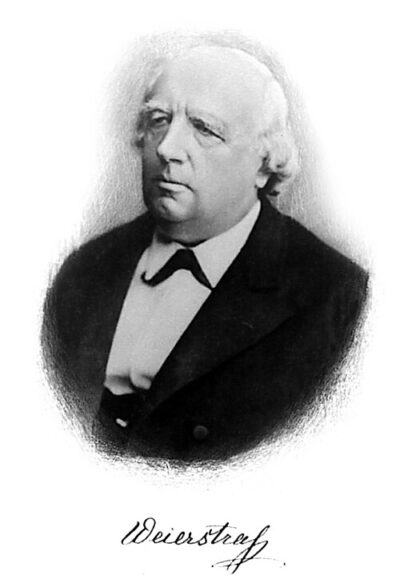
Karl Weierstraß
Karl Weierstraß was a German mathematician. Born October 31, 1815, in Ostenfelde. Died February 19, 1897, in Berlin. Known for list of things named after Karl Weierstrass. Educated at University of Bonn and University of Münster. Awards include honorary doctor of the University of Königsberg, Copley Medal and Pour le Mérite for Sciences and Arts order.
Facts
41 facts · 2 confirmed by two sources · 25 cited · 14 from one source
Where this comes from
Papalocal keeps its own record. It started from these sources; what each one said is kept here as it was copied, so a change on their side never changes this page by itself. Tap one to read its version.
What Wikidata says · copied November 16, 2026 · revision 2568760255
- Described as
- German mathematician (1815–1897)
- Other names
- Karl Weierstrass, Karl Theodor Wilhelm Weierstraß, Karl Theodor Wilhelm Weierstrass
- Born
- October 31, 1815 · 9 references
- Died
- February 19, 1897 · 10 references
- Born in
- Ostenfelde · 4 references
- Died in
- Berlin · 6 references
- Buried in
- Alter Domfriedhof der St.-Hedwigs-Gemeinde · 1 reference
- Cause of death
- pneumonia · 1 reference
- Name at birth
- Karl Theodor Wilhelm Weierstrass · 2 references
- Citizen of
- Kingdom of Prussia · 1 reference
- Occupation
- mathematician · 4 references; university teacher · 3 references; physicist
- Worked for
- Frederick William University Berlin (1857–1890) · 1 reference; Gewerbeinstitut Berlin (1856–1864) · 1 reference; Collegium Hosianum (1848–1856) · 1 reference; 2nd middle school in Wałcz (1842–1848) · 1 reference
- Education
- University of Bonn (1834–1838) · 2 references; University of Münster (1838–1840) · 1 reference; Gymnasium Theodorianum (1829–1834) · 1 reference; University of Königsberg (–1854) · 2 references
- Member of
- Royal Society of London; Corps Saxonia Bonn (1836–) · 1 reference; German Academy of Sciences Leopoldina (1883–) · 1 reference; Saint Petersburg Academy of Sciences; Royal Swedish Academy of Sciences; American Academy of Arts and Sciences; Russian Academy of Sciences; Royal Prussian Academy of Sciences (1856–) · 1 reference; Accademia Nazionale delle Scienze detta dei XL; Bavarian Academy of Sciences and Humanities
- Known for
- list of things named after Karl Weierstrass
- Awards
- honorary doctor of the University of Königsberg (1856) · 1 reference; Copley Medal (1895) · 1 reference; Pour le Mérite for Sciences and Arts order; Helmholtz Medal (1892); Cothenius Medal (1887); Bavarian Maximilian Order for Science and Art (1885); Foreign Member of the Royal Society (1881) · 1 reference
- Field
- complex analysis · 1 reference; mathematics · 1 reference; mathematical analysis · 1 reference; elliptic function · 1 reference
- Wikipedias with a page
- 86
Wikidata item Q57103 (wikidata.org/wiki/Q57103), public domain (CC0). Copied November 16, 2026.
What Wikipedia says · copied November 16, 2026 · revision 1375100435
Karl Theodor Wilhelm Weierstrass (; German: Weierstraß [ˈvaɪɐʃtʁaːs]; 31 October 1815 – 19 February 1897) was a German mathematician often cited as the "father of modern analysis". Despite leaving university without a degree, he studied mathematics and trained as a school teacher, eventually teaching mathematics, physics, botany and gymnastics. He later received an honorary doctorate and became professor of mathematics in Berlin.
Among many other contributions, Weierstrass formalized the definition of the continuity of a function and complex analysis, proved the intermediate value theorem and the Bolzano–Weierstrass theorem, and used the latter to study the properties of continuous functions on closed bounded intervals.
- Born, in its opening lines
- October 31, 1815
- Died, in its opening lines
- February 19, 1897
From the Wikipedia article “Karl Weierstrass” (en.wikipedia.org/wiki/Karl_Weierstrass), by its contributors, under CC BY-SA 4.0 (creativecommons.org/licenses/by-sa/4.0/). Copied November 16, 2026; not changed.
Confirmed Two sources agree. Cited One source, and it names where it got it. One source One source, without a reference of its own. Sources disagree The sources disagree. We show the best-supported value and keep theirs below.
