
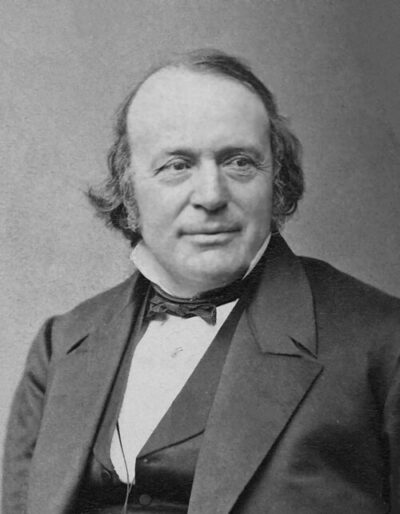
Louis Agassiz
Louis Agassiz was a Swiss-American naturalist. Born May 28, 1807, in Môtier. Died December 14, 1873, in Cambridge. Positions held include board member (1863–1873). Educated at University of Zurich and LMU Munich. Awards include Copley Medal, Pour le Mérite for Sciences and Arts order and Knight of the Legion of Honour.
Facts
58 facts · 2 confirmed by two sources · 24 cited · 32 from one source
Where this comes from
Papalocal keeps its own record. It started from these sources; what each one said is kept here as it was copied, so a change on their side never changes this page by itself. Tap one to read its version.
What Wikidata says · copied November 13, 2026 · revision 2568745543
- Described as
- Swiss-American naturalist (1807–1873)
- Other names
- L. Agassiz, J. L. R. Agassiz, Jean Louis Rudolph Agassiz, Agassiz, Jean Louis Rodolphe Agassiz
- Born
- May 28, 1807 · 9 references
- Died
- December 14, 1873 · 7 references
- Born in
- Môtier · 1 reference
- Died in
- Cambridge · 2 references
- Buried in
- Mount Auburn Cemetery · 2 references
- Name at birth
- Jean Louis Rodolphe Agassiz
- Citizen of
- Switzerland; United States
- Occupation
- geologist · 2 references; paleontologist · 2 references; racial theorist; zoologist · 2 references; glaciologist · 2 references; physician · 1 reference; university teacher; philosopher
- Positions held
- board member (1863–1873)
- Worked for
- Harvard University; Cornell University; University of Neuchâtel · 1 reference; Museum of Comparative Zoology (1859–1873)
- Education
- University of Zurich (1824–1826) · 1 reference; LMU Munich (–1830) · 1 reference; Heidelberg University (1826–) · 1 reference; University of Erlangen–Nuremberg (–1828) · 1 reference
- Member of
- Royal Society of London (1838–); Royal Prussian Academy of Sciences; German Academy of Sciences Leopoldina; Royal Swedish Academy of Sciences; Bavarian Academy of Sciences and Humanities; Saint Petersburg Academy of Sciences (1869–); French Academy of Sciences (1836–) · 1 reference; Hungarian Academy of Sciences; American Academy of Arts and Sciences; Royal Society of Edinburgh
- Awards
- Copley Medal (1861) · 1 reference; Pour le Mérite for Sciences and Arts order; Knight of the Legion of Honour (1859) · 2 references; Fellow of the Royal Society of Edinburgh; Fellow of the American Academy of Arts and Sciences; Foreign Member of the Royal Society (1838) · 1 reference; Fellow of the Royal Society (1836–) · 1 reference; Wollaston Medal (1836) · 1 reference; Honorary Fellow of the Royal Society Te Apārangi (1870–) · 1 reference
- Field
- botany; geology; glaciology · 1 reference; ichthyology; biology · 1 reference
- Spouse
- Elizabeth Cabot Agassiz (1850–1873) · 1 reference; Cecile Braun (1832–1848) · 1 reference
- Children
- Alexander Agassiz · 1 reference; Pauline Agassiz Shaw; Ida Higginson
- Siblings
- Cécile Suzette Agassiz; Auguste Agassiz; Olympe Francillon-Agassiz · 1 reference
- Religion
- reformed · 1 reference
- Wikipedias with a page
- 65
Wikidata item Q122972 (wikidata.org/wiki/Q122972), public domain (CC0). Copied November 13, 2026.
What Wikipedia says · copied November 13, 2026 · revision 1383243879
Jean Louis Rodolphe Agassiz ( AG-ə-see; French: [aɡasi]; May 28, 1807 – December 14, 1873) was a Swiss-born American biologist and geologist who is recognized as a scholar of Earth's natural history.
Spending his early life in Switzerland, he received a PhD at the University of Erlangen and a medical degree at the Ludwig-Maximilians-Universität München. After studying with Georges Cuvier and Alexander von Humboldt in Paris, Agassiz was appointed professor of natural history at the University of Neuchâtel. He emigrated to the United States in 1847 after visiting Harvard University. He went on to become professor of zoology and geology at Harvard, to head its Lawrence Scientific School, and to found its Museum of Comparative Zoology.
Agassiz is known for observational data gathering and analysis. He made institutional and scientific contributions to zoology, geology, and related areas, including multivolume research books running to thousands of pages. He is particularly known for his contributions to ichthyological classification, including of extinct species such as megalodon, and to the study of historical geology, including the founding of glaciology.
His theories on human, animal and plant polygenism have been criticised as implicitly supporting scientific racism.
- Born, in its opening lines
- May 28, 1807
- Died, in its opening lines
- December 14, 1873
From the Wikipedia article “Louis Agassiz” (en.wikipedia.org/wiki/Louis_Agassiz), by its contributors, under CC BY-SA 4.0 (creativecommons.org/licenses/by-sa/4.0/). Copied November 13, 2026; not changed.
Confirmed Two sources agree. Cited One source, and it names where it got it. One source One source, without a reference of its own. Sources disagree The sources disagree. We show the best-supported value and keep theirs below.
