
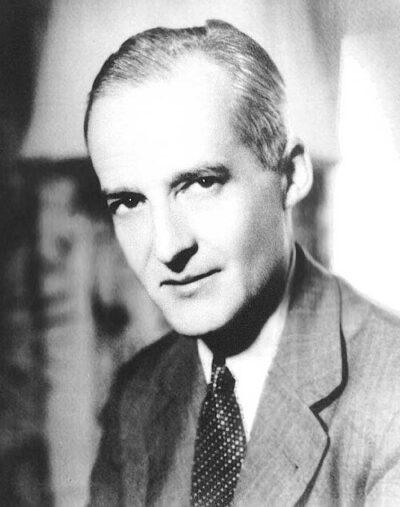
Luis Federico Leloir
Luis Federico Leloir was an Argentine biochemist. Born September 6, 1906, in 16th arrondissement of Paris. Died December 2, 1987, in Catamarca Province. Educated at Faculty of Medical Sciences, University of Buenos Aires. Awards include Nobel Prize in Chemistry, Canada Gairdner International Award and Louisa Gross Horwitz Prize.
Facts
42 facts · 2 confirmed by two sources · 21 cited · 18 from one source · 1 where the sources disagree
What’s different
- Died in: we show Catamarca Province (Sources disagree). Wikidata also lists Buenos Aires
Where this comes from
Papalocal keeps its own record. It started from these sources; what each one said is kept here as it was copied, so a change on their side never changes this page by itself. Tap one to read its version.
What Wikidata says · copied November 16, 2026 · revision 2569523029
- Described as
- Argentine biochemist
- Other names
- Luis F. Leloir, Luis Leloir
- Born
- September 6, 1906 · 6 references
- Died
- December 2, 1987 · 3 references
- Born in
- 16th arrondissement of Paris · 2 references
- Died in
- Catamarca Province; Buenos Aires
- Buried in
- Recoleta Cemetery
- Cause of death
- myocardial infarction
- Citizen of
- Argentina · 1 reference; France · 1 reference
- Occupation
- physician; biochemist · 1 reference; physicist; university teacher
- Worked for
- University of Buenos Aires (1958–1987) · 1 reference; Leloir Institute (1947–1987) · 1 reference; University of Cambridge (1936–1937) · 1 reference; University of Washington; Washington University in St. Louis (1943–1944); Columbia University (1944–1945)
- Education
- Faculty of Medical Sciences, University of Buenos Aires
- Member of
- Royal Society of London (1972–) · 1 reference; Pontifical Academy of Sciences · 1 reference; American Academy of Arts and Sciences; French Academy of Sciences (1978–) · 1 reference; American Philosophical Society (1963–) · 1 reference; Academia Argentina de Letras; Buenos Aires National Academy of Medicine; The World Academy of Sciences (1983–) · 1 reference; National Academy of Sciences (1960–); Sociedad Española de Bioquímica y Biologia Molecular (1963–)
- Awards
- Nobel Prize in Chemistry (1970) · 2 references; Canada Gairdner International Award (1966) · 1 reference; Louisa Gross Horwitz Prize (1967) · 1 reference; TWAS fellow (1983); Legion of Honour (1982) · 1 reference; honorary doctorate of the University of Granada (1967) · 1 reference; Foreign Member of the Royal Society (1972) · 1 reference; diamond Konex award (1983) · 2 references; Grand Cross of the Order Bernardo O'Higgins; doctor honoris causa from the University of Paris (1963) · 1 reference; honorary doctorate from University of Bordeaux-II (1972) · 1 reference
- Field
- biochemistry
- Lived in
- Buenos Aires · 1 reference
- Wikipedias with a page
- 59
Wikidata item Q233985 (wikidata.org/wiki/Q233985), public domain (CC0). Copied November 16, 2026.
What Wikipedia says · copied November 16, 2026 · revision 1382414135
Luis Federico Leloir (6 September 1906 – 2 December 1987) was an Argentine physician and biochemist who received the 1970 Nobel Prize in Chemistry for his discovery of the metabolic pathways by which carbohydrates are synthesized and converted into energy in the body. Although born in France, Leloir received the majority of his education at the University of Buenos Aires and was director of the private research group Fundación Instituto Campomar until his death in 1987. His research into sugar nucleotides, carbohydrate metabolism, and renal hypertension garnered international attention and led to significant progress in understanding, diagnosing and treating the congenital disease galactosemia. Leloir is buried in La Recoleta Cemetery, Buenos Aires.
- Born, in its opening lines
- September 6, 1906
- Died, in its opening lines
- December 2, 1987
From the Wikipedia article “Luis Federico Leloir” (en.wikipedia.org/wiki/Luis_Federico_Leloir), by its contributors, under CC BY-SA 4.0 (creativecommons.org/licenses/by-sa/4.0/). Copied November 16, 2026; not changed.
Confirmed Two sources agree. Cited One source, and it names where it got it. One source One source, without a reference of its own. Sources disagree The sources disagree. We show the best-supported value and keep theirs below.
