
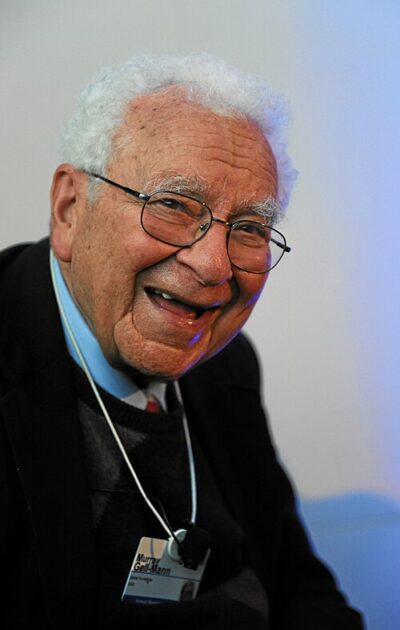
Murray Gell-Mann
Murray Gell-Mann was an American physicist. Born September 15, 1929, in Lower Manhattan. Died May 24, 2019, in Santa Fe. Positions held include board member (1974–1988). Educated at Yale College and Massachusetts Institute of Technology. Awards include Guggenheim Fellowship, Nobel Prize in Physics and Humanist of the Year.
Facts
49 facts · 2 confirmed by two sources · 25 cited · 22 from one source
Where this comes from
Papalocal keeps its own record. It started from these sources; what each one said is kept here as it was copied, so a change on their side never changes this page by itself. Tap one to read its version.
What Wikidata says · copied November 13, 2026 · revision 2563193127
- Described as
- American physicist (1929–2019)
- Born
- September 15, 1929 · 11 references
- Died
- May 24, 2019 · 10 references
- Born in
- Lower Manhattan
- Died in
- Santa Fe · 1 reference
- Buried in
- Red Butte Cemetery · 2 references
- Name at birth
- Murray Gell-Mann
- Citizen of
- United States
- Occupation
- non-fiction writer; theoretical physicist; physicist · 2 references
- Positions held
- board member (1974–1988)
- Worked for
- University of Chicago; California Institute of Technology · 1 reference
- Education
- Yale College; Massachusetts Institute of Technology; Yale University · 1 reference; Columbia Grammar & Preparatory School · 1 reference; Jonathan Edwards College
- Member of
- Royal Society of London (1978–) · 1 reference; National Academy of Sciences (1960–) · 1 reference; American Physical Society (1959–) · 1 reference; Russian Academy of Sciences (1994–) · 1 reference; American Academy of Arts and Sciences (1964–) · 1 reference; Indian National Science Academy; American Philosophical Society (1993–) · 1 reference; American Association for the Advancement of Science · 1 reference; JASON · 1 reference; Royal Irish Academy (2003–) · 1 reference
- Awards
- Guggenheim Fellowship (1971) · 1 reference; Nobel Prize in Physics (1969) · 2 references; Humanist of the Year (2005) · 1 reference; William Procter Prize for Scientific Achievement (2004) · 1 reference; Helmholtz Medal (2014) · 1 reference; John J. Carty Award for the Advancement of Science (1968) · 2 references; Franklin Medal (1967) · 1 reference; Richtmyer Memorial Lecture Award (1966) · 1 reference; Fellow of the American Physical Society; Dannie Heineman Prize for Mathematical Physics (1959) · 1 reference; Albert Einstein Medal (2005) · 1 reference; Fellow of the Pakistan Academy of Sciences; Fellow of the Committee for Skeptical Inquiry; Fellow of the American Academy of Arts and Sciences; Foreign Member of the Royal Society (1978) · 1 reference
- Field
- particle physics · 1 reference; physics · 1 reference
- Spouse
- J. Margaret Dow; Marcia Southwick
- Lived in
- United States · 1 reference
- Website
- http://tuvalu.santafe.edu/~mgm
- Wikipedias with a page
- 92
Wikidata item Q172840 (wikidata.org/wiki/Q172840), public domain (CC0). Copied November 13, 2026.
What Wikipedia says · copied November 13, 2026 · revision 1384445043
Murray Gell-Mann (; September 15, 1929 – May 24, 2019) was an American theoretical physicist who played a preeminent role in the development of the theory of elementary particles. Gell-Mann introduced the concept of quarks as the fundamental building blocks of the strongly interacting particles, and the renormalization group as a foundational element of quantum field theory and statistical mechanics. He received the 1969 Nobel Prize in Physics for his contributions and discoveries concerning the classification of elementary particles and their interactions.
Gell-Mann played key roles in developing the concept of chirality in the theory of the weak interactions and spontaneous chiral symmetry breaking in the strong interactions, which controls the physics of the light mesons. In the 1970s he was a co-inventor of quantum chromodynamics (QCD) which explains the confinement of quarks in mesons and baryons and forms a large part of the Standard Model of elementary particles and forces.
- Born, in its opening lines
- September 15, 1929
- Died, in its opening lines
- May 24, 2019
From the Wikipedia article “Murray Gell-Mann” (en.wikipedia.org/wiki/Murray_Gell-Mann), by its contributors, under CC BY-SA 4.0 (creativecommons.org/licenses/by-sa/4.0/). Copied November 13, 2026; not changed.
Confirmed Two sources agree. Cited One source, and it names where it got it. One source One source, without a reference of its own. Sources disagree The sources disagree. We show the best-supported value and keep theirs below.
