
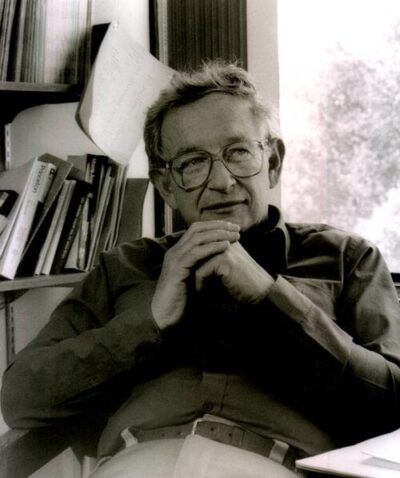
Philip W. Anderson
Philip W. Anderson was an American physicist. Born December 13, 1923, in Indianapolis. Died March 29, 2020, in Princeton. Educated at Harvard University and University Laboratory High School. Awards include Nobel Prize in Physics, Harvard Centennial Medal and Oliver E. Buckley Condensed Matter Prize.
Facts
39 facts · 2 confirmed by two sources · 18 cited · 19 from one source
Where this comes from
Papalocal keeps its own record. It started from these sources; what each one said is kept here as it was copied, so a change on their side never changes this page by itself. Tap one to read its version.
What Wikidata says · copied November 13, 2026 · revision 2563198824
- Described as
- American physicist (1923-2020)
- Other names
- Philip Anderson, P. W. Anderson, P. Anderson, Philip Warren Anderson
- Born
- December 13, 1923 · 8 references
- Died
- March 29, 2020 · 4 references
- Born in
- Indianapolis · 2 references
- Died in
- Princeton · 1 reference
- Buried in
- Princeton Cemetery · 1 reference
- Citizen of
- United States
- Occupation
- physicist · 1 reference; university teacher; theoretical physicist; writer · 1 reference
- Worked for
- Princeton University (1975–) · 1 reference; Santa Fe Institute; University of Cambridge (1967–1975) · 1 reference; Bell Labs
- Education
- Harvard University · 1 reference; University Laboratory High School · 1 reference
- Member of
- Royal Society of London (1980–); National Academy of Sciences (1967–); American Academy of Arts and Sciences; Russian Academy of Sciences (1994–); Indian National Science Academy; American Physical Society · 1 reference; Japan Academy (1988–) · 1 reference; American Philosophical Society (1991–); Accademia Nazionale dei Lincei (1985–) · 1 reference
- Awards
- Nobel Prize in Physics (1977) · 2 references; Harvard Centennial Medal; Oliver E. Buckley Condensed Matter Prize (1964) · 1 reference; National Medal of Science (1982); Dannie Heineman Prize (1975) · 1 reference; John Bardeen Prize (1997); Guthrie Medal and Prize (1978) · 1 reference; Fellow of the American Academy of Arts and Sciences; honorary doctor of the Tsinghua University (2007) · 1 reference; Foreign Member of the Royal Society (1980) · 1 reference; honorary doctorate from ENS (1994) · 1 reference
- Field
- physics
- Religion
- atheism · 1 reference
- Website
- http://www.princeton.edu/prism/people/faculty-1/anderson/ · 1 reference
- Wikipedias with a page
- 72
Wikidata item Q190770 (wikidata.org/wiki/Q190770), public domain (CC0). Copied November 13, 2026.
What Wikipedia says · copied November 13, 2026 · revision 1385033695
Philip Warren Anderson (December 13, 1923 – March 29, 2020) was an American theoretical physicist who shared the 1977 Nobel Prize in Physics with Nevill Mott and John Van Vleck "for their fundamental theoretical investigations of the electronic structure of magnetic and disordered systems."
Anderson made contributions to the theories of localization, antiferromagnetism, symmetry breaking (including a paper in 1962 discussing symmetry breaking in particle physics, leading to the development of the Standard Model around 10 years later), and high-temperature superconductivity, and to the philosophy of science through his writings on emergent phenomena. He is also responsible for naming the field of physics that is now known as condensed matter physics.
- Born, in its opening lines
- December 13, 1923
- Died, in its opening lines
- March 29, 2020
From the Wikipedia article “Philip W. Anderson” (en.wikipedia.org/wiki/Philip_W._Anderson), by its contributors, under CC BY-SA 4.0 (creativecommons.org/licenses/by-sa/4.0/). Copied November 13, 2026; not changed.
Confirmed Two sources agree. Cited One source, and it names where it got it. One source One source, without a reference of its own. Sources disagree The sources disagree. We show the best-supported value and keep theirs below.
