
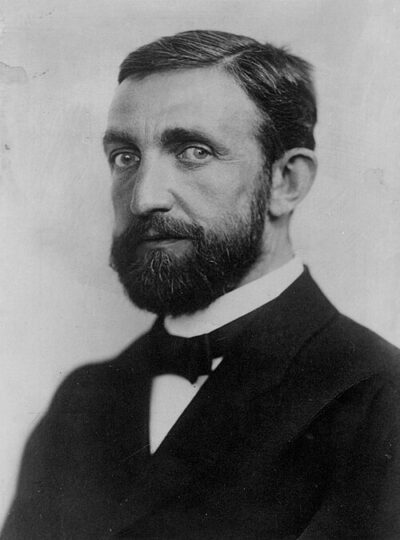
Philipp Lenard
Philipp Lenard was a German physicist. Born June 7, 1862, in Bratislava. Died May 20, 1947, in Messelhausen. Positions held include professor. Educated at Heidelberg University and Gymnasium Grösslingová. Awards include Nobel Prize in Physics, Golden Party Badge and Rumford Medal.
Facts
37 facts · 2 confirmed by two sources · 13 cited · 22 from one source
Where this comes from
Papalocal keeps its own record. It started from these sources; what each one said is kept here as it was copied, so a change on their side never changes this page by itself. Tap one to read its version.
What Wikidata says · copied November 16, 2026 · revision 2568762475
- Described as
- German physicist (1862–1947)
- Other names
- Philipp von Lenard, Philipp Eduard Anton von Lenard
- Born
- June 7, 1862 · 11 references
- Died
- May 20, 1947 · 10 references
- Born in
- Bratislava · 3 references
- Died in
- Messelhausen · 1 reference
- Buried in
- Messelhausen
- Name at birth
- Philipp Eduard Anton von Lenard
- Citizen of
- Germany (1907–1947); Hungary (–1907) · 1 reference
- Occupation
- physicist · 1 reference; inventor; university teacher · 1 reference
- Positions held
- professor
- Political party
- Nazi Party (1937–) · 2 references
- Worked for
- Kiel University; Heidelberg University; Budapest University of Technology and Economics; University of Wrocław; RWTH Aachen University; University of Bonn · 1 reference
- Education
- Heidelberg University (–1886) · 1 reference; Gymnasium Grösslingová
- Member of
- Royal Prussian Academy of Sciences; Royal Swedish Academy of Sciences; Militant League for German Culture; Hungarian Academy of Sciences; Heidelberg Academy of Sciences and Humanities (1909–1934) · 1 reference; Royal Society of Arts and Sciences in Gothenburg; Accademia Nazionale dei Lincei (1907–) · 1 reference
- Awards
- Nobel Prize in Physics (1905) · 2 references; Golden Party Badge · 1 reference; Rumford Medal (1896) · 1 reference; Matteucci Medal (1896); Franklin Medal (1932) · 1 reference; honorary doctor of Comenius University (1942) · 1 reference; honorary member of the Physics Association (Frankfurt am Main, Germany) (1895)
- Field
- physics
- Spouse
- Katharina Lenard · 1 reference
- Wikipedias with a page
- 99
Wikidata item Q57063 (wikidata.org/wiki/Q57063), public domain (CC0). Copied November 16, 2026.
What Wikipedia says · copied November 16, 2026 · revision 1377913278
Philipp Eduard Anton von Lenard (German: [ˈfɪlɪp ˈleːnaʁt] ; 7 June 1862 – 20 May 1947) was a German experimental physicist who received the Nobel Prize in Physics in 1905 for his work on cathode rays. This work led to his experimental realization of the photoelectric effect, discovering that the energy (speed) of the electrons ejected from a cathode depends only on the frequency and not the intensity of light.
As an active proponent of the Nazi ideology, Lenard supported Adolf Hitler in the 1920s and was an important role model for the Deutsche Physik movement during the Nazi period. He labeled Albert Einstein's contributions to theoretical physics as "Jewish physics".
- Born, in its opening lines
- June 7, 1862
- Died, in its opening lines
- May 20, 1947
From the Wikipedia article “Philipp Lenard” (en.wikipedia.org/wiki/Philipp_Lenard), by its contributors, under CC BY-SA 4.0 (creativecommons.org/licenses/by-sa/4.0/). Copied November 16, 2026; not changed.
Confirmed Two sources agree. Cited One source, and it names where it got it. One source One source, without a reference of its own. Sources disagree The sources disagree. We show the best-supported value and keep theirs below.
