
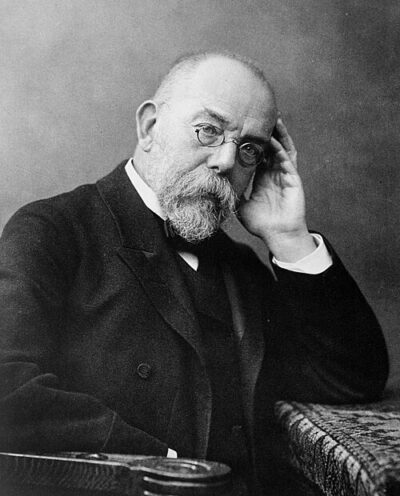
Robert Koch
Robert Koch was a German physician, bacteriologist. Born December 11, 1843, in Clausthal. Died May 27, 1910, in Baden-Baden. Known for Koch's postulates. Educated at University of Göttingen. Awards include Pour le Mérite for Sciences and Arts order, Nobel Prize in Physiology or Medicine and honorary citizen of Berlin.
Facts
45 facts · 2 confirmed by two sources · 9 cited · 34 from one source
Where this comes from
Papalocal keeps its own record. It started from these sources; what each one said is kept here as it was copied, so a change on their side never changes this page by itself. Tap one to read its version.
What Wikidata says · copied November 16, 2026 · revision 2567564125
- Described as
- German physician, bacteriologist (1843–1910)
- Other names
- Heinrich Hermann Robert Koch, Koch R., R. Koch, Koch, Koch R, R Koch, Robert Heinrich Hermann Koch
- Born
- December 11, 1843 · 17 references
- Died
- May 27, 1910 · 15 references
- Born in
- Clausthal · 1 reference
- Died in
- Baden-Baden · 3 references
- Cause of death
- myocardial infarction
- Name at birth
- Robert Heinrich Hermann Koch · 1 reference
- Citizen of
- Kingdom of Hanover; German Empire
- Occupation
- biologist; physician · 2 references; inventor; photographer; university teacher; chemist; military physician; bacteriologist · 1 reference
- Worked for
- Humboldt-Universität zu Berlin
- Education
- University of Göttingen
- Member of
- Royal Society of London (1897–); Royal Prussian Academy of Sciences; Royal Swedish Academy of Sciences; American Academy of Arts and Sciences; Royal Society of Arts and Sciences in Gothenburg; Russian Academy of Sciences; French Academy of Sciences · 1 reference; Académie Nationale de Médecine; National Academy of Sciences (1903–); Accademia Nazionale dei Lincei (1888–) · 1 reference
- Known for
- Koch's postulates
- Awards
- Pour le Mérite for Sciences and Arts order; Nobel Prize in Physiology or Medicine (1905) · 2 references; honorary citizen of Berlin; Bavarian Maximilian Order for Science and Art (1909); honorary citizen of Clausthal-Zellerfeld; Grand Cross of the Order of the Red Eagle; Foreign Member of the Royal Society (1897) · 1 reference; honorary member of the Physics Association (Frankfurt am Main, Germany) (1889)
- Field
- microbiology
- Spouse
- Emmy Koch (1867–1893) · 1 reference; Hedwig Koch
- Children
- Gertrud Pfuhl
- Father
- Hermann Koch · 1 reference
- Mother
- Mathilde Henriette Koch
- Siblings
- Hugo Koch; Helene Koch
- Wikipedias with a page
- 125
Wikidata item Q37193 (wikidata.org/wiki/Q37193), public domain (CC0). Copied November 16, 2026.
What Wikipedia says · copied November 16, 2026 · revision 1377810391
Heinrich Hermann Robert Koch ( KOKH; German: [ˈʁoːbɛʁt kɔx] ; 11 December 1843 – 27 May 1910) was a German physician and microbiologist. He won the 1905 Nobel Prize in Physiology or Medicine "for his investigations and discoveries in relation to tuberculosis".
As the discoverer of the specific causative agents of deadly infectious diseases, including tuberculosis, cholera, and anthrax, he is regarded as one of the main founders of modern bacteriology. As such, he is popularly nicknamed the father of microbiology (with Louis Pasteur), and as the father of medical bacteriology. His discovery of the anthrax bacterium (Bacillus anthracis) in 1876 is considered the birth of modern bacteriology. Koch used his discoveries to establish that germs "could cause a specific disease" and directly provided proofs for the germ theory of diseases, therefore creating the scientific basis of public health, saving millions of lives. For his life's work, Koch is seen as one of the founders of modern medicine.
While working as a private physician, Koch developed many innovative techniques in microbiology. He was the first to use the oil immersion lens, condenser, and microphotography in microscopy. His invention of the bacterial culture method using agar and glass plates (later developed as the Petri dish by his assistant Julius Richard Petri) made him the first to grow bacteria in the laboratory. In appreciation of his work, he was appointed as the government advisor at the Imperial Health Office in 1880, promoted to a senior executive position (Geheimer Regierungsrat) in 1882, Director of Hygienic Institute and Chair (Professor of hygiene) of the Faculty of Medicine at Berlin University in 1885, and the Royal Prussian Institute for Infectious Diseases (later renamed Robert Koch Institute after his death) in 1891.
The methods Koch used in bacteriology led to the establishment of a medical concept known as Koch's postulates, four generalized medical principles to ascertain the relationship of pathogens with specific diseases. The concept is still in use in most situations and influences subsequent epidemiological principles such as the Bradford Hill criteria. A major controversy followed when Koch discovered tuberculin as a medication for tuberculosis which was proven to be ineffective, but developed for diagnosis of tuberculosis after his death. The day he announced the discovery of the tuberculosis bacterium, 24 March 1882, has been observed by the World Health Organization as "World Tuberculosis Day" every year since 1982.
- Born, in its opening lines
- December 11, 1843
- Died, in its opening lines
- May 27, 1910
From the Wikipedia article “Robert Koch” (en.wikipedia.org/wiki/Robert_Koch), by its contributors, under CC BY-SA 4.0 (creativecommons.org/licenses/by-sa/4.0/). Copied November 16, 2026; not changed.
Confirmed Two sources agree. Cited One source, and it names where it got it. One source One source, without a reference of its own. Sources disagree The sources disagree. We show the best-supported value and keep theirs below.
