
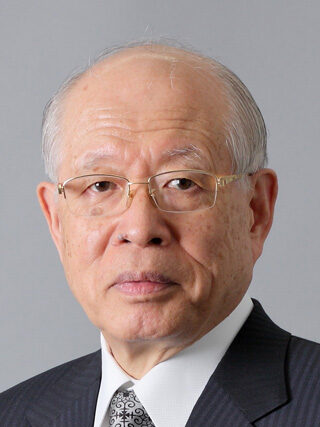
Ryōji Noyori
Ryōji Noyori is a Japanese chemist. Born September 3, 1938, in Ashiya. Teams include Kyoto University Rugby Football Club. Educated at Nagoya University and Harvard University. Awards include Order of Culture, Nobel Prize in Chemistry and Lomonosov Gold Medal.
Facts
42 facts · 1 confirmed by two sources · 17 cited · 24 from one source
Where this comes from
Papalocal keeps its own record. It started from these sources; what each one said is kept here as it was copied, so a change on their side never changes this page by itself. Tap one to read its version.
What Wikidata says · copied November 16, 2026 · revision 2565697139
- Described as
- Japanese chemist (1938 - )
- Other names
- Ryoji Noyori, Ryouji Noyori, Noyori Ryōji, Noyori Ryoji, Noyori Ryouji
- Born
- September 3, 1938 · 5 references
- Born in
- Ashiya
- Citizen of
- Japan · 2 references
- Occupation
- chemist · 3 references; professor
- Worked for
- Harvard University; Nagoya University; Meijo University
- Education
- Nagoya University; Harvard University; Kyoto University (1957–1967); Nada Junior and Senior High School
- Member of
- Royal Society of London (2005); Pontifical Academy of Sciences (2002–) · 1 reference; National Academy of Sciences (2003–) · 2 references; Japan Academy (2002–) · 1 reference; Polish Academy of Sciences; Chinese Academy of Sciences; American Academy of Arts and Sciences; American Association for the Advancement of Science · 1 reference; European Academy of Sciences (2002–) · 1 reference
- Teams
- Kyoto University Rugby Football Club
- Awards
- Order of Culture (2000); Nobel Prize in Chemistry (2001) · 2 references; Lomonosov Gold Medal (2009) · 1 reference; King Faisal Prize in Science (1999) · 1 reference; Wolf Prize in Chemistry (2001) · 1 reference; Arthur C. Cope Award (1997); Person of Cultural Merit (1998); Asahi Prize (1992) · 1 reference; Centenary Prize (1988); honorary doctor of the University of Rennes I (2000) · 2 references; Honorary doctor of the University of Ottawa (2003) · 1 reference; honorary doctor of the Nanjing University of Science and Technology (2006) · 1 reference; Foreign Member of the Royal Society (2005) · 1 reference; honorary doctor of the Hong Kong Polytechnic University; Roger Adams Award in Organic Chemistry (2001) · 1 reference
- Field
- chemistry; physical chemistry · 1 reference; organic chemistry · 1 reference
- Lived in
- Kobe
- Website
- http://www.riken.jp/engn/r-world/riken/president/index.html
- Wikipedias with a page
- 66
Wikidata item Q157210 (wikidata.org/wiki/Q157210), public domain (CC0). Copied November 16, 2026.
What Wikipedia says · copied November 16, 2026 · revision 1371993419
Ryōji Noyori (野依 良治, Noyori Ryōji; born 3 September 1938) is a Japanese chemist. He won the Nobel Prize in Chemistry in 2001. Noyori shared a half of the prize with William S. Knowles for the study of chirally catalyzed hydrogenations; the second half of the prize went to K. Barry Sharpless for his study in chirally catalyzed oxidation reactions (Sharpless epoxidation).
- Born, in its opening lines
- September 3, 1938
From the Wikipedia article “Ryōji Noyori” (en.wikipedia.org/wiki/Ryōji_Noyori), by its contributors, under CC BY-SA 4.0 (creativecommons.org/licenses/by-sa/4.0/). Copied November 16, 2026; not changed.
Confirmed Two sources agree. Cited One source, and it names where it got it. One source One source, without a reference of its own. Sources disagree The sources disagree. We show the best-supported value and keep theirs below.
