
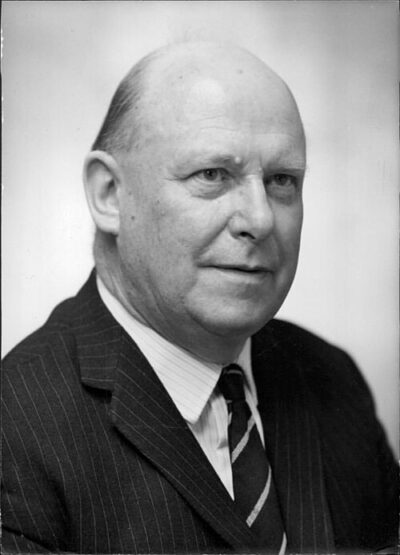
W. V. D. Hodge
W. V. D. Hodge was a British mathematician. Born June 17, 1903, in Edinburgh. Died July 7, 1975, in Cambridge. Positions held include Master of Pembroke College (1958–1970), Lowndean Professor of Astronomy and Geometry (1936–1970) and chairperson (2 times) (1947–1954). Known for Hodge star operator, Hodge conjecture and Hodge algebra. Educated at George Watson's College and St John's College. Awards include Fellow of the Royal Society, Copley Medal and Royal Medal.
Facts
40 facts · 2 confirmed by two sources · 17 cited · 21 from one source
Where this comes from
Papalocal keeps its own record. It started from these sources; what each one said is kept here as it was copied, so a change on their side never changes this page by itself. Tap one to read its version.
What Wikidata says · copied November 17, 2026 · revision 2567739579
- Described as
- British mathematician (1903–1975)
- Other names
- William Vallance Douglas Hodge, Sir William Vallance Douglas Hodge, William Hodge
- Born
- June 17, 1903 · 2 references
- Died
- July 7, 1975 · 2 references
- Born in
- Edinburgh · 1 reference
- Died in
- Cambridge · 1 reference
- Name at birth
- William Vallance Douglas Hodge
- Citizen of
- United Kingdom
- Occupation
- mathematician · 2 references; astronomer · 1 reference
- Positions held
- Master of Pembroke College (1958–1970); Lowndean Professor of Astronomy and Geometry (1936–1970); chairperson (2 times) (1947–1954)
- Worked for
- University of Cambridge (1931–1970) · 1 reference; University of Bristol (1926–1931) · 1 reference
- Education
- George Watson's College (1909–1920) · 1 reference; St John's College (1923–1926) · 1 reference; University of Edinburgh (1920–1923) · 1 reference
- Member of
- Royal Society of London (1938–); American Academy of Arts and Sciences; National Academy of Sciences (1959–); Göttingen Academy of Sciences and Humanities in Lower Saxony; American Philosophical Society (1964–)
- Known for
- Hodge star operator; Hodge conjecture; Hodge algebra; Hodge theory; Hodge structure; Hodge index theorem; Hodge–Tate module; P-adic Hodge theory; Hodge bundle
- Awards
- Fellow of the Royal Society (1938) · 1 reference; Copley Medal (1974) · 2 references; Royal Medal (1957) · 1 reference; De Morgan Medal (1959) · 1 reference; Adams Prize (1937) · 1 reference; Senior Berwick Prize (1952) · 1 reference; Knight Bachelor (1959) · 1 reference; Gunning Victoria Jubilee Prize (1964)
- Field
- mathematics; geometry · 1 reference
- Wikipedias with a page
- 27
Wikidata item Q1356359 (wikidata.org/wiki/Q1356359), public domain (CC0). Copied November 17, 2026.
What Wikipedia says · copied November 17, 2026 · revision 1379655937
Sir William Vallance Douglas Hodge (; 17 June 1903 – 7 July 1975) was a British mathematician, specialising in geometry.
His discovery of far-reaching topological relations between algebraic geometry and differential geometry—an area now called Hodge theory and pertaining more generally to Kähler manifolds—has been a major influence on subsequent work in geometry.
- Born, in its opening lines
- June 17, 1903
- Died, in its opening lines
- July 7, 1975
From the Wikipedia article “W. V. D. Hodge” (en.wikipedia.org/wiki/W._V._D._Hodge), by its contributors, under CC BY-SA 4.0 (creativecommons.org/licenses/by-sa/4.0/). Copied November 17, 2026; not changed.
Confirmed Two sources agree. Cited One source, and it names where it got it. One source One source, without a reference of its own. Sources disagree The sources disagree. We show the best-supported value and keep theirs below.
