
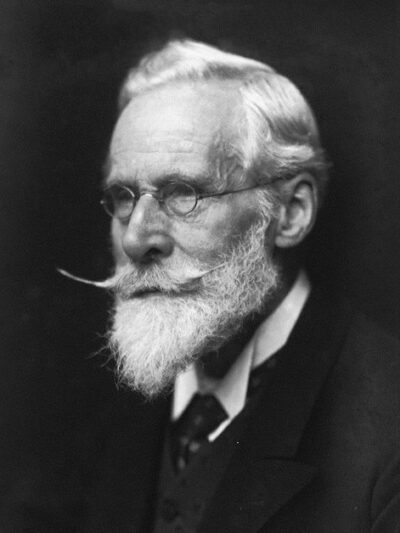
William Crookes
William Crookes was a British chemist and physicist. Born June 17, 1832, in London. Died April 4, 1919, in London. Positions held include President of the Royal Society (1913–1915). Known for Crookes tube, Crookes radiometer and discovery. Educated at Imperial College London. Awards include Fellow of the Royal Society, Copley Medal and Royal Medal.
Facts
34 facts · 2 confirmed by two sources · 14 cited · 18 from one source
Where this comes from
Papalocal keeps its own record. It started from these sources; what each one said is kept here as it was copied, so a change on their side never changes this page by itself. Tap one to read its version.
What Wikidata says · copied November 16, 2026 · revision 2559450874
- Described as
- British chemist and physicist (1832-1919)
- Other names
- Sir William Crookes
- Born
- June 17, 1832 · 11 references
- Died
- April 4, 1919 · 12 references
- Born in
- London · 2 references
- Died in
- London · 2 references
- Buried in
- Brompton Cemetery · 1 reference
- Citizen of
- United Kingdom of Great Britain and Ireland
- Occupation
- chemist · 1 reference; physicist · 1 reference; psychic; photographer
- Positions held
- President of the Royal Society (1913–1915) · 1 reference
- Worked for
- University of Chester
- Education
- Imperial College London
- Member of
- Royal Society of London; Royal Swedish Academy of Sciences; Accademia Nazionale dei Lincei (1908–) · 1 reference; National Academy of Sciences (1913–); Romanian Academy
- Known for
- Crookes tube; Crookes radiometer; discovery
- Awards
- Fellow of the Royal Society · 1 reference; Copley Medal (1904) · 1 reference; Royal Medal (1875); Elliott Cresson Medal (1912) · 1 reference; Albert Medal (1899) · 1 reference; Royal Society Bakerian Medal (1883) · 3 references; Davy Medal (1888) · 1 reference; Knight Bachelor (1897)
- Field
- chemistry · 1 reference; physics · 1 reference; spectroscopy · 1 reference; spiritism · 1 reference
- Spouse
- Ellen Humphrey (1856–) · 1 reference
- Wikipedias with a page
- 67
Wikidata item Q189552 (wikidata.org/wiki/Q189552), public domain (CC0). Copied November 16, 2026.
What Wikipedia says · copied November 16, 2026 · revision 1380613073
Sir William Crookes (; 17 June 1832 – 4 April 1919) was an English chemist and physicist who attended the Royal College of Chemistry, now part of Imperial College London, and worked on spectroscopy. He was a pioneer of vacuum tubes, inventing the Crookes tube, which was made in 1875. Observing cathode rays generated in these tubes, Crookes posited that "radiant matter" was a unique fourth state of matter, a foundational contribution to plasma physics.
He is credited with discovering the element thallium, announced in 1861, with the help of spectroscopy. He was also the first to describe the spectrum of terrestrial helium, in 1865. Crookes was the inventor of the Crookes radiometer, but did not discern the true explanation of the phenomenon he detected.
According to historian William H. Brock, Crookes's later work on ultraviolet eye protection arose from 1907 Royal Society investigations into cataracts among furnace and glass workers. Developed in partnership with Wigmore Street opticians Sir William Wingate and Frank Melson Wingate, by 1918 the resulting 'Crookes Lenses' under Melson Wingate Ltd combined scientific research with practical industrial safety as a manufactured product. Brock argues that this work laid the foundation for the modern sunglasses industry, while the lenses themselves were applied to industrial, military and aviation applications for much of the twentieth century, until modern sunglass branding gradually superseded them.
- Born, in its opening lines
- June 17, 1832
- Died, in its opening lines
- April 4, 1919
From the Wikipedia article “William Crookes” (en.wikipedia.org/wiki/William_Crookes), by its contributors, under CC BY-SA 4.0 (creativecommons.org/licenses/by-sa/4.0/). Copied November 16, 2026; not changed.
Confirmed Two sources agree. Cited One source, and it names where it got it. One source One source, without a reference of its own. Sources disagree The sources disagree. We show the best-supported value and keep theirs below.
