
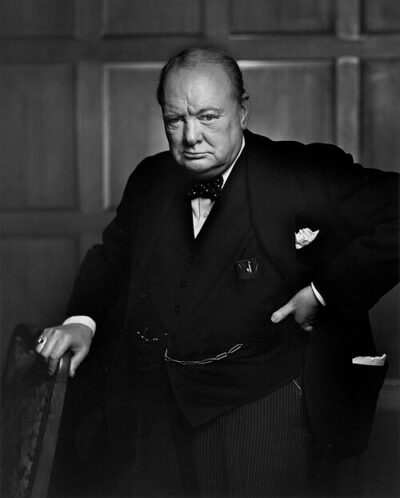
Winston Churchill
Winston Churchill was a British statesman, soldier and writer. Born November 30, 1874, in Blenheim Palace. Died January 24, 1965, in 27 And 28, Hyde Park Gate Sw7. Positions held include Prime Minister of the United Kingdom (2 times) (1940–1955), Secretary of State for Defence (2 times) (1940–1952) and Chancellor of the Exchequer (1924–1929). Known for A History of the English-Speaking Peoples, The Second World War and A Traveller in War-Time. Educated at Harrow School and Royal Military College, Sandhurst. Awards include Nobel Prize in Literature, Companion of the Liberation and Fellow of the Royal Society.

Facts
81 facts · 2 confirmed by two sources · 25 cited · 54 from one source
Where this comes from
Papalocal keeps its own record. It started from these sources; what each one said is kept here as it was copied, so a change on their side never changes this page by itself. Tap one to read its version.
What Wikidata says · copied November 16, 2026 · revision 2569998924
- Described as
- British statesman, soldier and writer (1874–1965)
- Other names
- The Right Honourable Sir Winston Churchill, Colonel Warden, Mr Green, The Honourable Sir Winston Spencer Churchill, Winston Spencer Churchill, Sir Leonard Spencer, Charles Maurin, David Winter, The Right Honourable Sir Winston Spencer Churchill, The Right Honourable Sir Winston Leonard Spencer Churchill, Sir Winston Spencer Churchill, Winston Leonard Spencer Churchill
- Born
- November 30, 1874 · 27 references
- Died
- January 24, 1965 · 26 references
- Born in
- Blenheim Palace
- Died in
- 27 And 28, Hyde Park Gate Sw7 · 2 references
- Buried in
- St Martin's Church, Bladon
- Cause of death
- stroke
- Name at birth
- Winston Leonard Spencer Churchill
- Citizen of
- United Kingdom · 2 references; United Kingdom of Great Britain and Ireland (–1927)
- Occupation
- politician · 4 references; journalist · 2 references; painter; historian; autobiographer; screenwriter; biographer; statesperson
- Positions held
- Prime Minister of the United Kingdom (2 times) (1940–1955); Secretary of State for Defence (2 times) (1940–1952); Chancellor of the Exchequer (1924–1929); Home Secretary (1910–1911); Chancellor of the Duchy of Lancaster (1915); Minister of Munitions (1917–1919); Leader of the Opposition (1945–1951); Leader of the Conservative Party (1940–1955); First Lord of the Admiralty (2 times) (1911–1940); Secretary of State for the Colonies (1921–1922); Secretary of State for Air (1919–1921); Secretary of State for War (1919–1921); Member of the Privy Council of the United Kingdom; member of the 42nd Parliament of the United Kingdom (1959–1964) · 1 reference; member of the 41st Parliament of the United Kingdom (1955–1959) · 1 reference
- Political party
- Conservative Party (2 times) (1900–1964); Liberal Party (1904–1924)
- Worked for
- University of Edinburgh
- Education
- Harrow School; Royal Military College, Sandhurst; St George's School, Ascot; Stoke Brunswick School
- Member of
- American Academy of Arts and Sciences (1946–) · 1 reference; Royal Society of London; Society of the Cincinnati (1952–1965); Order of the Garter (1953–1965); American Philosophical Society (1951–)
- Known for
- A History of the English-Speaking Peoples; The Second World War; A Traveller in War-Time
- Awards
- Nobel Prize in Literature (1953) · 2 references; Companion of the Liberation (1958); Fellow of the Royal Society · 1 reference; Grand Cross of the Order of the Oak Crown; honorary citizen of the United States (1963); Grand cross of the Order of the White Lion (2014) · 2 references; Charlemagne Prize (1956) · 1 reference; Knight Grand Cross with Collar of the Order of Saint Olav (1948–) · 1 reference; Freedom Award (1958); Knight Grand Cross in the Order of the Netherlands Lion (1946) · 1 reference; Grand Cordon of the Order of Leopold; Congressional Gold Medal; Distinguished Service Medal (1919); Queen's Sudan Medal (1889); Queen's South Africa Medal (1901)
- Spouse
- Clementine Churchill (1908–1965) · 3 references
- Children
- Diana Churchill · 2 references; Randolph Churchill · 3 references; Sarah Churchill · 3 references; Marigold Churchill · 2 references; Mary Soames · 3 references
- Father
- Lord Randolph Churchill · 2 references
- Mother
- Jeanette Jerome · 1 reference
- Siblings
- Jack Churchill
- Religion
- Church of England
- Military branch
- British Army; cavalry · 1 reference
- Military rank
- colonel (1940–) · 1 reference; Lieutenant Colonel (1916) · 2 references; cadet (–1895) · 1 reference
- Lived in
- Dublin; Blenheim Palace
- Nickname
- The pug · 1 reference; The Old Lion · 1 reference
- Wikipedias with a page
- 266
Wikidata item Q8016 (wikidata.org/wiki/Q8016), public domain (CC0). Copied November 16, 2026.
What Wikipedia says · copied November 16, 2026 · revision 1385149983
Sir Winston Leonard Spencer Churchill (30 November 1874 – 24 January 1965) was a British statesman, military officer, and writer who was Prime Minister of the United Kingdom from 1940 to 1945, during the Second World War, and again from 1951 to 1955. For some 62 of the years between 1900 and 1964, he was a member of Parliament (MP) and represented a total of five constituencies over that time. Ideologically an adherent to economic liberalism and imperialism, he was for most of his career a member of the Conservative Party, which he led from 1940 to 1955. He was a member of the Liberal Party from 1904 to 1924.
Of mixed English and American parentage, Churchill was born in Oxfordshire into the wealthy, aristocratic Spencer family. He joined the British Army in 1895 and saw action in British India, the Mahdist War and the Second Boer War, gaining fame as a war correspondent and writing books about his campaigns. Elected a Conservative MP in 1900, he defected to the Liberals in 1904. In H. H. Asquith's Liberal government, Churchill was president of the Board of Trade and later Home Secretary, championing prison reform and workers' social security. As First Lord of the Admiralty before and during the First World War he oversaw the disastrous naval attack on the Dardanelles (a prelude to the Gallipoli campaign) and was demoted to Chancellor of the Duchy of Lancaster. He resigned in November 1915 and joined the Royal Scots Fusiliers on the Western Front for six months. In 1917, he returned to government under David Lloyd George and served successively as Minister of Munitions, Secretary of State for War, Secretary of State for Air, and Secretary of State for the Colonies, overseeing the Anglo-Irish Treaty and British foreign policy in the Middle East. After two years out of Parliament, he was Chancellor of the Exchequer in Stanley Baldwin's Conservative government, returning sterling in 1925 to the gold standard, depressing the UK economy.
Out of government during his so-called "wilderness years" in the 1930s, Churchill took the lead in calling for rearmament to counter the threat of militarism in Nazi Germany. At the outbreak of the Second World War he was re-appointed First Lord of the Admiralty. In May 1940, he became prime minister, succeeding Neville Chamberlain. Churchill formed a national government and oversaw British involvement in the Allied war effort against the Axis powers, resulting in victory in 1945. After the Conservatives' defeat in the 1945 general election, he became Leader of the Opposition. Amid the developing Cold War with the Soviet Union, he publicly warned of an "iron curtain" of Soviet influence in Europe and promoted European unity. Between his terms, he wrote several books recounting his experience during the war. He was awarded the Nobel Prize in Literature in 1953. He lost the 1950 election but was returned to office in 1951. His second term was preoccupied with foreign affairs, especially Anglo-American relations and preservation of what remained of the British Empire, with India no longer a part of it. Domestically, his government's priority was their extensive and successful housebuilding programme. In declining health, Churchill resigned in 1955, remaining an MP until 1964. Upon his death in 1965, he was given a state funeral.
One of the 20th century's most significant figures, Churchill remains popular in the UK. He is generally viewed as a victorious wartime leader who played an integral role in defending liberal democracy against the spread of fascism. A staunch imperialist, he has sometimes been criticised for comments on race, in addition to some wartime decisions such as area bombing. Historians rank Churchill as one of the greatest British prime ministers.
- Born, in its opening lines
- November 30, 1874
- Died, in its opening lines
- January 24, 1965
From the Wikipedia article “Winston Churchill” (en.wikipedia.org/wiki/Winston_Churchill), by its contributors, under CC BY-SA 4.0 (creativecommons.org/licenses/by-sa/4.0/). Copied November 16, 2026; not changed.
Confirmed Two sources agree. Cited One source, and it names where it got it. One source One source, without a reference of its own. Sources disagree The sources disagree. We show the best-supported value and keep theirs below.
