
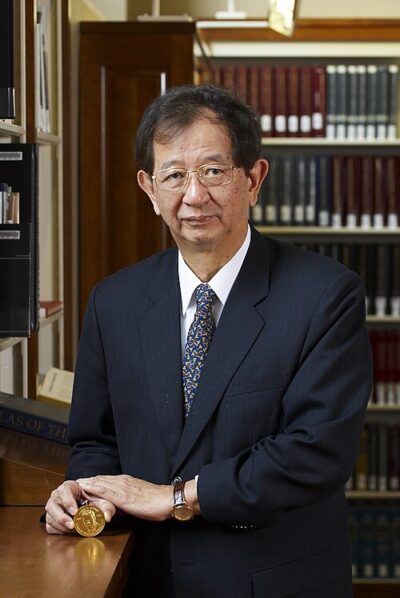
Yuan T. Lee
Yuan T. Lee is a Taiwanese chemist. Born November 19, 1936, in Shinchiku City. Positions held include senior advisor. Educated at National Taiwan University and University of California, Berkeley. Awards include Guggenheim Fellowship, Faraday Lectureship Prize and Nobel Prize in Chemistry.
Facts
46 facts · 1 confirmed by two sources · 17 cited · 28 from one source
Where this comes from
Papalocal keeps its own record. It started from these sources; what each one said is kept here as it was copied, so a change on their side never changes this page by itself. Tap one to read its version.
What Wikidata says · copied November 13, 2026 · revision 2567914237
- Described as
- Taiwanese chemist
- Other names
- Yuan-Tseh Lee, Li Yuanzhe, Lee Yuan-tseh, Yuan Tseh Lee, Lee YT
- Born
- November 19, 1936 · 2 references
- Born in
- Shinchiku City
- Citizen of
- Taiwan; United States (1974–1994); Empire of Japan (1936–1945)
- Occupation
- chemist · 1 reference; university teacher; Nobel Prize winner · 1 reference
- Positions held
- senior advisor
- Worked for
- Harvard University; University of California, Berkeley; University of Chicago · 1 reference; California Institute of Technology · 1 reference
- Education
- National Taiwan University; University of California, Berkeley; National Hsinchu Senior High School
- Member of
- National Academy of Sciences (1979–) · 1 reference; Pontifical Academy of Sciences (2007–) · 1 reference; Royal Swedish Academy of Engineering Sciences; American Academy of Arts and Sciences (1975–) · 1 reference; Göttingen Academy of Sciences and Humanities in Lower Saxony (1988–) · 1 reference; Academia Sinica; Indian National Science Academy; American Physical Society (1976–) · 1 reference; Committee of 100; Accademia Nazionale dei Lincei (2018–) · 1 reference
- Awards
- Guggenheim Fellowship (1976) · 1 reference; Faraday Lectureship Prize (1992) · 1 reference; Nobel Prize in Chemistry (1986) · 2 references; National Medal of Science (1986) · 1 reference; Fellow of the American Physical Society (1976) · 1 reference; Honorary doctor of the University of Ottawa; honorary doctor of the University of Hong Kong; honorary doctor of the Chinese Academy of Sciences (1987) · 1 reference; honorary doctor of the Chinese University of Hong Kong; honorary doctorate from the University of Waterloo; honorary doctor of Waseda University; Ernest Orlando Lawrence Award (1981) · 1 reference; Clark Kerr Medal (1998) · 1 reference; Grand Officer of the National Order of Merit (2012) · 2 references; Peter Debye Award in Physical Chemistry (1986) · 1 reference
- Field
- chemistry
- Father
- Lee Tse-fan
- Siblings
- Yuan-Chuan Lee; Yuan-Pern Lee; Li Jimei
- Wikipedias with a page
- 53
Wikidata item Q243190 (wikidata.org/wiki/Q243190), public domain (CC0). Copied November 13, 2026.
What Wikipedia says · copied November 13, 2026 · revision 1381451072
Yuan Tseh Lee (Chinese: 李遠哲; pinyin: Lǐ Yuǎnzhé; Wade–Giles: Li³ Yüan³-che²; Pe̍h-ōe-jī: Lí Oán-tiat; born 19 November 1936) is a Taiwanese physical chemist who was awarded the Nobel Prize in Chemistry in 1986 for his contributions to the development of reaction dynamics.
Lee is a professor emeritus at the University of California, Berkeley, and honorary director of the Nagoya University Institute for Advanced Study along with Ryoji Noyori. He was awarded the Nobel with John C. Polanyi and Dudley R. Herschbach for "contributions to the dynamics of chemical elementary processes". He was the first Taiwanese person be awarded the Nobel Prize. His research in physical chemistry concerned the use of advanced chemical kinetics techniques to investigate and manipulate the behavior of chemical reactions using crossed molecular beams. From 1994 to 2006, Lee served as the President of the Academia Sinica. In 2011, he was elected head of the International Council for Science.
- Born, in its opening lines
- November 19, 1936
From the Wikipedia article “Yuan T. Lee” (en.wikipedia.org/wiki/Yuan_T._Lee), by its contributors, under CC BY-SA 4.0 (creativecommons.org/licenses/by-sa/4.0/). Copied November 13, 2026; not changed.
Confirmed Two sources agree. Cited One source, and it names where it got it. One source One source, without a reference of its own. Sources disagree The sources disagree. We show the best-supported value and keep theirs below.
